We may earn a commission from links on this page.
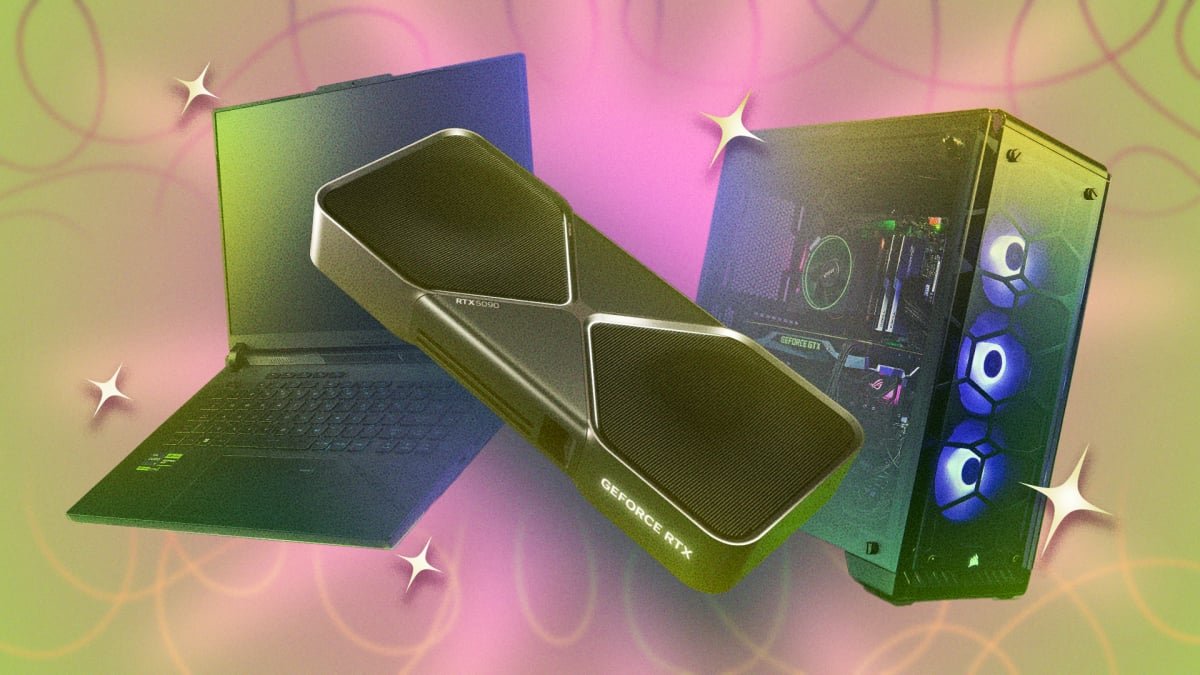
Nvidia might be courting controversy with its recent DLSS 5 tech, but the company’s GPUs are still pretty powerful devices for running your games. If you have an RTX card in your desktop or laptop, you might be able to get even better performance out of it than you’re already seeing. Here are some of my favorite hacks to optimize your Nvidia GPU.
Enable DLSS to boost your frame rates (or disable to save on performance)
Nvidia’s Deep Learning Super Sampling (or DLSS) is actually a suite of features collectively aimed at improving the resolution and frame rate of your games. Some of this involves rendering lower-resolution frames and using machine learning to upscale them, while the more recent DLSS 4 and 4.5 models can generate intermediate frames between traditionally rendered ones. In most cases, this means a smoother frame rate, at a lower computational cost.
Of course, DLSS doesn’t come at zero computational cost, and that trade-off might not be worth it for you. Competitive online games or fast-paced action shooters often benefit from smoother frame rates, but some games are perfectly fine at 60 fps or so. In some games, you can turn off DLSS specifically, or you might find a more simplified toggle between Performance and Quality modes. It’s worth experimenting with these settings to see whether your prefer higher visual fidelity, or smoother frame rates.
I should also briefly discuss DLSS 5, which isn’t currently available, but is expected to arrive on newer Nvidia GPUs later in 2026. This is the first version of DLSS demoed that substantially alters the content of what appears on screen. Nvidia insists that developers are in control of how it makes games look, though many developers aren’t exactly thrilled about it. When DLSS 5 eventually drops, you might want to explore disabling it just to see whether it affects the aesthetics of the game, on top of any performance changes.
Use DLAA for anti-aliasing in games you don’t use DLSS with
Nvidia’s Deep Learning Anti-Aliasing (or DLAA) is in a similar family to DLSS features, but comes at the problem from the opposite angle. Anti-aliasing is a cornerstone bit of graphical technology that helps prevent the “stair-stepping” effect that can occur when rendering angled or curved lines. Where DLSS renders lower-resolution images and upscales them, DLAA takes full-resolution frames and uses machine learning to clean them up to produce smoother lines, without as much of a computational lift.
In general, DLAA and DLSS are mutually exclusive. If you have DLSS enabled, you can’t use DLAA and vice versa. There are other anti-aliasing methods you might find buried in your game’s settings, and most of the older ones don’t rely on machine learning. But this is one area where using machine learning techniques can provide a tangible benefit without altering the creative design of your games.
Disable ray-tracing to increase your frame rates
Another of Nvidia’s marquee features, real-time ray tracing, is an incredibly powerful tool to get photorealistic lighting and shadows. This is the same method that CGI workflows have been using for decades in movies to get realistic images, but it requires so much processing power that it’s only become feasible for games in recent years.
That massive computational cost also means that, unless you’re running a game on exceptionally overpowered hardware, you’ll probably notice a frame rate drop in exchange for reflective puddles. Again, this will come down to personal preference, but if you’re finding that you’re struggling to get smooth motion in your games, consider turning off any ray tracing features in your game’s settings.
Tune your GPU to prioritize either performance or battery life
Overclocking your GPU is a common way to get a little performance boost, but if done the wrong way, it can potentially damage your hardware. So, Nvidia offers an official way to do it that’s designed to minimize that risk. In the official Nvidia app, head to the System tab, and enable “Automatic Tuning.” This will let you get some extra speed out of your GPU, while still staying within your graphics card’s warranty.
However, you might also want to consider under-clocking your GPU. For this, you’ll need third-party tools like MSI’s Afterburner. Rather than running your GPU faster than its default, you can set it to run slightly slower. Why on earth would you want to do that, though? Well, in many cases, you often won’t notice much of a difference in performance from a GPU that’s running 5% slower. But for that trade-off, you can make your system run quieter and, on a gaming laptop, get longer battery life.
Pick up a monitor that supports G-Sync
Most gaming-focused monitors (and many that aren’t) support Nvidia’s G-Sync, but if you haven’t double-checked yours, it’s worth looking into. G-Sync is Nvidia’s version of variable refresh rate (or VRR) tech that reduces screen-tearing. This is an effect that can happen when the number of frames being rendered by your GPU don’t perfectly sync up with the frame rate of your display. Tools like G-Sync allow your GPU to vary the number of frames sent to your monitor each second, to avoid accidentally sending half-frames.
There are plenty of great G-Sync compatible monitors out there, from budget-friendly models like this one from LG, to some higher-end models like this one from Alienware. You can usually find G-Sync listed among the top-line specs for monitors while shopping, but if you’re not sure about your current display, find its model number and search for its specs online. If your monitor doesn’t officially support G-Sync, but does support AMD’s competing FreeSync, it’s sometimes possible to still get G-Sync working for you too.
Enable G-Sync Pulsar for even better motion clarity
This one is much more rare, but if you have one of a handful of compatible monitors, then Nvidia’s newer G-Sync Pulsar feature can get you even better motion clarity. This new tech pulses the backlight on a supported monitor at a variable frequency to render motion more clearly. Nvidia claims it’s the equivalent of, effectively, a 1,000Hz refresh rate.
That’s a bit of a bold claim, and at a certain point it might be impossible for the human eye to tell the difference anyway. That said, if you have a monitor that supports it, you may as well turn the feature on to maximize the motion clarity in your games.
What do you think so far?
Enable Reflex to reduce input latency
When you’re playing a competitive online game, there are a lot of steps between when you click a button, and when the game registers what you’ve done. And that delay can mean the difference between clicking heads and getting your own head clicked. That’s where Nvidia’s Reflex tech can help.
This feature tightens the pipeline between your mouse clicks, your GPU, and your CPU, shaving milliseconds off your input latency. That might not sound like a lot, but it can make a difference. Most online games operate on a tick rate (meaning how often per second the game’s state is updated) of around 60-64Hz. That means the game is checking your position, aim, and inputs every 15-17 milliseconds or so. If your input latency is over 20ms, that can mean you’re essentially missing a “turn” or two in the game, just waiting for your input to register. Reflex can shave that down.
You’ll find the option in the input setting for most games under “Nvidia Reflex Low Latency.” Here, you can choose between “Off,” “On,” or “On + Boost” (though usually you can just go for “On + Boost” unless you’re facing some niche technical problem).
Enable Video Super Resolution for better streaming video
We tend to think of GPUs as mostly being aimed at gaming graphics, but regular old streaming video can benefit from some of Nvidia’s special features too. For example, RTX Video Super Resolution (or VSR) can upscale video from sites like YouTube, Netflix, or Twitch. To turn it on, head to your Nvidia Control Panel or the Nvidia app and look for “Super Resolution” under the Video tab in Settings.
This feature is particularly useful when you’re watching older or lower-resolution video, particularly 720p or lower. For higher-resolution, 1080p streaming video and up, you might not notice much of a difference, because those videos are already pretty high quality, but it can be a nice boost for lower-quality stuff. Keep in mind the usual caveats with machine learning-powered upscaling, though. It’s never perfect, and if you want to avoid artifacts or get the most accurate source image, you might want to disable this feature instead. But it’s a good hack for bumping the sharpness of lower-resolution media.
Use the Broadcast app to improve your streaming setup
If you stream online, or even if you just spend a lot of time in Zoom meetings, the Nvidia Broadcast app can potentially help clean up your audio and video feeds. In one of the better use-cases for machine learning, this app has a suite of tools that can help eliminate background noise your microphone picks up, cut out the background from your webcam, or clean up your video.
Some of the app’s features are a bit more, let’s say, ambitious than just cleaning things up, though. The “Eye Contact” feature, for example, will artificially make you appear as though you’re looking directly into the camera, even when you’re not. That can be more off-putting than helpful, so maybe don’t turn that particular feature on.
Update your drivers to make sure your games run smoothly
When it comes to solving technical problems, updating your drivers is right up there with “turn it off and on again.” Even if nothing is broken, though, it’s a good idea to check for new drivers any time you download a new game, or one of your favorites gets a big update.
Often, after a major game gets a new release or update, the Nvidia app will have updated drivers specifically tailored for it. These usually include bug fixes for specific games, as well as updates to the DLSS models that are trained on individual titles. Around the time of writing, for example, Nvidia is touting updates for Crimson Desert and the PC release of Death Stranding 2. If you haven’t checked for driver updates in a while, especially if you’re trying to play something new, make sure to hit that check for update button.