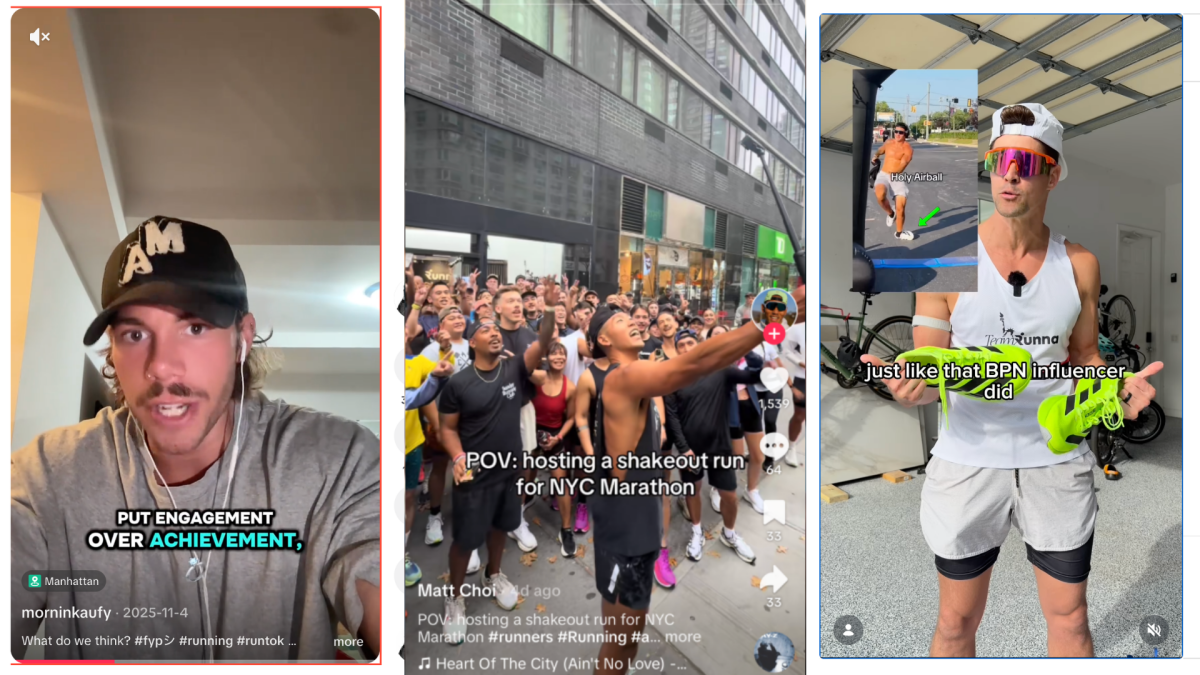
Running influencers are nothing new, but some of us plugged into the online running scene have noticed a shift lately. When I am drawn in by a caption that reads “my 5K race-day routine 🏃♀️ (full breakdown below)” only to discover that breakdown is sponsored by a major running app, I have to roll my eyes. Even if they aren’t going as far as lying about their times, these “runfluencers” add a lot of noise and distraction to the community.
Not that there’s anything wrong with running influencers in theory. I love seeing someone share their journey from couch to 10K—community is everything in this sport! The issue comes when, in their attempts to profit off the content creator economy, brands like Nike Run Club, Runna, and Strava platform a new class of runfluencer: aspirational, relatable, and, often, quite unqualified to be giving training advice. They’re even unqualified to handle their own setbacks, as I’ve watched an influx of content creators blame brands for their injuries (especially the ones falling for crappy AI-generated training plans). If you prioritize being an influencer over being a runner, you can even get banned from the New York City Marathon.
In short, there’s a widening gap between people who look like runners giving advice, and the people who actually know how to train runners. And if you’re getting your programming advice from the wrong side of that gap, you are leaving valuable wisdom on the table at best, and setting yourself up for injury at worst.
How the runfluencer economy was born
I’ve watched this running boom happen in real time. The New York City Marathon lottery has become as laughable as the actual lottery. Even local road races are selling out way faster than before the pandemic. A new wave of first-time runners needed guidance, and they’re turning to social media.
The problem is that social media rewards specific kinds of running content: race-day vlogs, before-and-after transformations, and even dramatized conflict with other runners. And where professional athletes have off-seasons built into their routines, content creators can’t afford to take time off from their content.
These algorithms don’t exactly reward nuance, like the unglamorous reality of base-building, or the importance of running most of your miles at a conversational pace. Boring, correct advice loses to exciting, compelling advice every time the algorithm runs its counts.
Meanwhile, brands have incentives to exacerbate the situation. A sponsorship deal with a creator who has a million followers on TikTok will reach more potential customers than a meticulous training guide written by a certified coach who has only 12,000 YouTube subscribers. As on every other corner of the internet, the result is an information ecosystem that’s noisier, less reliable, and harder to navigate.
The most common mistakes runfluencers make
I need to get more specific here, because “influencer advice is bad” isn’t necessarily true either. Some of it might be just fine—sensible even. But not all of it, by a long shot. Here are the specific red flags I keep seeing from unqualified runfluencers online:
-
Running way too fast, way too often. Roughly 80% of training mileage should be done at easy, conversational pace. Around 20% is fast work, like intervals, tempo, threshold runs. Easy runs don’t make for “impressive” content, so the resulting advice pushes recreational runners to run too hard too often, which is one of the fastest routes to overuse injury and burnout.
-
Shoe, gear, and training plan misinformation. Creators are rarely positioned to give unbiased assessments of whether a $200 carbon-plate shoe is appropriate for the beginner marathon runner who is watching their video (it’s usually not), because their income depends on the relationship with the brand. This is obvious, but worth saying: Content creators are ultimately trying to sell you something. If they give a ringing endorsement of any sort of app or gear, make sure to do your own due diligence on their claims.
-
Missing the individual picture entirely. A real coach asks questions. What’s your injury history? How many days per week can you train? How much sleep are you getting? Influencer advice, structurally, cannot do this. A video or a post is a one-way street, and, again, their advice might even be based on falsified times.
How to evaluate running advice online
So how do you tell the good from the bad? Here’s a set of questions to ask before you let someone’s training philosophy into your head.
What are their credentials, and are they legit?
Look for trustworthy certifications: USATF (USA Track & Field) Level 1, 2, or 3 coaching certification; RRCA (Road Runners Club of America) certification; an exercise science, or sports physiology degree; or experience as a competitive athlete. A big follower count is not a credential.
Do they explain the why, or just the what?
Giving flat, prescriptive advice—”everyone should run at least five days a week,” or “you should always do long runs on Sundays”—without caveats or explanations is a red flag.
What do you think so far?
To see what the “why” behind a workout might look like, I recommend reading up on why would you have to run slower, why you should start running stairs, and what the hell a fartlek even is.
Do they readily disclose their sponsors or financial relationships?
Sponsorships and brand deals aren’t automatically disqualifying, but they should be disclosed clearly and factored into how you weight gear reviews and product recommendations. Undisclosed sponsorships are a significant red flag.
Where to find good (free!) running advice
An enormous amount of excellent running resources exist online, and most of them are totally free. Here are some of my favorites.
-
Hal Higdon’s free training plans. These are my go-to. Higdon has been publishing free beginner-through-advanced marathon and half-marathon plans for decades. They’re well-structured, conservative in progression, and built on real coaching principles.
-
Runner’s World. They have trustworthy, downloadable plan options for whatever you might need, from “Start Running” to “Sub-3-Hour Marathon.”
-
Your local running club. There’s a solid chance the in-person collective knowledge in a room of people who’ve been running for years is worth more than most content online.
-
Reddit. Similarly, I often turn to running subreddits (r/AdvancedRunning, r/running), with appropriate skepticism applied. The advanced running community in particular has a high signal-to-noise ratio and actively calls out misinformation. Their wiki is a solid starting resource.
The problem with running apps
Of course, there are everyone’s favorite running apps. You won’t catch me claiming that Runna, Nike Run Club, and Strava‘s coach features are outright bad. Runna in particular uses a structured training model, and has credentialed coaches behind the programming.
The issue, then, isn’t the apps themselves—it’s the influencer-marketing layer that’s been placed on top of them, which often creates unrealistic expectations about pace, mileage, and what progress should look like. If you use a structured app, try to understand the training principles it’s built on, not just the workouts it assigns.
The bottom line
None of this means you should stop watching running content online—I know I won’t. I love seeing other people’s journeys, race experiences, and day-to-day running life. There’s a big difference, however, between inspirational content and instructional content. Ask yourself the questions above to find runners you can really trust, and tune out the noise.