We may earn a commission from links on this page.
I flagged smart bands as one of the tech trends of 2026, based on what I was seeing, so it’s interesting to watch the rollout of the Fitbit Air and the buzz around the (still unconfirmed) Garmin Cirqa. Whoop, which has long been the undisputed leader in this area, now has a ton of competition. Here’s what I see going on, and what I think we should expect going forward.
Fitness trackers have reached the end of their evolution, and their universe is rebooting
To explain how we got here, I’m going to take you through a little history lesson with the theme of: What do we expect a fitness tracker to be? Fitbit has been working on this question for over 15 years, beginning with simple digital pedometers that clipped to your pocket. As more advanced technology became more affordable, Fitbits gained lights and buttons and screens and heart rate sensors—the more you could pack into a device, the better. This evolution continued until some Fitbits were full-on smartwatches. To be honest, until about last year, I would have told you that there’s no longer any meaningful distinction between “smartwatches” and “fitness trackers”—they’ve merged into the same product category.
In parallel with that evolution, smartwatches and fitness watches also gained features, and then stagnated while trackers caught up. Garmins started off as bulky GPS units you could strap to your wrist; the Apple Watch was an extension of your smartphone that happened to be able to measure heart rate. Over time these categories merged into a single watch-shaped format that had an AMOLED screen, a heart rate sensor, and as many software features as the companies could figure out how to stuff into them. “Do I want an Apple Watch or a Garmin?” is a reasonable question to ask, since the overlap between fitness watches and smartwatches is an almost-but-not-quite-circular Venn diagram.
But smartwatches, fitness watches, and fitness trackers have all arrived at roughly the same place: They have as many features as people want. In fact, they have more features than people want. The fastest marathon runner in the world seems to be perfectly happy with an old Garmin that was the bottom of the line when it launched five years ago.
Tech companies can no longer grow by reaching out to people who haven’t heard of smartwatches; most everybody who would want one already has one. Companies also have a hard time convincing people to upgrade the devices they already have, since newer models don’t have any killer features that older ones are missing.
These days, upgrades mostly consist of putting higher-end features in lower-end watches, which isn’t a strategy that can work for long. That brings us nice perks like the flashlight in Garmin’s Forerunner 970, but the result is that hardware companies like Garmin are ratcheting their hardware prices up, and wondering how they can make their money on something more profitable and longer-lasting, like subscriptions. (Garmin seems to be grasping for straws on subscription features as well, but that’s another story.)
Everybody can load an app onto their phone these days, so devices no longer need to stand alone. As a tech company, if all your fitness tracker’s features are in the app, and your customers aren’t excited about new hardware, you might as well go back to basics and offer a simple sensor on a strap. That’s what we’re seeing now.
How smart bands found their new niche
“Smart band” hasn’t been a tech category for long. Until recently there was only one major product in this area: the Whoop band. Whoop’s hardware was never all that fancy—just a heart rate sensor on a strap. The clasp and the charger were (and are) both cleverly designed, and the focus is on everything but the electronic internals. You get device for “free”—it’s the app that keeps you engaged, and the app that makes you feel you’re getting $239/year of value out of it.
My review of the Whoop 4.0 (no longer the current model) is worth a read if you want to see how this played out over time. In the two years I had that band in my possession, its app gained a ton of new features. Whoop markets itself to athletes who want to monitor their recovery and optimize their sleep schedules, and the app has always provided a treasure trove of data alongside tools to highlight what’s most important to focus on.
But not everybody wants to pay that subscription fee, or think of themselves as athletes hyper-optimizing their routine. For years, people would pop up on tech forums asking if there was a way to get a similar device without paying Whoop for a subscription, but none materialized.
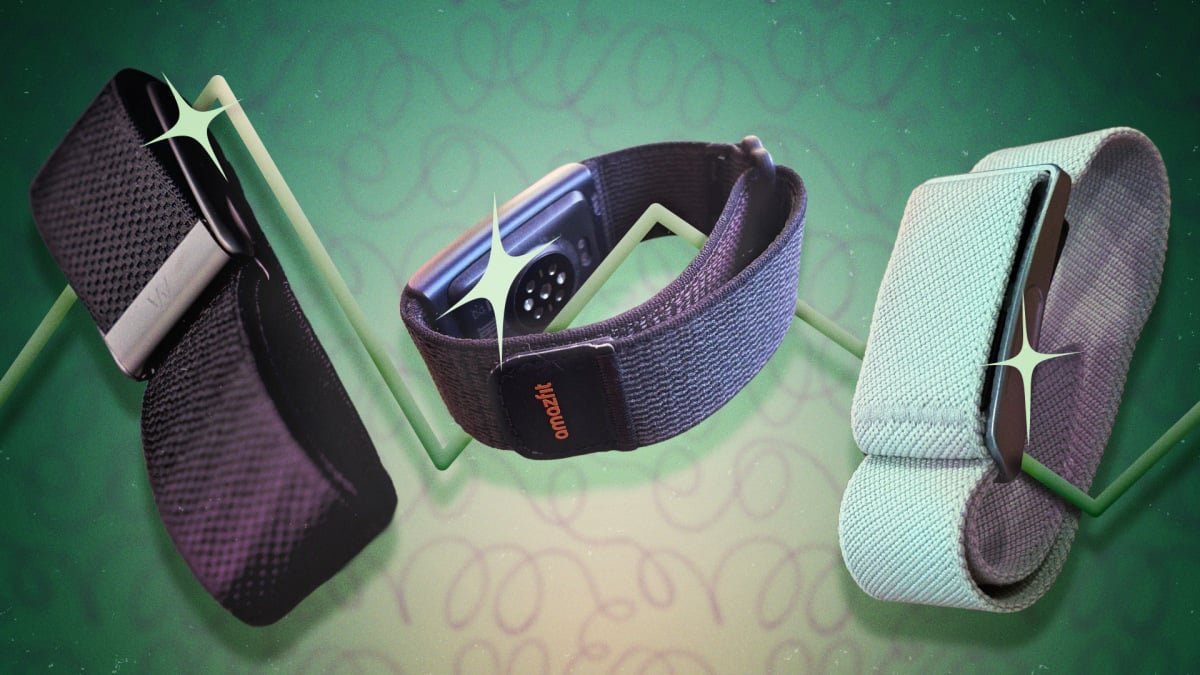
But last year, that began to change. I’m not sure if there’s a reason for that timing, aside from companies previously preferring to focus on the escalation of features I discussed above. If it turns out there was a legal challenge or technological issue, I’d love to know. In any case, we got the Polar Loop ($199), and the Amazfit Helio Strap ($99), both very basic devices that feed data to humdrum apps. Garmin’s Index sleep band ($169) somehow managed to be even more basic than these, not even tracking exercise—despite apparently having the internals to do so.
All three come from companies that already had their own apps that paired with smartwatches. Making a smart band requires no new features of the software, and the manufacturing side must be pretty easy for a company that’s used to making watches. Instead of building a watch with a sensor, you just stick the sensor directly onto a strap and send it out into the world. With that in mind, Polar’s and Garmin’s bands both felt overpriced. Amazfit’s price made a lot more sense, and from what I can tell the demand seems to have outpaced supply. Good luck finding an Amazfit Helio Strap anywhere.
The Fitbit Air finally puts everything together, and Whoop is right to be scared
Google just announced their own smart band, the Fitbit Air, and I feel like we’re seeing a rare moment of Google reading the room and offering exactly what people need. I say this with great uncertainty, though—everything depends on whether the Health Coach is reliable enough to power the new app. My tests of an earlier version of the Coach were not promising.
What do you think so far?
But if the Fitbit Air and its new app live up to Google’s promises, then we have a smart band that’s the same cost ($99) as the Amazfit Helio Strap, with a much larger customer base and better name recognition, and a full-featured app that provides analytics and coaching much like Whoop does.
I’m not saying Google Health will be quite as good as the Whoop app, but if it’s almost as good, and you only have to pay $99 once, ever, rather than $239 every year, almost everyone except diehard athletes would probably prefer the Fitbit.
And that’s where we get the next stage of evolution. Similar to the trend I observed in smart rings, smart band makers are realizing that hardware isn’t a cash cow, and people don’t want to pay for subscriptions. The money has to come from somewhere else.
Whoop has already been in the process of shifting to thinking of itself as a health company. You can book blood tests through the Whoop app, and Whoop just announced (somewhat defensively, right after the Fitbit Air announcement) that it will offer video consults with healthcare professionals as a paid add-on service. Healthcare is a big market, since U.S. companies have basically infinite opportunities to take money to fill in the gaps in our crappy healthcare system.
What I’d buy in 2026
So right now—or coming soon—we have a few viable options for smart bands. The ones I like best are:
-
The reigning champ, Whoop. It still does a lot of things that other bands don’t (like tracking recovery from strength training). If you want the best, I’d still go with Whoop. Get the Peak membership ($239/year) since the more expensive Life ($359/year) doesn’t provide any extras that are worth the cost.
-
The new Fitbit Air, with the enormous caveat that I haven’t tried it yet, and neither has almost anyone else. It’s the most affordable smart band (tied with the Amazfit Helio Strap at $99) and works with a full-featured app. It also works with Pixel watches, so you can have a smart band and a smartwatch that feed data to the same app to be analyzed together.
-
The Amazfit Helio Strap, if you can get it. It’s also $99, and can work alongside any of Amazfit’s watches. It’s not as full-featured as the two I named above, but it’s a good basic pick.
I would not recommend the Polar Loop. It’s overpriced for what you get, and any of the three above will give you a better experience. I wouldn’t recommend the Garmin Index sleep band either, unless you’re a Garmin user who really just wants something comfy to sleep in and doesn’t mind the extra cost.
The Luna band announced at CES has not yet materialized, we don’t know the cost, and there aren’t any smartwatches on the U.S. market that work with the Luna app. Garmin’s Cirqa band—if it’s real, and if it is indeed a Whoop-style smart band—is unlikely to dethrone any of my top picks. But I suppose we’ll have to wait and see.