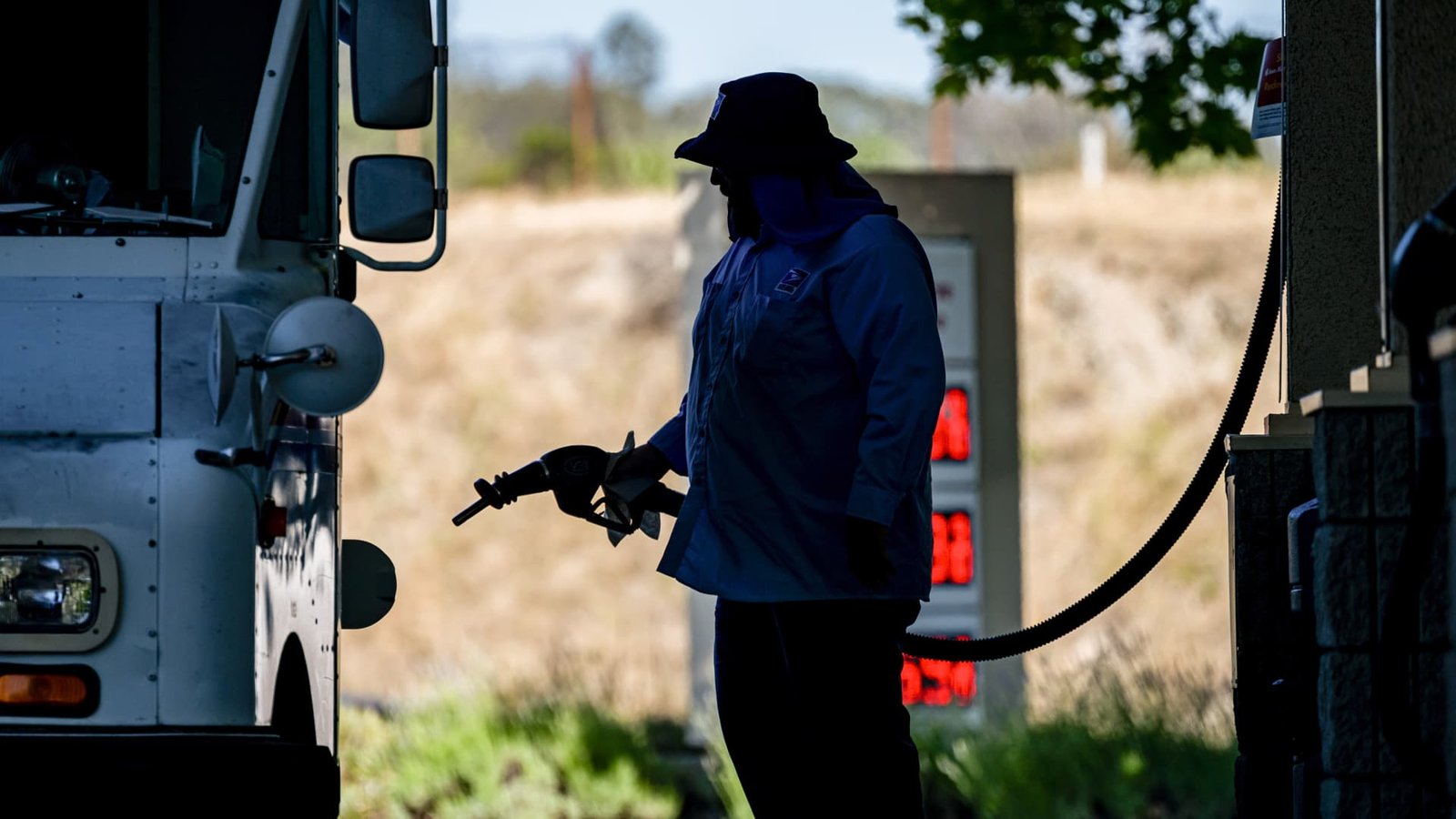
A driver refuels a vehicle at a Shell gas station in Hercules, California, May 21, 2026.
David Paul Morris | Bloomberg | Getty Images
Consumer prices in May rose at their fastest pace in more than three years as the Iran war continued to put upward pressure on gasoline and other energy-related costs.
The consumer price index, a key inflation gauge, increased to 4.2% last month relative to a year earlier — the highest annual inflation rate since April 2023 and an increase from 3.8% in April, the U.S. Bureau of Labor Statistics said Wednesday.
“Inflation is painfully high,” said Mark Zandi, chief economist at Moody’s. “And while it’s likely peaking given the recent decline in oil and gasoline prices, it’s not going to go back to anything we feel good about for a long time.”
The current inflation rate is roughly double the Federal Reserve’s 2% long-term target, Zandi said. It will likely take until this time next year for inflation to decline to policymakers’ target, all else equal, Zandi said.
What is causing higher inflation?
Joe Seydl, a senior markets economist at J.P. Morgan Private Bank, pointed to three main factors responsible for higher inflation in the U.S. economy right now.
For one, an “oil shock” in the Middle East has raised gasoline and other energy prices, he said.
Energy accounted for more than 60% of the monthly increase in the consumer price index for May, the Bureau of Labor Statistics said Wednesday.
Additionally, tariffs imposed by the Trump administration have raised the costs to import goods, Seydl said. An artificial intelligence “capital spending boom” has also increased consumer costs in categories like electronics and electricity, for example, he said.
The inflation report comes ahead of a Federal Reserve policy meeting next week, when officials will choose whether to raise or lower interest rates or keep them unchanged.
That meeting will be the first helmed by Chair Kevin Warsh, President Donald Trump’s pick to lead the U.S. central bank. Warsh was sworn in last month to replace outgoing chair Jerome Powell.
Chairman of the Federal Reserve Kevin Warsh delivers remarks after being sworn in during a swearing-in ceremony in the East Room of the White House on May 22, 2026 in Washington, DC.
Roberto Schmidt | Getty Images
Trump has made no secret of his desire for lower interest rates — and of his displeasure toward Powell’s refusal to lower rates as quickly or steeply as the president desired.
“You watch what’s going to happen. I had a rotten head of the Fed, and now I have a great head of the Fed,” Trump said at a campaign-style rally in Suffern, N.Y., after Warsh’s swearing in.
However, higher inflation, coupled with a hotter-than-expected jobs report on Friday, may make it less likely the Fed will cut rates in the near term, economists said. In fact, it may even hike interest rates this year, depending on the trajectory of inflation, economists said.
The Iran war inflation impact
As a result, prices have risen sharply for gasoline and other energy products refined from crude oil. Those refined products include jet fuel and diesel, which are respectively key inputs for airline fares and the transportation of food and goods to store shelves.
Prices among all motor fuels were up 41% in May versus a year earlier, according to the consumer price index.
Consumers paid about $4.31 per gallon, on average, at the gasoline pump as of June 1, according to weekly data published by the U.S. Energy Information Administration. Those prices are up 38% from $3.13 a year earlier and up from $4.12 on April 27.
Average prices have declined a bit since the start of June, to $4.15 per gallon, according to EIA data.
Airline fares were up about 27% in May from a year earlier, according to the consumer price index.
That’s largely on the back of elevated prices for jet fuel, economists said. A gallon of jet fuel cost $3.23, on average, as of Monday, up from $2.50 per gallon before the Iran war, according to an Argus Media jet fuel price index. However, prices steadily declined throughout May.
Economists said there’s room for oil prices to drift upward if the Iran war were to continue.
“The Middle East situation is still unresolved,” Seydl said. “We are approaching critical levels of inventories in the global economy, and the Strait of Hormuz is still largely closed. If this were to keep going, our estimates are that by October or November, you’ll likely see higher global oil prices.”
Oil prices could jump to $140 per barrel or higher over that time frame if conditions persist, up from about $93 today, he said.
Even if the Iran war were to wind down, oil prices — and, by extension, gasoline prices — would likely remain elevated above their pre-war level, Zandi said. Traders would likely tack on a price premium given the future risk of a supply blockage in the Strait of Hormuz, he said.
“We’ll get some relief, but not a lot of relief” on gasoline prices, Zandi said.
Housing, vehicles are a counterweight
Cars parked in front of homes in Daly City, California, May 19, 2026.
Jason Henry | Bloomberg | Getty Images
Meanwhile, inflation for vehicles and housing has been “tame,” providing a counterweight to high inflation elsewhere, Zandi said.
The dynamic is likely due to meager consumer demand amid affordability issues, Zandi said.
For example, higher gasoline prices and auto loan rates and a runup in vehicle prices during the Covid-19 pandemic have likely weighed on demand among consumers, who view buying a car as being financially out of reach right now, Zandi said.
New vehicle prices were up just 0.2% over the past year, while those for used cars and trucks were down 2%, according to CPI data.
“Housing and vehicles [account for] like half the CPI,” Zandi said. “We’re very fortunate half the CPI is pinned down by weak demand. But the other half is raging.”
Tariff inflation may not last much longer
People watch as the Doris Ocean container ship departs from the Port of Los Angeles, in Los Angeles, May 28, 2026.
Mario Tama | Getty Images
Meanwhile, the Trump administration’s tariff agenda has led to higher consumer prices, especially for certain physical goods, economists said.
The Supreme Court struck down a centerpiece of that tariff regime earlier this year, deeming it unconstitutional.
However, the White House has taken steps to levy tariffs — taxes on imports — using alternate legal mechanisms. For example, the U.S. proposed fresh tariffs of up to 12.5% last week on imports from 60 economies for failing to ban forced labor goods.
Even so, economists said they don’t expect inflation to be a meaningful source of inflation going forward.
Oxford Economics estimates the U.S. tariff rate will increase marginally, to 9.7% from 9.3%, as a result of the latest salvo, but not enough to change the firm’s inflation forecasts, Grace Zwemmer, a U.S. economist at the firm, wrote in a June 4 research note.
“We think that most of the tariff-driven inflation has run its course,” according to a Bank of America Global Research report on June 8. “That said, supply chain pressures are building from the Iran war. That should lead to firmer core goods inflation in [the second half of 2026], all else equal.”
AI is ‘really inflationary’
Construction of a $16 billion data center developed by Related Digital for Oracle and Open AI, in Saline, Michigan, May 6, 2026.
Jim West | Universal Images Group | Getty Images
Artificial intelligence is also “really inflationary,” Zandi said.
The data centers that underpin AI infrastructure are raising electricity demand, thereby increasing U.S. electricity prices for households. Electricity prices are up about 6% over the past year, according to CPI data.
AI has also increased demand for the chips that go in all sorts of consumer electronics and products, increasing prices for those consumer goods, Zandi said.
“[Inflation] is not just about the war,” Zandi said. “There are other things going on that will conspire to keep prices [elevated].”