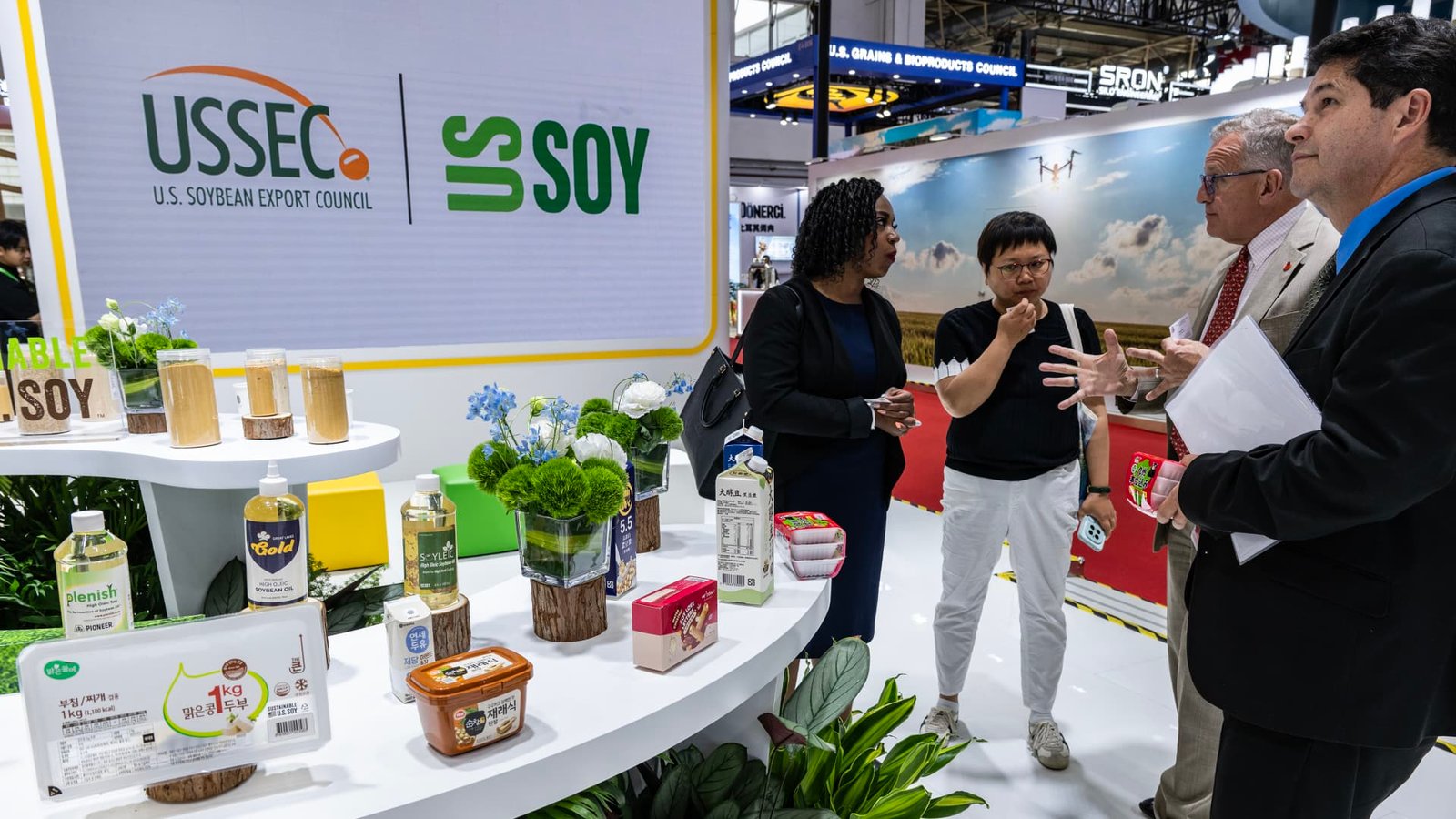
The U.S. Soybean Export Council booth is pictured here during the 4th China International Supply Chain Expo on June 22, 2026 in Beijing, China.
China News Service | Getty Images
BEIJING — As Brazil takes a greater share of Chinese soybean purchases away from American farmers, the U.S. is trying to win back buyers by emphasizing crop quality.
“Soybean production in North America and soybean production in South America is very different,” Carlos Salinas, executive director, East Asia, at the U.S. Soybean Export Council said in a presentation Tuesday at the China International Supply Chain Expo in Beijing.
He compared a range of weather factors between a city in Brazil and one in the U.S. state of Illinois, such as rainfall in the 30 days ahead of harvest: 231 millimeters versus 72 mm.
“That impacts crop condition. That impacts quality,” he said.
The half-day event for “advancing a sustainable and resilient U.S.-China soybean supply chain” was co-organized with the China Council for the Promotion of International Trade.
“What we really encourage buyers in soy to do is to make sure they’re educating themselves on this to go deeper,” Jim Sutter, CEO of the U.S. Soybean Export Council told CNBC on the sidelines of the event, noting new ways to measure quality and nutrition, especially for animal feed.
American soybeans have become a bargaining chip in the escalation of U.S.-China trade tensions over the last several years. Beijing, the world’s largest soybean importer, has also diversified its sourcing to Brazil and Argentina in an effort to ensure food security.
While the U.S. and Brazil each accounted for around 40% of China’s soybean imports a decade ago, Brazil started to take a far larger share in 2018 after the first round of U.S. tariffs on China, according CNBC calculations of Chinese customs data accessed through Wind Information.
As of the first five months of 2026, more than 60% of China’s soybean imports came from Brazil, 23% from the U.S. and 10% from Argentina, the data showed.
U.S. soybean exports to China plunged 76% last year to $3.1 billion, down sharply from a peak of $17.9 billion in 2022, according to official U.S. figures. At 7.37 million metric tons, U.S. soybeans remained the largest American agricultural export to China during the last calendar year.
Convincing Chinese buyers to ramp up purchases will take time.
Last month, the White House said China would buy at least $17 billion of U.S. agricultural goods annually through 2028, following U.S. President Donald Trump’s meeting with Chinese President Xi Jinping in Beijing. That amount would be “in addition to the soybean purchase commitments that it made in October 2025.”
After a Trump-Xi meeting in South Korea last fall, the U.S. said China agreed to buy at least 25 million metric tons of American soybeans in each of the following three years.
China has bought all 12 million metric tons of American soybeans that it agreed to purchase in the marketing year ending August 2026, and almost all of that has been shipped, Sutter said.
As for the subsequent 25 million metric tons, Sutter said purchases began last week.
On June 17 and 18, the U.S. Department of Agriculture said private exporters reported sales of 132,000 metric tons of soybeans for delivery to China in the marketing year ending Aug. 31, 2027, as well as sales of far more soybeans to unknown destinations spread over two years. Sutter noted such unknown destinations often turn out to be China.
There are further signs of a modest pickup.
“In the last week and a half, the Chinese have committed to buy nearly a million metric tons of crop we’ll start harvesting this September,” Jerry Slocum, director of the United Soybean Board and a Mississippi farmer, told CNBC.
“So we’re seeing the agreement that the two presidents made, we’re seeing it come to fruition,” Slocum said. But he didn’t expect to get new orders on Tuesday, noting “there’s still some trepidation about it.”
Slocum also presented during Tuesday’s event, emphasizing his five-generation family farm’s crop rotation and other efforts to preserve soil quality.
The US Heartland China Association brought a delegation to Zhengzhou in Henan province as well as Beijing last week for an agricultural roundtable.
“It’s been a couple weeks that Americans have been here on the ground in China looking at the agricultural cooperation that China and the United States once had at a much larger magnitude,” said Darrell Irwin, assistant professor in residence at the University of Connecticut’s Department of Sociology, who participated in the visit.
Agriculture is “not as big a trade as it was in 2019 when it dropped off considerably,” he said.
Despite the optimism, U.S. soybeans likely won’t be flooding back into China anytime soon.
Sutter said he expected export volumes to hover around 25 million to 30 million metric tons for the next year or two, before potentially climbing toward 40 million metric tons in subsequent years.