
The Office of Personnel Management (OPM) has published a final rule making significant changes to how federal agencies administer employee performance appraisal systems. The rule applies to most non-Senior Executive Service (SES) employees, including those covered by the General Schedule (GS) and prevailing rate (Wage Grade) systems.
The regulation posted today finalizes a proposed rule OPM published on February 24, 2026. OPM received 626 comments during the 30-day public comment period. These responses came from a range of sources: 602 individuals—including current and former civil servants, scientists, attorneys, and researchers—plus four federal agencies, 11 organizations such as employee advocacy groups and professional associations, 8 unions, and a member of Congress.
According to OPM, the changes are intended to make performance ratings more meaningful by better distinguishing outstanding performers from employees who simply meet expectations. The agency also aims to increase supervisory accountability and provide agencies with greater flexibility in designing their performance management systems.
While the rule does not change federal retirement benefits, it could influence career progression, promotions, and performance awards during the final years of a federal career. For employees who are five to ten years from retirement, those indirect effects may be worth paying attention to because salary earned during those years can influence future retirement income.
The final rule becomes effective August 6, 2026, with new OPM certification requirements beginning January 1, 2027.
Why OPM Changed the Rules
For many years, critics of the federal performance management system have argued that annual performance ratings often fail to distinguish exceptional employees from those who simply perform satisfactorily.
Advertisement

In the preamble to the final rule, OPM explains that the current regulations have not always produced meaningful distinctions in employee performance. The agency believes that many appraisal systems have evolved into processes where a large percentage of employees receive the highest ratings, making those ratings less useful when agencies make personnel decisions involving promotions, awards, or leadership opportunities.
To address those concerns, OPM revised its government-wide regulations to give agencies additional flexibility while placing greater emphasis on accountability and effective performance management.
According to OPM, the objectives of the final rule include:
- Creating more meaningful performance distinctions
- Strengthening supervisory accountability
- Improving consistency across federal agencies
- Giving agencies additional flexibility to design appraisal systems
- Better supporting merit-based personnel decisions
Although these changes are administrative in nature, they could become increasingly important for federal employees approaching retirement who are still hoping to earn promotions or maximize their earnings during the final years of federal service.
Why Employees Nearing Retirement Should Pay Attention
Many federal employees assume that once they are within five or ten years of retirement, annual performance appraisals become less important. After all, their retirement eligibility has already been established, and they may be focused on estimating their FERS annuity, building their Thrift Savings Plan, or deciding when to claim Social Security.
However, the years immediately before retirement often represent the highest-paying years of a federal career. For employees who still expect to pursue a promotion, compete for leadership positions, or receive performance-based awards, these revised appraisal rules could affect how agencies evaluate those opportunities.
It’s important to understand what the rule does not do. It does not change:
Instead, the rule changes how agencies evaluate employee performance, and those evaluations may influence decisions that affect an employee’s salary before retirement. Because a FERS annuity is based on an employee’s High-3 average salary, any promotion earned during the final years of federal service may increase future retirement income. Performance ratings themselves are not used in the pension calculation, but they often play an important role in promotion decisions.
Change #1: Agencies Have More Flexibility in How They Distribute Performance Ratings
Perhaps the most discussed aspect of the final rule is OPM’s decision to remove the longstanding prohibition against standardized rating distributions. The rule itself does not require agencies to adopt quotas or predetermined percentages of performance ratings. Instead, it removes the government-wide restriction that previously prohibited agencies from using those approaches if they choose to incorporate them into their own appraisal systems.
In practical terms, agencies now have more flexibility when designing how performance ratings are assigned. OPM believes this flexibility will help agencies better distinguish exceptional performers from employees whose work simply meets expectations. Whether any individual agency adopts significant changes remains to be seen. Each agency must still establish its own performance management policies within OPM’s regulatory framework.
What This Could Mean for Employees Nearing Retirement
For many employees, annual performance reviews have historically produced relatively high ratings across an office or work unit.
If an agency decides to make greater distinctions between employees, earning the highest rating could become more competitive.
That may not matter very much to an employee planning to retire within the next year.
However, for someone who expects to remain in federal service another five to ten years, stronger performance ratings could become increasingly important when competing for:
- Promotions
- Leadership positions
- Quality Step Increases (QSIs)
- Performance awards
- Developmental assignments
None of those directly increase a FERS pension. But many of them can increase basic pay, which can eventually increase the employee’s High-3 average salary used in calculating a retirement annuity.
Example
Imagine two GS-13 employees with similar experience. One hopes to retire next year and has no interest in another promotion. The other plans to work another seven years and would like to become a GS-14 before retiring.
If the agency begins placing greater emphasis on documented performance, measurable accomplishments, and stronger distinctions among employee ratings, the second employee may benefit from carefully documenting achievements and maintaining a strong performance record throughout those remaining years.
The new rule does not guarantee promotions or require agencies to rank employees differently, but it does create additional flexibility that could make performance evaluations more influential in future personnel decisions.
Change #2: Simpler Performance Rating Structures
The final rule also simplifies several regulatory requirements governing performance appraisal systems. OPM eliminated certain required summary rating patterns, giving agencies more flexibility in how they design and administer appraisal programs while still complying with government-wide standards. According to OPM, reducing unnecessary complexity should allow agencies to focus more on meaningful performance discussions rather than administrative requirements.
For many employees, this change may not be immediately noticeable. The annual appraisal process will likely continue to include performance plans, progress discussions, and annual ratings. What may change is how agencies structure those ratings internally and how they distinguish different levels of employee performance.
Why This Matters During the Final Years of Your Career
Employees approaching retirement sometimes view annual appraisals as routine paperwork. Under the revised regulations, agencies may place greater emphasis on identifying measurable accomplishments instead of simply completing annual evaluation forms.
If you’re still planning to compete for promotions before retirement, consider maintaining a record throughout the year that includes:
- Major projects completed
- Cost-saving initiatives
- Process improvements
- Leadership assignments
- Customer recognition
- Awards received
- Training and certifications completed
Having that information readily available can make annual performance discussions more productive and help ensure your accomplishments are fully reflected in your evaluation.
Change #3: Supervisors Will Be Evaluated on How They Manage Performance
One of the more significant structural changes in the final rule affects supervisors themselves.
Under the revised regulations, supervisors must have a critical performance element addressing how effectively they manage employee performance.
Rather than evaluating supervisors solely on mission accomplishment, agencies must also assess how well supervisors carry out responsibilities such as:
- Setting performance expectations
- Monitoring employee performance
- Providing meaningful feedback
- Addressing poor performance
- Conducting performance evaluations
OPM believes this change will improve accountability throughout federal agencies by encouraging supervisors to engage more actively in the performance management process.
What Federal Employees Should Expect
For employees, this could mean performance management becomes more of an ongoing conversation rather than a once-a-year administrative exercise.
You may experience:
- More frequent discussions about expectations
- Better documentation throughout the year
- More detailed feedback
- Earlier conversations if performance concerns arise
For employees who still have several working years before retirement, these discussions present opportunities to identify the skills, accomplishments, and leadership experiences that could strengthen future promotion opportunities.
Change #4: Performance Ratings Generally Can No Longer Be Challenged Through Negotiated Grievance Procedures
Another significant change in the final rule is OPM’s removal of the regulatory provision that previously allowed ratings of record to be challenged through negotiated grievance procedures. For many federal employees, this may be one of the least understood changes in the regulation.
A rating of record is the official annual performance rating that becomes part of an employee’s personnel record and may be used when making decisions involving promotions, awards, reductions in force (RIFs), or other personnel actions. Under the revised regulation, agencies generally will no longer provide negotiated grievance procedures to challenge the rating itself.
OPM explains that this change is intended to reduce administrative burdens and provide agencies with greater flexibility in administering their performance management systems. It is important to understand what this change does not mean. Employees do not lose all workplace protections. Depending on the circumstances, employees may still have rights under:
- Merit System Principles
- Prohibited Personnel Practice protections
- Equal Employment Opportunity (EEO) laws
- Merit Systems Protection Board (MSPB) procedures when otherwise applicable
- Collective bargaining agreements where other provisions remain available
Employees who have questions about their rights should consult their agency’s human resources office or applicable union agreement.
Why This Matters if You’re Approaching Retirement
Employees within five to ten years of retirement often assume that annual performance ratings are simply part of the normal administrative process. However, if ratings become more significant in promotion or award decisions — and agencies have greater flexibility to distinguish between performance levels—it becomes increasingly important to participate actively throughout the appraisal cycle instead of waiting until the annual review.
Some practical steps include:
- Review your performance plan early in the appraisal year.
- Ask questions if expectations are unclear.
- Keep a record of significant accomplishments.
- Request feedback before the annual appraisal.
- Discuss performance concerns as they arise rather than after a rating has been issued.
Being proactive throughout the year may become more valuable than relying on formal challenges after a rating has already been finalized.
Change #5: OPM Will Review Agency Appraisal Systems Every Two Years
The final rule also introduces recurring oversight of agency performance appraisal systems.
Beginning January 1, 2027, OPM will conduct biennial certifications of covered agency appraisal programs. According to OPM, these reviews are intended to ensure agencies continue operating performance management systems that comply with government-wide requirements while supporting merit-based personnel decisions.
Although individual employees will likely never interact directly with this certification process, agencies may periodically review and update their internal appraisal policies to maintain compliance. That means today’s appraisal process may continue evolving over the next several years as agencies respond to OPM guidance and certification findings.
Why Long-Term Employees Should Pay Attention
For someone planning to retire next month, these future reviews may have little practical impact. For someone expecting to remain in federal service until 2030 or beyond, however, agency appraisal systems could continue changing during the remainder of their career. Federal employees who understand those changes — and adjust accordingly — may be better positioned when competing for promotions or leadership opportunities.
Who Is Affected By These Changes?
The final rule applies to most non-Senior Executive Service employees covered by OPM’s government-wide performance appraisal regulations, including:
- General Schedule (GS) employees
- Prevailing Rate (Wage Grade) employees
- Senior-Level (SL) employees
- Scientific and Professional (ST) employees
- Certain other employees covered under OPM performance appraisal regulations
Senior Executive Service (SES) employees continue to operate under separate performance management regulations. Individual agencies will continue administering their own appraisal systems within OPM’s revised regulatory framework.
What Doesn’t Change
Whenever OPM publishes a major personnel regulation, many federal employees understandably ask whether the change affects retirement benefits. In this case, the answer is no.
What This Rule Changes—and What It Doesn’t
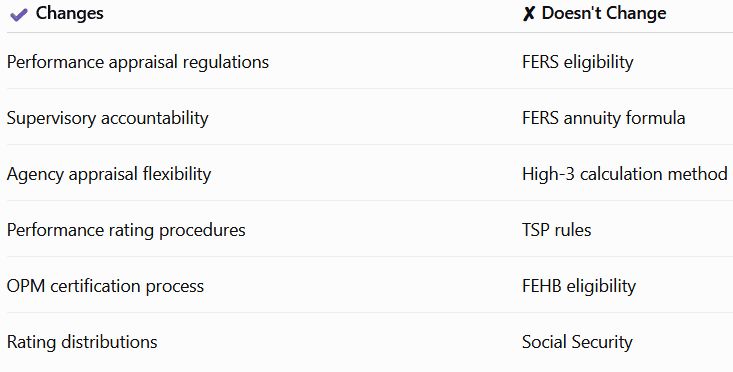
Instead, the regulation focuses exclusively on how agencies evaluate employee performance. For employees who are five to ten years from retirement, the practical impact is indirect.
Performance ratings themselves are not used to calculate your pension. However, performance may influence:
- Promotions
- Salary increases associated with promotions
- Quality Step Increases
- Performance awards
- Leadership opportunities
Those career opportunities may increase your salary before retirement, and because your High-3 average salary is based on your highest consecutive three years of basic pay, promotions earned late in your career can increase your future FERS annuity.
What Should Federal Employees Do Now?
Most employees do not need to take immediate action simply because OPM published this final rule. Instead, consider using the next appraisal cycle as an opportunity to become more engaged in your own performance management.
If you expect to remain in federal service for another five to ten years, consider:
Understand Your Agency’s Changes
Every agency will implement these regulations somewhat differently. Pay attention to new guidance from your agency regarding performance plans, appraisal procedures, and rating criteria.
Keep Better Records
Maintain a simple file throughout the year documenting:
- Significant accomplishments
- Cost-saving ideas
- Process improvements
- Customer compliments
- Awards
- Training completed
- Leadership activities
- Measurable results
- This documentation can make performance discussions more accurate and productive.
Meet With Your Supervisor Regularly
Don’t wait until the annual appraisal. Periodic conversations can help ensure expectations remain clear and accomplishments are recognized while projects are still fresh.
Think About Your Remaining Career
If retirement is still several years away, ask yourself:
- Am I hoping for one final promotion?
- Would a Quality Step Increase benefit me?
- Are there leadership opportunities I’d still like to pursue?
- Will increased salary improve my High-3 average?
For many employees, the answer may be “yes” to these questions.
Frequently Asked Questions
Are agencies now required to rank employees against one another?
No. The final rule removes the prohibition on standardized rating distributions, but it does not require agencies to use quotas or forced rankings. Each agency will determine how its appraisal system operates within OPM’s regulations.
Will everyone receive lower performance ratings?
Not necessarily. The rule gives agencies greater flexibility, but individual agencies will decide whether to revise their performance management systems. Some agencies may make only modest changes.
Can this reduce my retirement pension?
Not directly. Your retirement formula has not changed. However, if changes to performance management affect promotions or salary growth during your final working years, they could indirectly influence your High-3 average salary.
Should I delay retirement because of this rule?
For most employees, probably not. The rule changes performance management—not retirement eligibility or retirement benefits. Retirement decisions should continue to be based on your financial readiness, personal goals, health, and family circumstances rather than these appraisal regulations alone.
Summary
OPM’s final rule represents one of the most significant updates to the federal performance appraisal system in recent years. By giving agencies greater flexibility to design appraisal programs, increasing supervisory accountability, and encouraging more meaningful distinctions in employee performance, OPM hopes to strengthen merit-based personnel decisions across the federal workforce.
For federal employees who are five to ten years from retirement, the rule is less about changing retirement benefits and more about maximizing the value of the years that remain before retirement.
Those final years often determine:
- Whether you receive another promotion.
- Whether you qualify for higher-paying leadership opportunities.
- Whether you earn a Quality Step Increase.
- Whether your High-3 average salary increases before you retire.
The regulation does not guarantee any of those outcomes. Nor does it require agencies to dramatically change their appraisal systems overnight.
But it does signal that OPM expects agencies to place greater emphasis on meaningful performance management.
If you are approaching retirement, this is a good reminder that your career is not on autopilot. Continue documenting your accomplishments, engage with your supervisor throughout the appraisal cycle, and stay informed about how your agency implements these new regulations. Strong performance during your final working years can still open doors that improve your career—and potentially your retirement income.