Your high-3 average salary is one of the most important numbers used to calculate your Federal Employees Retirement System (FERS) pension. Despite its name, it is not simply your highest-paid three calendar years. Instead, it is the highest average basic pay you earned during any consecutive 36-month period of federal service.
Understanding how the high-3 is calculated can help you estimate your future pension, evaluate retirement timing, and avoid common misconceptions.
Key Takeaways
- The high-3 is the highest average rate of basic pay over any consecutive 36 months.
- It is based on basic pay, not your total compensation.
- Overtime, bonuses, awards, travel reimbursements, and most allowances are not included.
- Annual pay raises that occur during the 36-month period are reflected in the calculation.
- For most employees, the high-3 occurs during the final three years of federal service—but not always.
When federal employees begin planning for retirement, one of the first questions they ask is: “What is my high-3 average salary?”
The answer is important because your high-3 is one of the three primary factors used to determine your FERS basic annuity:
- Your high-3 average salary
- Your years and months of creditable service
- The FERS pension multiplier
Even a modest increase in your high-3 can increase your lifetime retirement income.
What Is the FERS High-3 Average Salary?
The Office of Personnel Management (OPM) defines the high-3 average salary as the highest average basic pay you earned during any consecutive 36 months of federal service.
Advertisement

Many employees mistakenly believe the high-3 refers to their highest-paid three calendar years. In reality, OPM looks for the highest-paid 36 consecutive months, regardless of where they fall during your federal career.
For example, your high-3 period could be:
- July 15, 2024 through July 14, 2027
- October 1, 2023 through September 30, 2026
The dates do not have to align with the beginning or end of a calendar year.
What Counts as Basic Pay?
Only basic pay is included in your high-3 calculation. This is important because many forms of compensation that increase your paycheck are not considered retirement-covered pay.
Basic pay generally includes:
- Base General Schedule (GS) salary
- Locality pay
- Special salary rates
- Law Enforcement Availability Pay (LEAP), when retirement deductions are withheld
- Administratively Uncontrollable Overtime (AUO), when retirement deductions apply
- Other forms of premium pay specifically designated as basic pay for retirement purposes
Basic pay generally does not include:
- Overtime pay
- Cash awards
- Performance bonuses
- Recruitment or relocation incentives
- Travel reimbursements
- Per diem
- Uniform allowances
- Moving expenses
- Most premium pay that is not subject to retirement deductions
As a result, your W-2 wages may be significantly higher than your official high-3 average salary.

How the High-3 Average Salary Is Calculated
OPM calculates your high-3 by identifying the consecutive 36-month period during which your average basic pay was the highest.
Suppose your annual basic pay was:
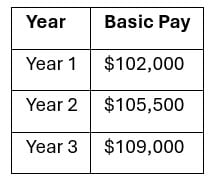
Your high-3 average would be:
($102,000 + $105,500 + $109,000) ÷ 3 = $105,500
In practice, OPM performs a more precise calculation because pay raises, promotions, and locality pay changes often occur during the middle of a year rather than on January 1.
Why Your High-3 Average Salary Matters
Your high-3 average salary is one of the three components used to calculate your FERS basic annuity.
For most employees, the formula is:
High-3 Average Salary × Years of Creditable Service × 1%
If you retire at age 62 or later with at least 20 years of creditable service, the multiplier generally increases to 1.1%, resulting in a larger pension.
Because the high-3 is multiplied by every year of service, even a relatively small increase can produce thousands of dollars in additional lifetime retirement income.
Example
Maria retires with:
- High-3 average salary: $120,000
- Creditable service: 30 years
- Standard FERS multiplier: 1%
Her annual FERS pension would be: $120,000 × 30 × 1% = $36,000 per year
If Maria qualified for the enhanced 1.1% multiplier by retiring at age 62 or older with at least 20 years of service, her annual pension would increase to:
$120,000 × 30 × 1.1% = $39,600 per year
That’s an increase of $3,600 annually before taxes.
Does Your High-3 Have to Be Your Last Three Years?
No. Although the final three years of federal employment are often the highest-paid because of annual pay raises and promotions, that is not always the case.
Your highest-paid consecutive 36 months could occur earlier if you:
- Accepted a lower-paying position before retirement
- Moved from a higher locality pay area to a lower one
- Left a position with a special salary rate
- Experienced a reduction in pay for another reason
OPM automatically identifies the consecutive 36-month period that produces the highest average basic pay.
Common Misconceptions
“It’s my highest three calendar years.”
No. The high-3 is based on 36 consecutive months, not calendar years.
“It includes overtime.”
Generally, no. Most overtime pay is excluded because it is not considered basic pay for retirement purposes.
“My W-2 salary is my high-3.”
Not necessarily. Your W-2 includes many forms of compensation that are excluded from the high-3 calculation.
“Working one more year always increases my high-3.”
Not always. If your earlier 36-month period already represents your highest average salary, working another year may not significantly change your high-3. However, another year of creditable service can still increase your pension.
Tips for Federal Employees
If you’re approaching retirement, consider these best practices:
- Review your SF-50s for accuracy.
- Verify that promotions and pay adjustments are correctly documented.
- Understand which types of pay count toward retirement.
- Estimate your FERS pension before selecting a retirement date.
- Remember that delaying retirement may increase both your years of service and your high-3 average salary.
Frequently Asked Questions
Does locality pay count toward my high-3?
Yes. Locality pay is generally considered part of your basic pay and is included in the calculation.
Do bonuses count toward my high-3?
No. Performance awards, cash awards, and bonuses are generally excluded.
Does overtime count toward my high-3?
Most overtime pay does not count because it is not considered basic pay for retirement purposes.
Can my high-3 come from the middle of my career?
Yes. OPM uses whichever consecutive 36-month period produces your highest average basic pay, regardless of when it occurred.
Who calculates my official high-3?
Your employing agency prepares your retirement records, and OPM makes the final determination when processing your retirement application.
Download the FERS High-3 Average Salary Estimator Worksheet
For educational purposes, you can download the free FERS High-3 Average Salary Estimator Worksheet (one page PDF).