We may earn a commission from links on this page.
The “loss of pulse detection” feature for the Pixel Watch 3 that received FDA clearance in February is now rolling out to U.S. users. Read on for more on what this feature does, how well it works (according to one early study), and how you’ll be able to enable it. If the watch detects that you no longer have a pulse—presumably due to a medical emergency—it can contact emergency services for you.
The feature has been available in several European countries since late 2024. According to a Google help page on the feature, it’s currently available in “Austria, Belgium, Denmark, France, Germany, Ireland, Italy, Netherlands, Norway, Portugal, Spain, Sweden, Switzerland, the United Kingdom, and the United States.”
What is “loss of pulse detection”?
The loss of pulse detection feature is meant to sound an alarm and contact emergency services whenever the person wearing the watch loses their pulse. This could be from a heart attack, poisoning, overdose, or other cause of respiratory or circulatory failure, according to Google’s documents on what they had in mind when developing the feature.
When the watch detects a “loss of pulse event” (it thinks you are wearing the watch but cannot detect a pulse with the regular heart rate sensor), the watch responds. According to documents from Google (archived here), the watch is programmed to do the following, in order:
-
Perform additional checks (taking about 20 seconds) to be sure that it’s not detecting movement or a pulse. For example, it can use brighter lights in the optical heart rate sensor, and check for movement from accelerometers.
-
Buzz your wrist and ask if you are OK. You can tap an “I’m OK” button to clear the alert. This phase lasts for 15 seconds.
-
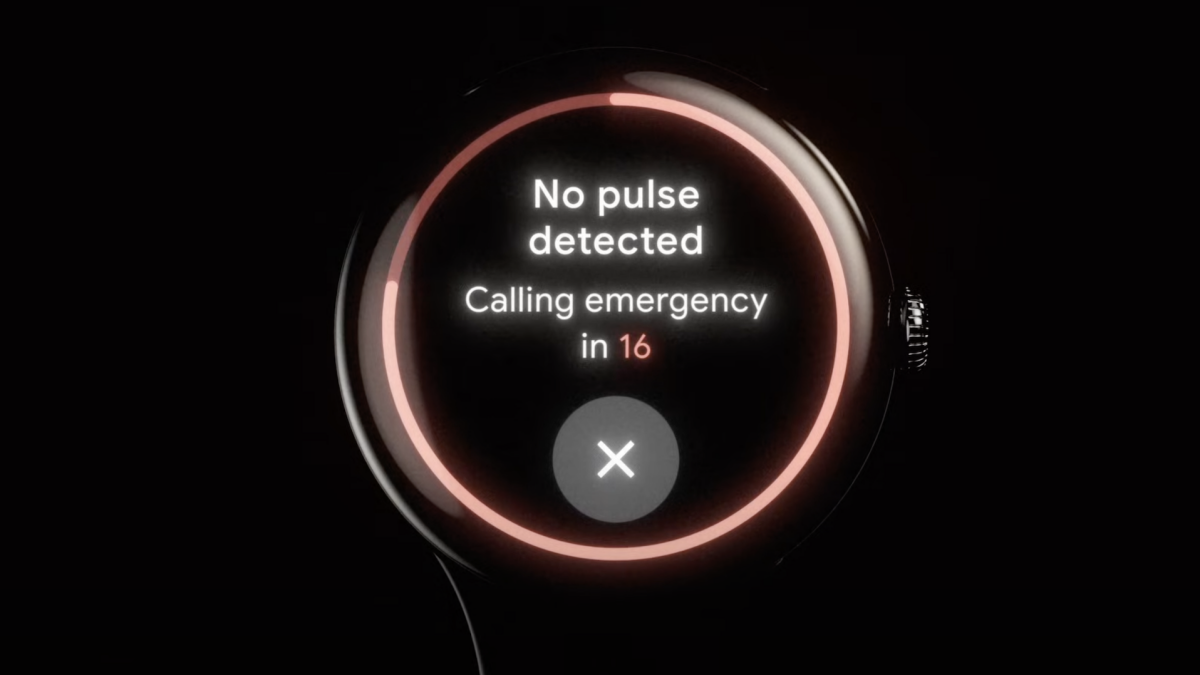
Play an audible alarm while displaying a 20-second countdown stating that it will place an emergency call (“No pulse detected / Calling 911 in…”)
-
Call 911 through the watch’s LTE connection, or through a connected phone, and play a recorded message to them (not audible to you or to bystanders). The message states that your watch detected a loss of pulse and that you are unresponsive, and it gives your approximate location.
-
While the call is ongoing, there is a “talk to 911” button displayed on the watch. You (or a bystander) can tap that button to interrupt the recorded message and speak to emergency services as a regular phone call.
What is (and isn’t) loss of pulse detection good for?
The loss of pulse detection feature is promising for what are sometimes called “unwitnessed” cardiac arrests, as a group of Italian healthcare professionals wrote in the journal Resuscitation. I wasn’t able to find any real-world accounts of this feature saving someone’s life, but to be fair it’s only been available for a few months.
Google emphasizes that the feature is not intended to provide any treatment or be expected to save your life, and definitely cannot replace medical monitoring devices that may have been prescribed or recommended to you by your provider. It can’t prevent a loss of pulse, or determine the cause of a loss of pulse, and it can’t even be sure that its emergency calls will go through.
Importantly, the loss of pulse detection process has not been tested in a variety of real-world situations that may increase the risk of false alarms, or of missing a real event. These are some of the people who might be most interested in this feature, so it’s worth noting that the feature has not been tested for people identified as high risk for sudden cardiac death, or for people who are pregnant, under 22 years of age, who have chronic pain, poor blood flow to the wrist, peripheral nerve conditions, cognitive impairment, sickle cell disease, or who have a tattoo on their wrist that may interfere with the sensor.
How well does loss of pulse detection work on the Pixel Watch 3?
Google had published a brief summary of the results of their testing from the watch, as part of the removed document (archived here) that gives instructions for use. They tested the feature on 135 volunteers, including—according to a press release—stunt actors who simulated falls while wearing a tourniquet. A study with some of the same data is also available here.
What do you think so far?
The sensitivity in a clinical trial was 69.3%, meaning that the feature was activated 69.3% of the time that a person had an actual loss of pulse. The other 30.7% of the time, it didn’t activate. That’s not great, but the idea seems to be that it’s a lot better than nothing.
The other metric of accuracy—specificity—Google described in the removed document as amounting to “1 false positive call over 7.75 user-years” with 131 of their users. (That would be compatible with 131 users wearing the watch for about three weeks each, resulting in one person getting a false positive, but Google didn’t release the full results so we can’t say whether that’s exactly how the study went, or how their use compared to what you might be doing with your watch over the next 7.75 years.)
If you do get a false positive, you’ll have a few chances to cancel the alert before it gets as far as calling emergency services. If you tap the “I’m OK” button, the watch will ask if you were doing anything innocuous that may have triggered it. Sleeping on your arm is one of the options; so is a loose fit on the watch band, or not wearing the watch at all. Google also notes that other factors like ambient light or pressure on the skin may sometimes result in false positives.
How to enable (or disable) loss of pulse detection on the Pixel Watch 3
Once the feature is available here, it will be an option when you’re setting up a new watch. (So far it hasn’t been announced for any Fitbit models or older Pixel watches, just the Pixel Watch 3 in both sizes.) To turn on loss of pulse detection for your Pixel Watch 3, go into the Pixel Watch app, tap Safety & Emergency, and look for Loss of Pulse Detection. There is a switch that allows you to turn the feature on or off.