The Tony Blair Institute participated in a project to develop a postwar Gaza plan that envisaged kick-starting the enclave’s economy with a “Trump Riviera” and an “Elon Musk Smart Manufacturing Zone”.
The plan outlined in a slide deck, seen by the Financial Times, was led by Israeli businessmen and used financial models developed inside Boston Consulting Group (BCG) to reimagine Gaza as a thriving trading hub.
Titled the “Great Trust” and shared with the Trump administration, it proposed paying half a million Palestinians to leave the area and attracting private investors to develop Gaza.
While the Tony Blair Institute (TBI) did not author or endorse the final slide deck, two staff members at the former UK prime minister’s institute participated in message groups and calls as the project developed, according to people familiar with the work.
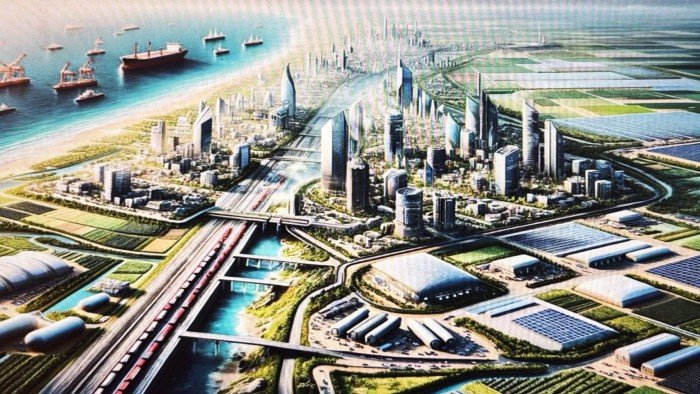
One lengthy document on postwar Gaza, written by a TBI staff member, was shared within the group for consideration. This included the idea of a “Gaza Riviera” with artificial islands off the coast akin to those in Dubai, blockchain-based trade initiatives, a deep water port to tie Gaza into the India-Middle East-Europe economic corridor, and low-tax “special economic zones”.
The TBI document said the devastating war in Gaza had “created a once-in-a-century opportunity to rebuild Gaza from first principles . . . as a secure, modern prosperous society”.
While there was some overlap, the Israeli businessmen’s slide deck, which runs to more than 30 pages, differed significantly from the paper written by TBI’s staff. The institute’s document did not refer to the relocation of Palestinians, an idea championed by US President Donald Trump earlier this year but condemned internationally.
When first approached by the FT regarding its role in the project, a TBI spokesperson said: “Your story is categorically wrong . . . TBI was not involved in the preparation of the deck, which was a BCG deck, and had no input whatever into its contents.”
The FT then provided details of a 12-person message group used for the project — including two TBI staff, BCG consultants and the Israeli businessmen — and an unpublished TBI document shared within the group titled “Gaza Economic Blueprint”.
At this point, the TBI spokesperson said: “We have never said TBI knew nothing about what this group was working on or that they weren’t on calls in which the group discussed their plans.”
TBI said that when meeting groups to discuss postwar plans, it is “essentially in listening mode”. The “internal TBI document” looked at proposals “being made by various parties . . . [and] is one of many such internal documents”.
“TBI emphatically did not provide its own internal document for the purposes of the BCG work,” it added. TBI staff “saw” the slide deck but “didn’t create it”, the spokesperson said. “It would be wrong to suggest that we were working with this group to produce their Gaza plan.”
TBI said Blair had sought a “better Gaza for Gazans” for the past two decades: “It has never been about relocating Gazans, which is a proposal TBI has never authored, developed or endorsed.”
BCG’s work relating to Gaza has put it at the centre of an international controversy. It helped establish a new Israel- and US-backed aid scheme for the shattered enclave, the Gaza Humanitarian Foundation (GHF), whose launch has been marred by the deaths of hundreds of Palestinians. It has disavowed much of the work, which it said was done largely without approval, and fired two partners who it said had misled senior executives.
The FT revealed last week that the BCG team had also modelled the reconstruction of Gaza. The team was working in direct contravention of an order not to do the project, the consulting firm said. “The work was not a BCG project, and BCG categorically told the lead partner not to do the work,” BCG said. “It was orchestrated and run secretly outside any BCG scope or approvals. We fully disavow this work. BCG swiftly exited both partners involved in this work.”
TBI said the FT had been “fed this information [regarding its involvement] by people anxious to deflect from their own role.”

The group of Israeli businessmen behind the project, including tech investor Liran Tancman and venture capitalist Michael Eisenberg, had earlier sketched out and helped set up the GHF, according to people familiar with their role.
Phil Reilly, an ally of the businessmen who now runs security operations for GHF, courted Tony Blair at a meeting in London in March. TBI said that Reilly, a former CIA officer and BCG adviser, had requested the meeting. “Again, Mr Blair listened. But as you know, TBI is not part of GHF.” A spokesperson for Reilly’s Safe Reach Solutions said Blair’s office had requested the meeting to learn about the work his company did manning a checkpoint during a brief ceasefire in the war earlier this year.
The businessmen’s postwar blueprint imagined an expanded role for the aid operation, which would provide temporary housing to Palestinians who stayed in the territory, while cash payments and food and rent subsidies totalling $9,000 per head would encourage a quarter or more of the population to leave.
The final slide deck, titled “The Great Trust: From a Demolished Iranian Proxy to a Prosperous Abrahamic Ally”, has been shared with members of the current and former US administrations, according to people familiar with the project, along with other governments and stakeholders in the Middle East. “Great” is short for Gaza Reconstitution, Economic Acceleration and Transformation.
It envisaged all Gaza’s public land being put into a trust for development, whose assets could be sold to investors via digital tokens traded on a blockchain. Gazans would be offered the chance to contribute their privately owned land to the trust in return for a token that gave them the right to a permanent housing unit.

The deck was produced in April, before Israel and the US launched attacks on Iran, and the group’s ideas are evolving in light of that war, the people said.
“It is the work of a group of business people who have worked tirelessly over the past 20 months to create a better future for Gaza,” said one of the people.
The trust would have administrative rights over the enclave until Gaza is “demilitarised and deradicalised” and authority could be passed to an “independent Palestinian polity”.
The project is one of a burgeoning number of postwar Gaza plans from governments and independent groups. The Arab League has endorsed a $53bn reconstruction programme laid out by Egypt in March, while private think-tanks, including Rand, have set out their own proposals.
During Trump’s first term in the White House in 2020, he set out another long-term peace plan for the region that included the economic development of Gaza, which was rejected by the Palestinians. In February, he suggested Gaza should be emptied of Palestinians while the US took it over to redevelop the enclave as the “Riviera of the Middle East”.
The slide deck prepared by the Israeli businessmen was “an economic exploration of the ideas brought by President Trump”, according to one of the people familiar with its preparation. It contains flourishes specifically designed to attract the attention of the US president and Gulf leaders who might support aspects of the plan.
Among 10 “Mega Projects”, the document includes the “MBS Ring” and “MBZ Central” highways — named after the leaders of Saudi Arabia and the United Arab Emirates, Mohammed bin Salman and Mohamed bin Zayed al-Nahyan, respectively — and an “Elon Musk Smart Manufacturing Zone” on the Gaza-Israel border where US electric vehicle companies would build cars for export to Europe. It was prepared at a time when Musk was one of Trump’s closest advisers, before their subsequent souring of relations.

The plan also envisages what the authors called the Gaza Trump Riviera & Islands, “world class resorts along the coastline and on small artificial islands similar to the Palm Islands in Dubai”. Such islands are also mentioned in the TBI document.
The slide deck describes how the new highways, port and airport would turn Gaza into a trading hub and “secure US industry access to $1.3tn of rare-earth minerals in the Gulf” from western Saudi Arabia.
The slide deck is also peppered with the logos of companies the authors aspired to attract to Gaza, from Tesla and Amazon Web Services to Ikea and the hotels group IHG. There is no indication that the companies had any awareness of the project.
Using a complex financial model produced by the BCG team, the plan assumed 25 per cent of Gazans would leave voluntarily, a majority never to return.
It said the relocation scheme would cost $5bn but that it would generate “$23k savings on every Palestinian relocating” because subsidies were cheaper than spending on housing support and other costs in the territory.
Increasing the number of Gazans who left during the reconstruction would further reduce costs, it said.
Together with a flourishing of industry and a growing GDP, the plan would “increase [the] value of Gaza to ~$324B from $0 today”, according to BCG’s financial model.
A five-person BCG team that produced the model and created graphics for inclusion in the slide deck were working without billing for the work, characterising it as “business development”, according to people familiar with the project. They did not give the Israeli businessmen or TBI direct access to their calculations, hoping that they could one day use the model to win paid work.
“BCG offered to do pro bono work and, of course, the group jumped on it because of BCG’s experience at planning large reconstruction projects around the world and their expertise in innovative funding models, including tokenisation,” said one person familiar with the project.
The consultants provided “modelling, benchmarking and slide crafting”, the person said, calling it “phenomenal work”.