This article is an on-site version of our Europe Express newsletter. Sign up here to get the newsletter sent straight to your inbox every weekday and Saturday morning
Good morning. Yesterday, we reported on a push to water down laws on damaging methane emissions. But in a win for the climate (and despite last minute backroom politics) the industry-friendly amendments failed in the EU parliament during the final vote.
Today, our Berlin bureau chief and I dissect German chancellor Olaf Scholz’s calls to press forward with the EU’s asylum and migration reforms. And our Milan correspondent explains the politics behind appointing the new leadership of energy giant Enel.
Easier said than done
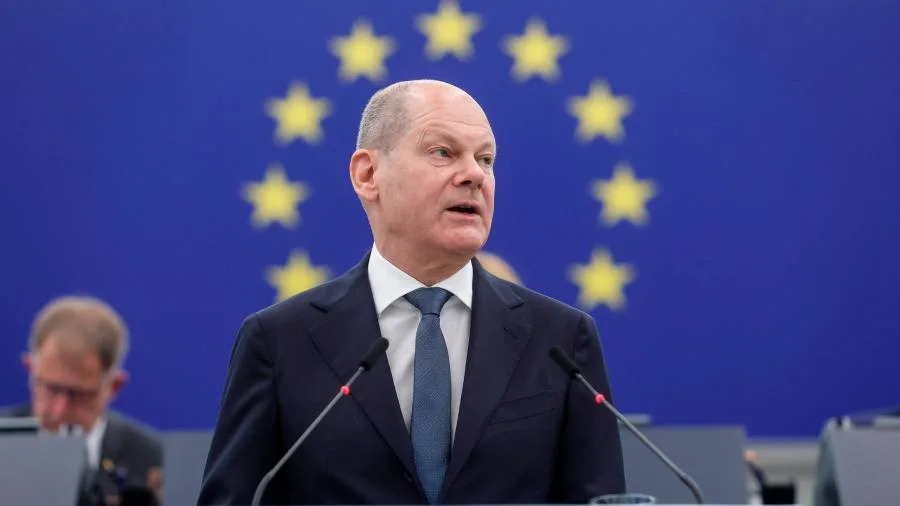
German chancellor Olaf Scholz has called for progress on contentious EU asylum and migration reforms — while facing intensifying criticism on refugee policy at home, write Guy Chazan and Laura Dubois.
Context: The EU is frantically working to overhaul its asylum and migration system, with the distribution of asylum seekers a main sticking point between states. Asylum applications in Germany increased by 80 per cent in the first four months of this year, compared with the same period of 2022.
“Of course there needs to be a solution in the end that meets the demands of European solidarity,” Scholz said in a speech at the European parliament yesterday. He called for “effective border protection at Europe’s external borders” and “common procedures at the borders” for asylum seekers.
The current Swedish EU presidency aims for member states to agree on the reforms by June, before starting negotiations with parliament on a final deal.
“I very much hope . . . that we will succeed in realising this in this legislation period”, Scholz said with an eye on the European elections in the summer of next year.
Today, the chancellor is hosting the prime ministers of Germany’s 16 federal states, which have been begging Berlin for more money to deal with the huge influx of refugees.
Scholz has pledged to pay the states and municipalities €2.75bn this year to help with the costs of accommodating and looking after the newcomers, a figure that includes €1.5bn for Ukrainian refugees alone. But he has resisted demands to offer more.
His stonewalling — and arguable lack of solidarity — has caused an outcry across the Länder.
“The financial resources of the federal government must be oriented towards the actual number of people who have come here as refugees,” said Stephan Weil, prime minister of Lower Saxony. “Flat-rate, one-time payments don’t work.”
Hendrik Wüst, prime minister of North Rhine-Westphalia, Germany’s most populous state, said the government was brushing aside the “cries for help from cities and municipalities”.
Even Ricarda Lang, co-leader of the Green party — part of Scholz’s coalition — said many towns were reaching “breaking point”. Yet she was convinced the government did not want to let anyone down. “I’m optimistic that we can together reach a solution,” she said.
Chart du jour: Unfriendly robots
The war in Ukraine has helped defence tech start-ups shake up the arms industry — and the battlefield.
Succession
The battle for control over Europe’s largest utility company Enel, which has pitted Rome against a group of international investors, is coming to a head today, writes Silvia Sciorilli Borrelli.
Context: The Italian government is Enel’s largest shareholder, owning 23 per cent through its finance ministry. Picks to run publicly controlled companies are traditionally a way for government coalition parties to exercise their clout. Giorgia Meloni’s rightwing government has put forward two names.
Paolo Scaroni, a longtime ally of ex-premier Silvio Berlusconi and the mastermind behind oil major Eni’s Russia expansion, will probably be confirmed as chair at today’s shareholder meeting. Flavio Cattaneo, who is seen as close to Eurosceptic League leader Matteo Salvini, is expected to be voted as chief executive.
Scaroni and Cattaneo were not the prime minister’s first choice, according to multiple officials in Rome, and instead appear to be compromise candidates. Both Berlusconi’s and Salvini’s parties are in Meloni’s coalition government.
The outgoing chief executive, Francesco Starace, was not popular with the current Italian government, including because of his focus on the green energy transition, seen as excessive in Rome.
But the government’s choice of new candidates has not gone down well with investors. A small London-based hedge fund, Covalis, decided to present an alternative slate of candidates, causing turmoil in Rome.
According to the law, three out of nine board seats go to minority investors. But Covalis went further, and presented an alternative chair candidate — Marco Mazzucchelli. It openly criticised the “lack of transparency and poor governance” that characterise appointments at Italian state-controlled companies.
The move has won some unexpected backing from other international investors. Let’s see if the gamble — however improbable — will pay off this afternoon.
What to watch today
-
Giorgia Meloni meets Czech premier Petr Fiala in Prague.
-
EU parliament president Roberta Metsola hosts Portuguese president Marcelo Rebelo de Sousa in Strasbourg.
Now read these
Are you enjoying Europe Express? Sign up here to have it delivered straight to your inbox every workday at 7am CET and on Saturdays at noon CET. Do tell us what you think, we love to hear from you: europe.express@ft.com. Keep up with the latest European stories @FT Europe