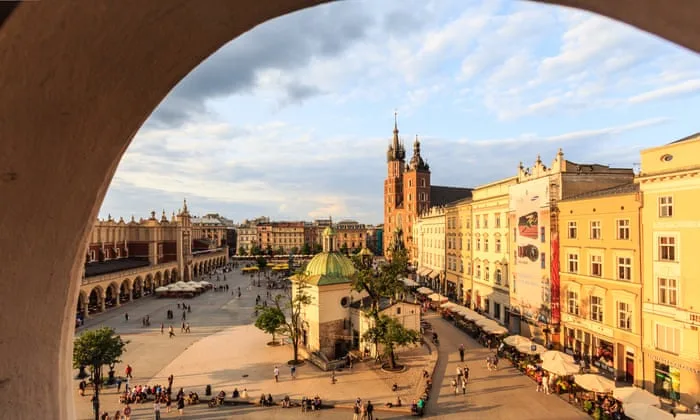
Kraków, Poland
To accompany its castle, cobbles and glorious architecture, Poland’s culture capital also has a sterling food scene. Try the famed pierogi dumplings – the city has a festival devoted to them in all their varieties from 6-12 August – game, or bigos, a hearty pork-based hunter’s stew. There are also plenty of sweet treat options such as sernik (baked cheesecake) or Polish apple pie. The famous Wierzynek restaurant in Rynek Glowny central square, where a 650-year tradition of feasting meets pan-European cuisine, offers silver service and an impressive wine cellar. For something less refined, flame-grilled kielbasa sausages are common, and there’s excellent vegan food and ice-cream; for the latter, aim for locals’ favourite Lody na Starowiślnej, which makes fresh batches daily. Drinks-wise, you might try some of Poland’s flavoured vodkas – perhaps in rose water or apricot; or head to the Bunkier Sztuki Gallery of Contemporary Art for glasses of tank beer – a less-carbonated-than-normal lager – on a sunny cafe terrace.
Where to stay: Hotel Saski Kraków, Curio Collection by Hilton
The sophisticated Hotel Saski Krakow, Curio Collection by Hilton has a 200-year history in the heart of the old town. Legendary composers from Liszt to Brahms used to walk the halls and perform in its ballroom, Saska Hall. It’s also home to a superb restaurant that gives a modern makeover to vintage Polish dishes such as steak tartare, cottage-cheese dumplings or żurek, a sour rye soup. The concierge can also provide further insider dining tips.
Munich, Germany
You might well have heard of weissbier, but how about weisswurst? Concocted from pork back bacon and veal, and usually flavoured with lemon, mace and ginger, this ghostly sausage is a quintessential Munich snack – although, or so local lore dictates, one that should only be consumed before midday. Grillers are ubiquitous across the city, including at the food-focused Viktualienmarkt beside stalls selling freshly baked pretzels. Pleasure seekers are also directed to the cosy Cafe Frischhut, which deep-fries the city’s doughnut-like schmalznudel pastries to order, and the Dallmayr delicatessen: effectively, a Bavarian version of the Fortnums food hall.
Where to stay: Hilton Munich Airport
Beer is another institution, even for those swerving Oktoberfest. Accordingly, a canny place to stay is this hotel – partly for its head-soothing heated pool, spa and Alps-inspired bedrooms, and partly due to an unexpected brewery. Though overshadowed by central Munich’s rowdy, 3,500-person Hofbräuhaus, the airport courtyard’s very own Airbräu brewery is brilliant, especially if you combine pints with their yummy, mac-and-cheese-esque spätzle. Bed will only be a few minutes’ walk away.
Barcelona, Spain
Around the beachside quarter of Barceloneta, taverns proffer a seafood-stacked paella made with noodles. Imported from Valencia, fideuà is just one of Barcelona’s culinary stalwarts; many of the others come in tapas form. Patatas bravas and pan con tomate are virtual perrenials on bar menus, as are croquetas, typically filled with jamón or bacalao (salted cod), and deep-fried bombas balls. Then you have open montadito sandwiches, paprika-powered pulpo a la gallega – octopus and sliced potatoes, best enjoyed alongside cava at the old La Boqueria food market – and, utterly Catalan, cargols a la llauna: oven-cooked, in-shell snails, often dished up with aioli.
Where to stay: Hilton Diagonal Mar Barcelona
You can also try new dishes with authentic Spanish flavours and local ingredients. Diners at Aürt, a luxurious Michelin one-star restaurant with a unique dining experience in the Hilton Diagonal Mar Barcelona, can sample thrilling 15-course locavore tasting menus by head chef Artur Martínez; or, over in Ma’i, his own experimental tapas and cocktails. Very close to sandy Nova Mar Bella beach, the hotel throws in its own beach club in Puro Beach, a seasonal outdoor pool and sea-view rooms for good measure.
Naples, Italy
Margherita pizza was invented in Naples to honour an eponymous queen’s visit in 1889 – as attested by a plaque at proud Pizzeria Brandi. Today, strict rules govern the production of “proper” wood-fired Neapolitan margheritas, with stronger San Marzano tomatoes, rich buffalo mozzarella and fresh basil leaves all non-negotiable. Neighbourhood pizzerias are as common as Vespas around the frenzied southern city and its laundry-lined lanes. That said, simple spaghetti alle vongole (clams) constitutes another lure for gourmands, as do shell-shaped sfogliatelle puff pastries and powerful coffees produced in gravity-reliant cuccumella flip pots.
Where to stay: The Britannique Naples, Curio Collection by Hilton
Returning to pizza – because, in Naples, there’s really no avoiding it – if you try just one Neapolitan margherita, do so at century-old Gorizia, up in posh Vomero. From this fabled hilltop haunt, you can then descend via funicular to the Britannique Naples and indulge in the solarium or spa before a siesta. Fancy a nightcap? Ask for a fine limoncello, made using world-renowned Amalfi lemons, while enjoying sensational sea views from the rooftop Niq Bar.
Paris, France
From Norman moules frites to southern cassoulets, Paris unites Gallic favourites – with the archetypal place to try them a bistro decked out with the classic brass rails and red velvet chairs. Asian cuisine is also exceptionally good here, as are classic French favourites; as 2022’s reigning best butter croissant-maker in the sacrosanct Concours du Meilleur Croissant du Grand Paris competition, the Carton boulangerie should be your first stop. Two other must-tries are multicoloured macarons (plus, for peak decadence, a chocolat chaud) from Carette’s iconic Place des Vosges branch and the cult chocolate-pistachio “escargot” pastries made by baking god Christophe Vasseur in Du Pain et des Idées, near cool canal Saint-Martin.
Where to stay: Hilton Paris Opera
Paris’s longest-running patisserie, Stohrer, meanwhile, was founded by the man credited with dreaming up rum babas. A more comfortable place to try this alcohol-soaked dessert, however, lies on the other side of Galeries Lafayette amid this stylishly grand Hilton Paris Opera. Built for the Universal Exposition at the same time as the Eiffel Tower – 1889 – it’s all grand 19th-century architecture and handily placed for the Louvre and plenty of other major attractions. Its romantic Le Grand Salon is open all day below two colossal chandeliers, and serves sweet tooths a further pair of classic Parisian delicacies: mille-feuilles and profiteroles. You only live once, after all …
Rome, Italy
At its heart, cucina Romana revolves around four simple pasta sauces, each of them typically clinging to spaghetti or bucatini. Both the tomatoey amatriciana and peppery gricia feature guanciale (cured pork jowl), while cacio e pepe, a culinary phenomenon in recent years, is built from only three ingredients: pasta, black pepper and pecorino cheese. Best known of all is carbonara: egg yolks, rendered guanciale and pecorino romano – but, please, never cream. While this quartet can be found everywhere, they’re best scoffed in traditional trattorias amid riverside Trastevere. Here you might additionally try some slow-simmered romanesco artichokes, found at their fresh best between February and April.
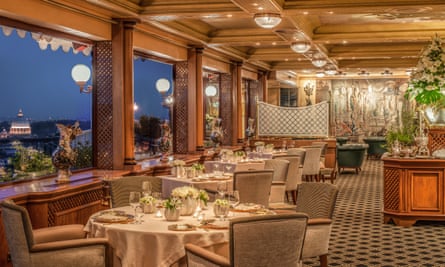
Where to stay: Rome Cavalieri, A Waldorf Astoria Hotel
All roads lead to Rome, as we know, and that, seemingly, includes those taken by Mediterranean producers. Hence rooftop La Pergola, the city’s sole three-Michelin-star restaurant which, under chef-magician Heinz Beck, is positively a love letter to Med ingredients (and typically booked up months ahead). Alongside a luxurious spa and lush gardens, it’s part of the lavish Rome Cavalieri, A Waldorf Astoria Hotel. If you’ve some room left over, the original Gelateria dei Gracchi shop, whose pistachio flavour has ice-cream purists purring, isn’t far afield. For foodies wanting to try out something new, head to newly opened Hilton Rome Eur La Lama for a signature cocktail accompanied with cichetti, small dishes of local delicacies, at the Blade Bar.