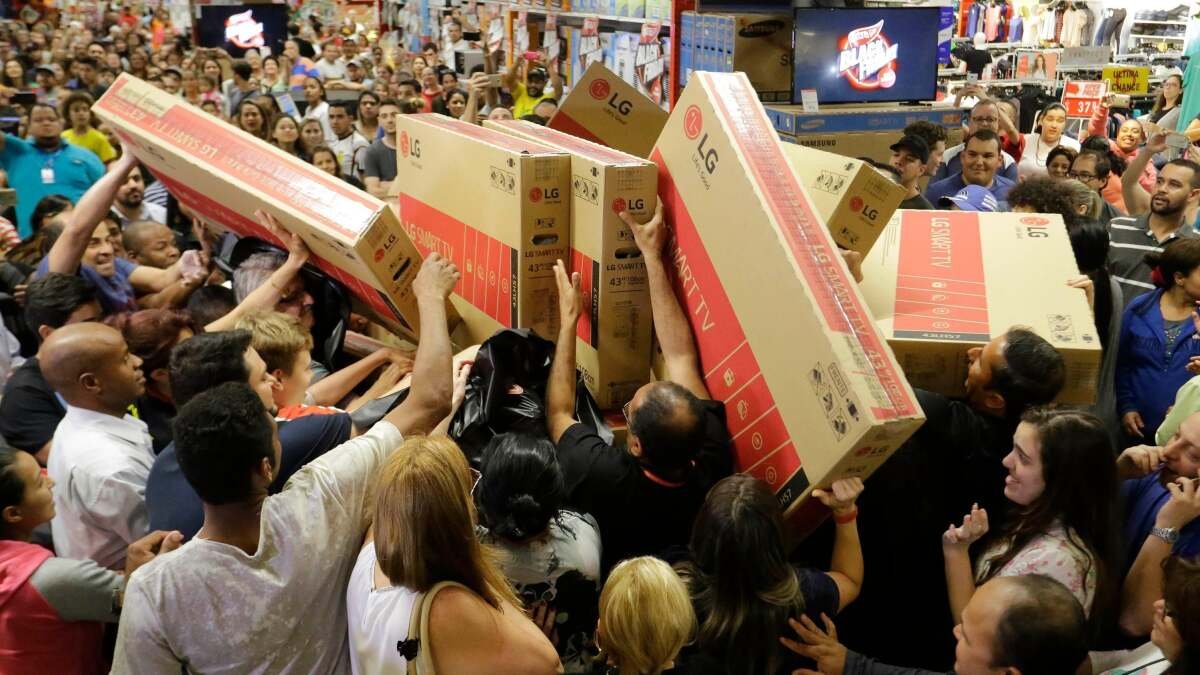
Black Friday—once simply known as “the day after Thanksgiving”—has become a quasi-holiday in the United States, one marked by consumer discounts, ceaseless shopping, and occasional violence.
Black Friday has grown and metastasized so much that it isn’t a mere day anymore: It’s a week, a month, a veritable state of mind. (Speaking of which, check out Lifehacker’s Black Friday coverage. We got all the deals, baby!) While waking up early and shopping at physical stores on Black Friday is waning as online shopping grows, it’s still a big deal in the U.S.—it’s estimated that around 90 million Americans shopped online and 76.2 million Americans visited a brick-and-mortar store during Black Friday in 2023.
But where did Black Friday come from and what does it all mean?
When was the first Black Friday?
“Black Friday” in the United States originally referred to the start of the Panic of 1869, when the collapse of the price of gold devastated the national economy. “Black Friday” as a description of the shopping day after Thanksgiving only dates back to 1951: The term first appeared in the journal Factory Management and Maintenance to refer to the number of employees who skipped work on the day after Thanksgiving. Around the same time, the police in Philadelphia and Rochester started informally using “Black Friday” to describe the traffic and crowds that appeared in their cities as shoppers hit the stores on the day after Thanksgiving.
The phrase gradually caught on—it was picked up by national press in 1975 when the New York Times used the phrase to describe the day after Thanksgiving and the shopping and sales it brings.
But even before it had a name, Black Friday was a thing. The day after Thanksgiving has been known by merchants as the start of the shopping season since the late 1800s. Back then and into the 20th century, retailers often sponsored Thanksgiving Day parades that traditionally ended with an appearance by Santa Claus, as if to say, “Now it’s time to shop for Christmas.” By unspoken agreement among retailers, Christmas-themed advertisements rarely appeared prior to Thanksgiving in our grandparents’ day. This informal bargain obviously no longer applies.
Black Friday’s problematic name
Referring to a day as “black” traditionally denotes a period of calamity or tragedy, leading some to suggest different names for the day. In the early 1960s, the Philadelphia merchants suggested “Big Friday,” a name which did not catch on, leaving retailers with the weak explanation that the “black” in Black Friday refers to the black ink denoting profits in ledger (as if they aren’t making money the rest of the year). Oft-repeated lore suggests that retailers are “in the red” all year, and only start making an annual profit at the end of the year, but accounting doesn’t really work like that—big retail chains generally report on their profits to investors every quarter.
A more modern issue with the name is that Black Friday sales now lasts for days or even weeks, beginning in early to mid-November and bleeding over into the following Saturday, Sunday, “Cyber Monday,” Tuesday, and beyond, leading people to say things like, “Do you want to go Black Friday shopping this Sunday?” So far, alternative names like “Five-Day Frenzy” and “The day I get to trample someone to save $8 on a Nespresso” haven’t caught on. But here’s hoping.
The failure of “Black Thursday”
Beginning around 2011, an insatiable thirst for profits led many retailers to try to push the start of Black Friday shopping to Thursday (aka Thanksgiving Day). So some large retailers—Kmart, Toys R Us and others that haven’t since gone out of business—began opening on Thanksgiving. The trend never really caught on, with many shoppers appalled that employees were forced to work on Thanksgiving or angry that consumerism was encroaching upon a holiday meant to celebrate colonialism. By 2021 most major retailers had acquiesced and remained closed on Thanksgiving.
Cyber Monday is Black Friday’s bastard child
The term “Cyber Monday” describes the boost in online retail sales on the Monday after Thanksgiving, sparked by workers returning to the office and getting right to online shopping. The term first appeared on Nov. 28, 2005, in a Shop.org press release entitled “’Cyber Monday’ Quickly Becoming One of the Biggest Online Shopping Days of the Year,” which may be the most influential press release ever written.
Since its early 2000s birth, Cyber Monday has grown in popularity and is believed to have overtaken Black Friday in terms of sheer profit, although it’s hard to tell exactly. In 2023, online sales on Cyber Monday topped $12.4 billion according to Adobe Analytics. Exact numbers for total in‑store Black Friday sales aren’t readily available, but growth data suggests brick‑and‑mortar spending is much smaller in comparison. None of this actually matters to retailers, of course, who mash everything into the category of “Black Friday–Cyber Monday,” because a lot of people shop on Saturday and Sunday too.
What do you think so far?
Buy Nothing Day is the inverse of Black Friday
If all this naked consumerism makes you a little squeamish, you’re not alone. Anti-consumerists have named the day after Thanksgiving “Buy Nothing Day,” a day you can celebrate by doing charity work or simply not purchasing anything. Pioneered by artist Ted Dave for AdBusters magazine, the first Buy Nothing Day was celebrated in Canada in 1992.
It’s hard to measure the success of the alternative holiday. Both online and brick-and-mortar retail sales have increased sharply since 1992, suggesting Buy Nothing Day’s effect is negligible. On the other hand, maybe big retailers are losing millions because someone on Bluesky reminded you not to shop. Sure.
How many people has Black Friday killed?
Depending to how you measure it, Black Friday has resulted in between one and 17 deaths. Jdimytai Damour is the only person killed directly due to a Black Friday sale: The 34-year-old stock clerk was trampled to death by a surging crowd at a Long Island Walmart on Black Friday in 2008. If you include car accidents, shootings, retail worker suicides, and fatal heart attacks, Black Friday’s death toll balloons to 17, with 125 reported injuries.
Black Friday violence has even inspired a horror flick: Eli Roth’s 2023 holiday-themed slasher Thanksgiving opens with a hilariously brutal Black Friday riot that inspires two of its victims to cook up a brutal plan for revenge alongside the next year’s turkey.
Is Black Friday a gigantic scam?
I mean, yeah, of course. Critics of Black Friday point out that there is actually a better time to buy a new TV (the week before the Super Bowl) and other goods. Savings from Black Friday shopping are often largely illusory—big-ticket “doorbuster” items generally sell out quickly, leaving behind goods that are, by and large, priced the same as they would be at any other time of year, retailers often mark up products ahead of Black Friday so the discounts looks bigger, and if you’re buying online, your browser history, location, and cart contents can tweak the prices you see on Black Friday like any other day.
Despite protest holidays, the unpleasantness of shopping when stores are super crowded, and the frustration of hunting for bargains that often don’t exist, Black Friday remains an unofficial holiday, celebrated by over 100 million Americans in one way or another. What that says about our country and its relationship with capitalism is unclear, but personally, I’m going to continue my own day-after-Thanksgiving tradition of eating pie for breakfast and thinking about going for a walk but watching The Quick and the Dead instead. I’m not protesting anything; I just don’t need the hassle.