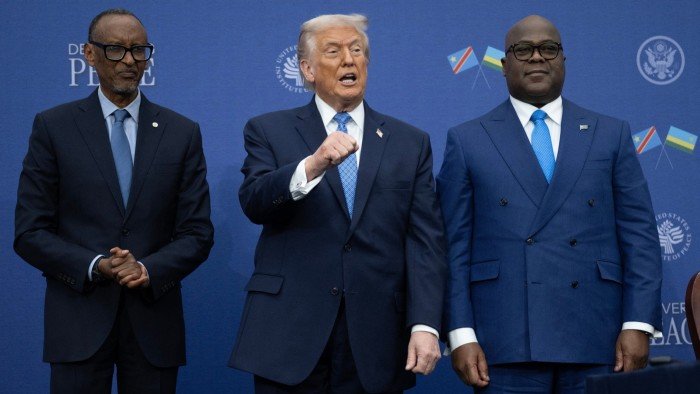
President Donald Trump hailed a “historic” peace agreement between Rwanda and the Democratic Republic of Congo on Thursday, even as the countries’ leaders expressed misgivings ahead of the signing.
The “Washington Accords,” as Trump dubbed the agreement, marks a critical moment for the two central African countries, with millions of people having been killed and displaced after decades of ethnic conflict in their border regions.
“This has become the eighth war that we’ve ended in less than one year,” Trump said at the US Institute of Peace, beside Rwandan President Paul Kagame and Congo’s Félix Tshisekedi.
Kagame and Tshisekedi had “spent a lot of time killing each other, and now they’re going to spend a lot of time hugging, holding hands and taking advantage of America economically like every other country does”, Trump said, drawing some laughs from his audience on Thursday.
But the run-up to the signing has been marred by continued fighting. And a palpable tension between the Rwandan and Congolese presidents — neither of whom acknowledged the other by name in their remarks nor shook hands — appeared to belie Trump’s optimism.
On Tuesday the Rwanda-allied M23 rebels — who have been consolidating control of a huge area of the mineral-rich east of Congo — and the Congolese army accused each other of violating an earlier ceasefire that has never fully taken effect.
Thousands of people have been killed and 1.6mn displaced as a result of the fighting just this year, according to the UN. The World Food Programme warned last month that it was struggling to access millions of people facing “emergency” levels of hunger.
Under the terms of the “Washington Accords” DR Congo will commit to neutralising FDLR rebels, whose origins can be traced to the former Rwandan army that carried out the 1994 genocide against Rwandan Tutsis. The rebels have periodically fought on the side of the Congolese army and associated local militias.
Rwanda in turn will agree to withdraw its troops, which it says are in the DR Congo as a defensive measure, and to cease all support for armed groups.
The scope of the agreement, which Trump administration officials have been brokering since March with help from Qatar, is hugely ambitious.
In addition to the security provisions, the two countries agreed to ratify a regional economic integration plan intended to foster peace through a shared interest in investment and growth.
However, without some form of force to keep the peace on the ground, the agreement signed Thursday would have “little credibility”, one Kinshasa official, who asked not to be named, warned earlier this week.
The big unknown is how the M23, the rebel group made up largely of Congolese ethnic Tutsis, will be persuaded to relinquish control of the territory it seized with help from Rwanda earlier this year, according to the UN.
“Unfortunately, on the ground [the M23] are still trying to gain territory, and those areas have minerals including gold and coltan which they are using to finance their rebellion,” said another Congolese official from the east of the country.
Kagame has repeatedly blamed the DR Congo for reneging on the terms of earlier accords, and Tshisekedi says Rwandan troops have remained in DR Congo alongside allied M23 rebels despite agreeing to withdraw.

Speaking in Washington on Thursday, Tshisekedi said he hoped Rwanda would show the “same seriousness” as the DR Congo would in its implementation of the peace deal, which Trump said included detailed provisions for a permanent ceasefire, the disarmament of “non-state forces”, the return of refugees, and justice and accountability for wartime atrocities.
“We do hope that . . . the republic of Rwanda will also respect fully the letter and the spirit of the commitments made here in Washington,” Tshisekedi said.
Ahead of his departure to Washington, Tshisekedi said he had always been committed to regional integration “but [Rwanda] stabbed us in the back”.
Kagame appeared more conciliatory.
“These accords provide everything needed to end this conflict once and for all,” Kagame said on Thursday, crediting Trump for his “pragmatic” approach.
Each country also signed bilateral deals with the US that will give Washington access to critical minerals.
“We’ll be involved with sending some of our biggest and greatest companies over to these two countries, and we’re going to take out some of the rare earth,” Trump said. “Everybody is going to make a lot of money.”
Initial plans to formalise the regional economic partnership in early October fell apart when the Congolese delegation abruptly left Washington out of frustration with continuing aggression from Rwanda and M23.
“Regional trade cannot take place without peace and restored trust,” Tshisekedi said before his trip to Washington, adding that this could only happen once Rwanda had withdrawn its troops and respected Congo’s territorial integrity.
A person close to the talks, who asked not to be named, said the success of the deal would depend in large part on how much pressure Trump — who has already, for months, claimed to have ended the conflict — applies on all sides.
The other seven wars that Trump claims to have ended this year include the Israeli-Palestinian conflict, where the second phase of his 20-point peace plan has stalled amid a tenuous ceasefire, as well as conflicts between India and Pakistan, and Israel and Iran, which regional analysts predict will flare again.