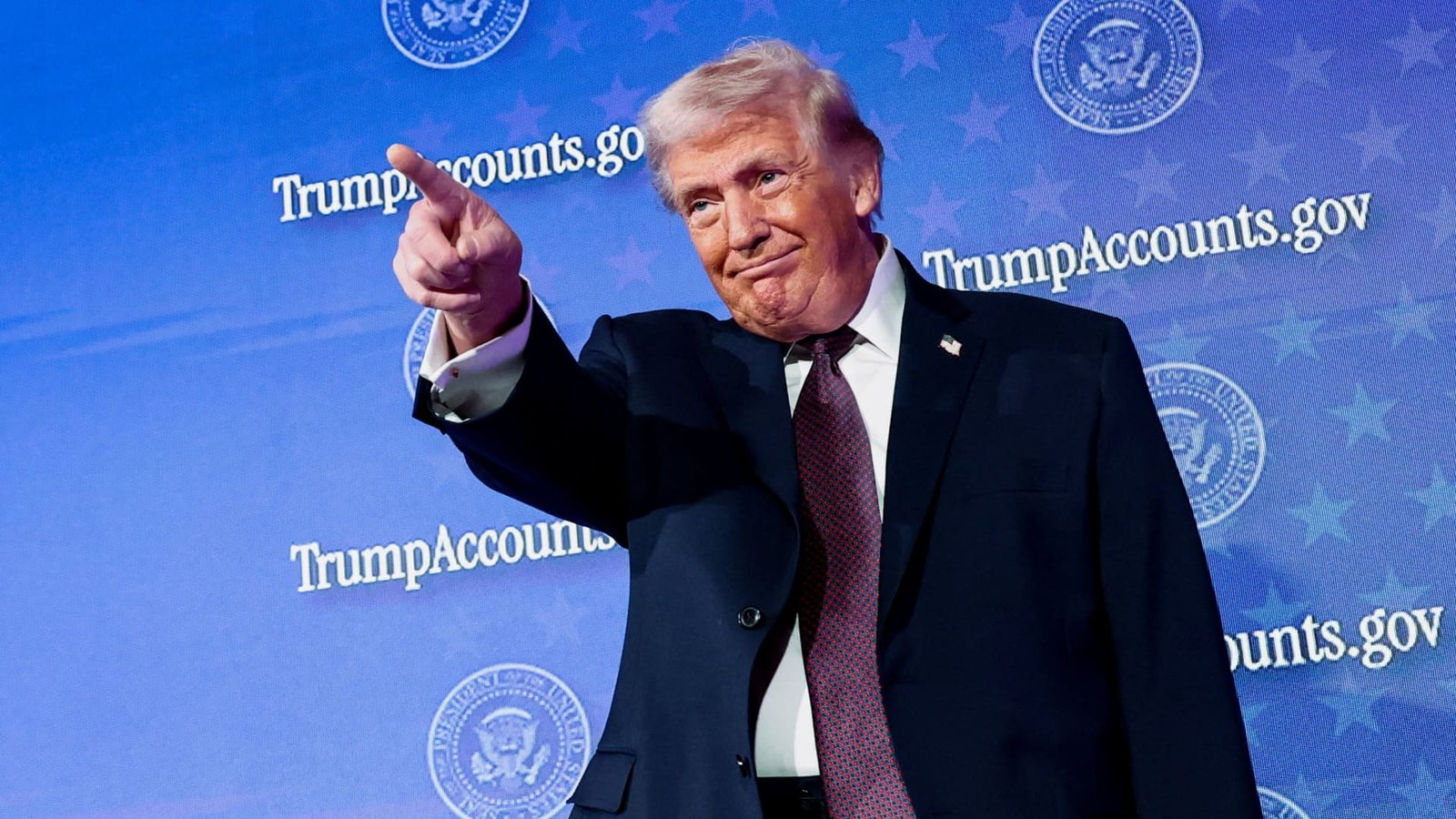
U.S. President Donald Trump points a finger onstage at the U.S. Treasury Department’s Trump Accounts Summit, in Washington, D.C., U.S. Jan. 28, 2026.
Kevin Lamarque | Reuters
The Trump administration has framed its new investment account, Trump accounts, as an early wealth-building tool for children — one that officials have said could make your kid a millionaire by their late 20s.
But financial advisors and policy experts say the numbers depend on annual contributions and investment performance, among other factors.
“As parents, if we make maximum contributions to our child’s Trump account, the projected value will be nearly $1.1 million by the time they are 28 years old,” White House Press Secretary Karoline Leavitt said Jan. 28 at the Trump Accounts Summit in Washington, D.C.
Later that day, President Donald Trump told summit attendees that “with every modest contribution, Trump accounts should reach at least $50,000 in value” by age 18 and could be “very substantially more than that.”
“With slightly greater contributions, the typical account will grow to $100,000, $200,000 and can even grow up to past $300,000 per child,” he said.
Other politicians and speakers tossed out additional projections throughout the event.
Projections ‘greatly overstate’ likely payoff
TrumpAccounts.gov projects that accounts could grow to $6,000 by age 18, $15,000 by age 27 or $243,000 by age 55, assuming the initial $1,000 Treasury deposit and no further contributions. This estimate is based on the S&P 500 historical annual average return of over 10%.
However, these are “unduly optimistic assumptions” about future stock market returns without adjusting for inflation or taxes, Alan Viard, senior fellow emeritus at the American Enterprise Institute, a conservative think tank, wrote in a Jan. 23 report.
“The administration’s projections greatly overstate the accounts’ likely payoff,” he wrote.
White House spokesman Kush Desai told CNBC in an email that many economists inaccurately predicted “economic catastrophe” under Trump.
“Economists who couldn’t see one year into the future need to have the humility to admit that they probably can’t predict 28-plus years of compound growth that a generation of American children will enjoy thanks to Trump Accounts,” Desai said.
How much a Trump account could grow
Math underpins account balance projections: Advisors and other experts use compound-growth calculations, but uncertainty remains in assumptions about future returns and contributions.
“Investors should understand that projections like these reflect best-case outcomes, not expectations,” said certified financial planner Cathy Curtis of Curtis Financial Planning in Oakland, California.
Administration estimates of Trump account growth may not be realistic for many families, she and other advisors say.
“Projections like these are mathematically possible, but they rely on a very specific set of assumptions that deserve scrutiny,” said CFP Douglas Boneparth, president of Bone Fide Wealth in New York.
To reach seven figures by a child’s late 20s, parents would need to max out Trump accounts for many years while earning “fairly strong, uninterrupted market returns,” said Boneparth.
“Unfortunately, that is not how most families actually save,” he said.
For example, if a family started from $0 and contributed $2,500 annually, they could have about $282,000 after 28 years, assuming they earned 9% returns annually, based on “long-term average growth rates of the stock market,” according to Gloria Garcia Cisneros, a CFP and wealth manager at LourdMurray in Los Angeles.
However, “year-to-year, the stock market is up and down quite a bit,” she said.
Some market analysts say U.S. stock market returns could be lower over the next decade, with estimates from six major firms ranging from 3.1% to 6.7% annually, according to a January report from Morningstar.
Plus, investors may need to consider any custodian fees or fund expense ratios that could reduce returns, said Zach Teutsch, founder and managing partner at Values Added Financial in Washington, D.C.
Trump accounts will invest in “broad U.S. equity index funds,” according to the Treasury, such as mutual or exchange-traded funds, with no more than 0.1% annual fees. The exact investment options are still unclear.
Garcia Cisneros said families should explore various account options, including 529 college savings plans, when funding education goals for their children.
Boneparth, Curtis, Garcia Cisneros and Teutsch are all members of CNBC’s Financial Advisor Council.