For years, a growing number of students have been considering alternatives to a four-year degree. Now the trend toward a two-year program or even shorter-term credential — also dubbed “un-college” — is gaining steam.
Ballooning college costs and the student loan debt that goes along with them are partly to blame. New borrowing limits for 2026 under President Donald Trump‘s “big beautiful bill” are another factor. Plus, students are increasingly seeking job training and career-driven pathways to secure a foothold in today’s softening labor market.
The term “un-college” first emerged about a decade ago to describe the rise of college alternative programs. This year, the shift will be striking, experts say.
In the fall, community college enrollment rose 3% from the prior academic year, compared to a 1.4% increase at public four-year colleges, according to a recent report from the National Student Clearinghouse Research Center. Enrollment in private four-year nonprofit institutions fell by 1.6% over the same period.
“Overall enrollment is up slightly, but the real story is the shift between sectors,” Matthew Holsapple, senior director of research at the National Student Clearinghouse Research Center, said in a statement. “Community colleges and public universities are gaining ground, while private colleges are down — a clear departure from the broad-based growth of recent years.”
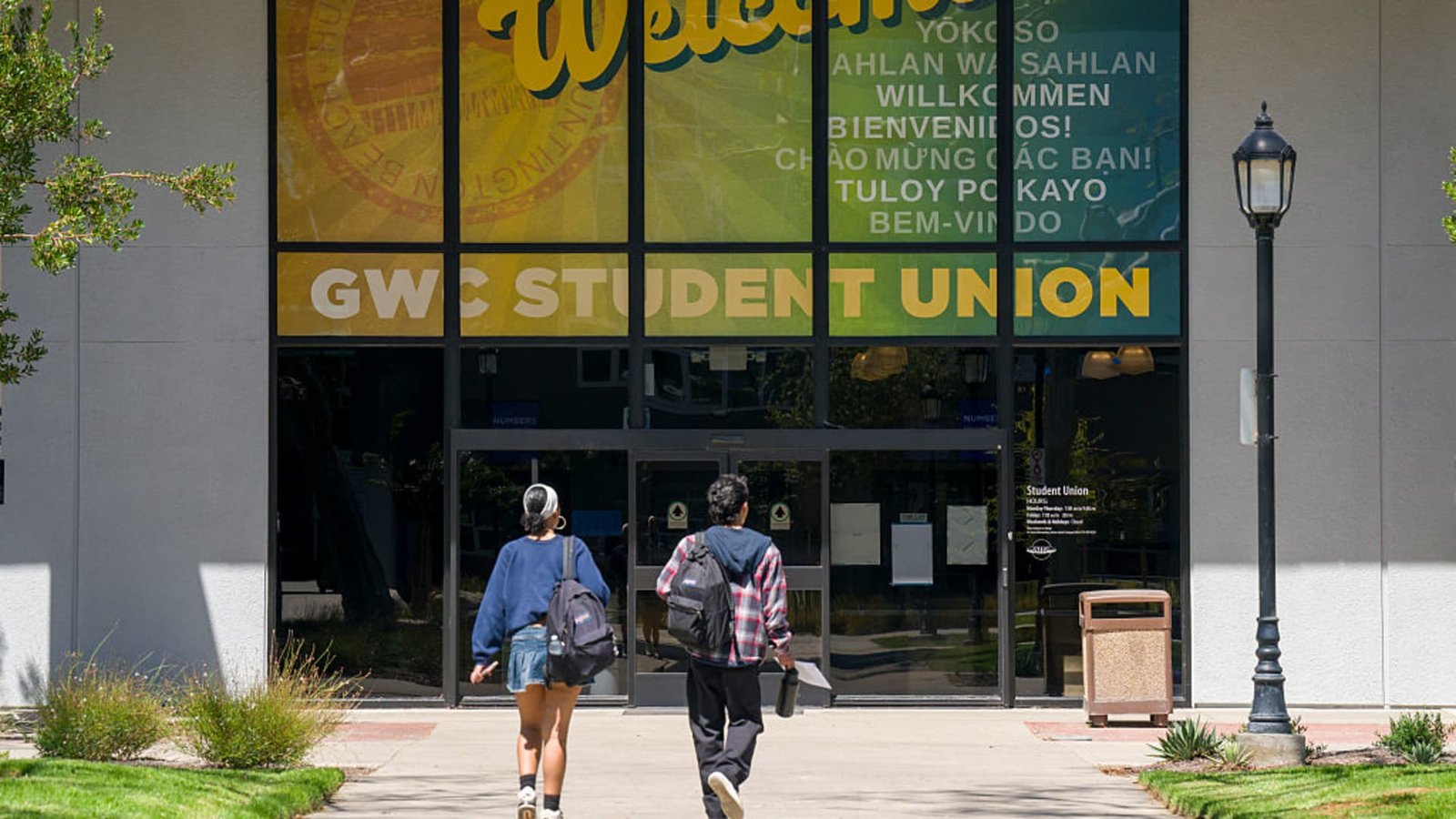
Golden West College students walk to the GWC Student Union in Huntington Beach on Wednesday, Sept. 3, 2025.
Leonard Ortiz | Orange County Register | MediaNews Group | Getty Images
The benefits of a two-year degree, vocational program or other types of certifications “are amplified in an environment of economic uncertainty,” according to DeRionne Pollard, president and CEO of the American Association of Community Colleges.
To be sure, the job market for new grads is shakier than it’s been in years.
As the rise of artificial intelligence reshapes the workforce, there are fewer entry-level jobs for those just starting out. Some experts say this is the start of an AI-driven, white-collar recession.
New grads face a challenging job market
Employers are projecting just a 1.6% increase in hiring for the Class of 2026 when compared to the Class of 2025, according to the National Association of Colleges and Employers. This year, more employers are also focusing on job applicants’ skills rather than academic degrees or grade point averages, NACE’s Job Outlook 2026 survey found.
At the same time, a shortage of skilled tradespeople is boosting the number of job opportunities and pay in industries like nursing, manufacturing and construction, other research shows. Some in-demand trade jobs have average salaries well over $100,000 a year, according to the job site Indeed.
How the ‘big beautiful bill’ may impact higher education
Amid a challenging job market, Trump’s “big beautiful bill,” which Congress passed last July, will usher in more sweeping changes to higher education.
The legislation package establishes, for the first time, a cap on the amount of money that students and their families can borrow from the federal government to pay for college and graduate school. The new limits on federal student loans include a total lifetime borrowing limit of $257,500.
Those limits are likely to prompt families to “increasingly opt for more cost-efficient pathways, such as starting at a two-year college and then transferring to a four-year institution, or choosing in-state public universities over private colleges,” said Tricia Scarlata, head of education savings at J.P. Morgan Asset Management.
“Now more than ever, weighing the return on investment … is essential, not optional,” said Derek Brainard, financial director of education nonprofit AccessLex Institute.
Further driving interest in “un-college,” the “big beautiful” law also includes new provisions for short-term Pell Grants. Beginning in mid-2026, students enrolling in workforce training programs at community colleges may be eligible for Pell funding, a need-based aid program for low-income students.
“The creation of Workforce Pell Grants will increase interest in very short programs that are inexpensive and closely tied to jobs,” higher education expert Mark Kantrowitz said. The grants are worth up to $7,395 for the 2025-26 academic year. Previously, these funds were only available to degree-seeking undergraduate students.
“The smartest move students can make today is to plan with precision: explore scholarships, compare programs and avoid assuming that federal loans will fill every gap,” Brainard said. “Students should be running the numbers early — understanding program costs, federal limits and their long‑term borrowing capacity before committing.”