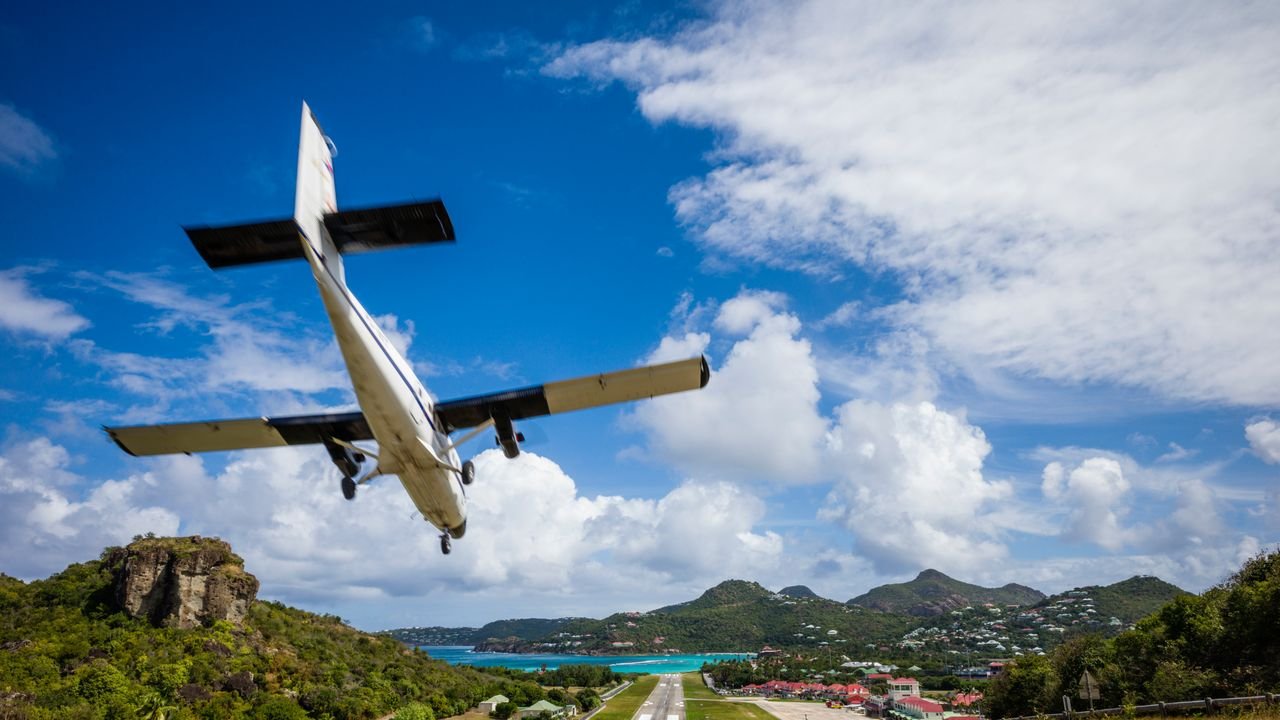
The shortest runways in the world make landing the journey’s most dramatic moment, where cliffs, gradients, tides and mountains compress aviation into a test of pure precision. A handful of airports operate on astonishingly short strips that push both aircraft performance and pilot skill to their limits, transforming routine arrivals into feats of concentration and nerve.
This numbers-driven guide looks at some of the shortest commercial runways on Earth, where geography dictates everything from aircraft choice to landing technique, and where touching down is anything but ordinary. Runway lengths, locations, and operational characteristics referenced in this article are drawn from analysis compiled by Bristol Groundschool, a pilot-training organisation that documents technically challenging airstrips used in real-world aviation training and operations.
This list focuses on commercial or regularly operated airstrips rather than private bush strips, using runway length as the primary ranking factor. To better reflect real-world flying conditions, the selection also considers operational challenges such as steep gradients, surrounding terrain, tidal dependence, and the absence of a safe go-around. Together, these criteria highlight not just the shortest runways on Earth, but the ones where geography most dramatically shapes the act of landing.
Operating from extremely short airstrips demands specialized pilot training, precise speed control, and deep understanding of aircraft performance limits. Many such locations restrict access to experienced pilots with specific endorsements. All runway measurements and descriptive details follow the Bristol Groundschool compilation of globally recognized short-runway airports.
A version of this article originally appeared in Condé Nast Traveller India.
1. Juancho E. Yrausquin Airport — Saba
At just 400 meters (1,312 feet), this cliff-edge strip is widely regarded as the shortest commercial runway in the world. Flanked by rocky drops and ocean, it can only accommodate small aircraft such as the BN-2 Islander, making precision landing essential. Known as the Caribbean’s “Unspoiled Queen,” this tiny island is a special municipality of the Netherlands, and a great place for an adventurous trip filled with hiking and diving, as Condé Nast Traveler contributor Betsy Andrews discovers while on honeymoon.
2. Tenzing–Hillary Airport — Lukla, Nepal
Lukla airport the most dangerous airport in the world.Getty
This airport is something of a gateway to Mount Everest, Lukla’s 527-meter (1,729 feet) runway combines a steep gradient, a mountain wall backdrop, and a valley drop-off that removes the possibility of a go-around, forcing pilots to commit fully to landing. Flying into Nepal is something more and more travelers are doing as parts of the region open up to tourism and exciting new hotels like the Shinta Mani Mustang cut their ribbons, offering luxe abodes where intrepid trekkers can rest in comfort.
3. Courchevel Altiport — France

Famous Courchevel ski resort airport by winterGetty