Land is one of those things that can disappear even as you see it. It falls away beneath you, becoming merely the ground under your feet, because you’re thinking about where you’re going, or a place slowly blurring out of focus from the airplane window. Land is a primal word, primordial even, like lava. And it is a loaded word if, say, you’re Indigenous or descend from a people whose land was taken from them. No one ever thinks about where land itself comes from, just where it begins and ends regarding property lines or borders.
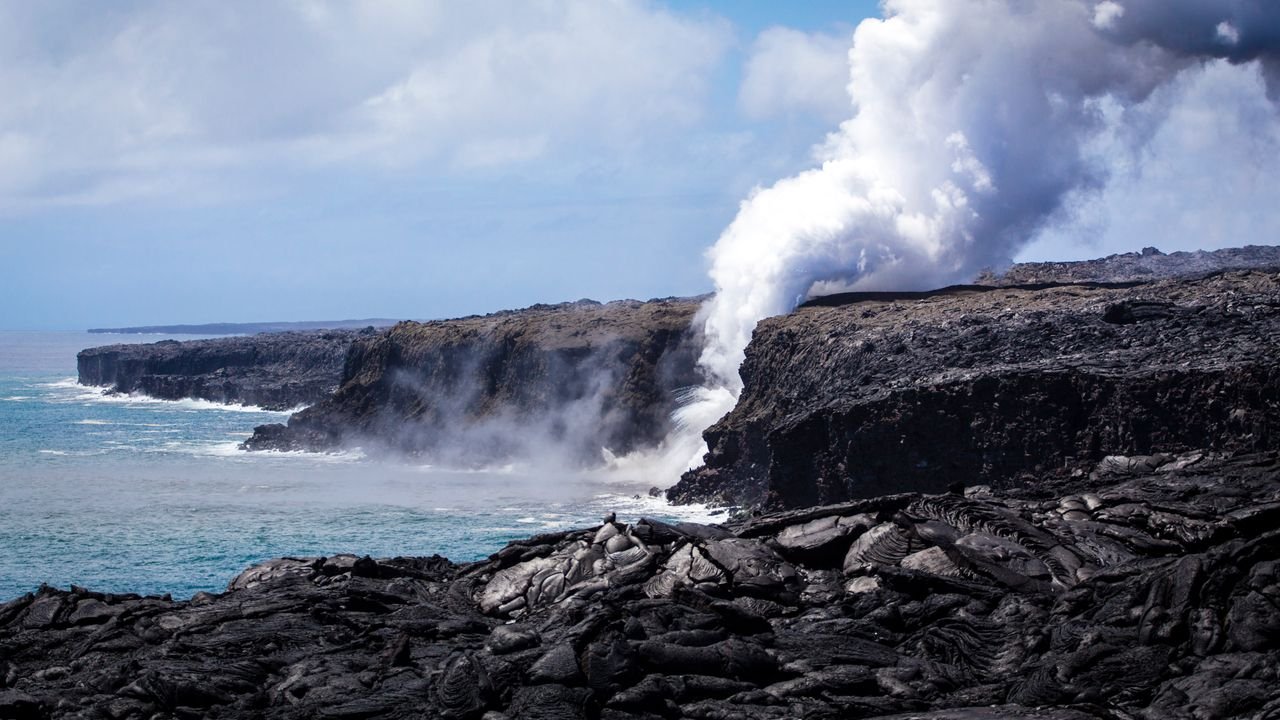
But 80 percent of land is made by volcanic activity—and the only place where you can see that new land being made is at a volcano. Kilauea, a volcano on the Big Island of Hawaii, is prolific in this sense. It grew 500 acres during its continuous eruption from 1983 to 2018, which was more of a steady leak until it finally turned dramatic in May of 2018, when the Puʻuʻōʻō vent collapsed. In a press conference that month, the first Native Hawaiian volcanologist James Kauahikaua said: “We are seeing the map change faster than we can draw it.”

My family ended up in Hawaii because of a skin problem our three-year-old started having shortly after he was born. For almost two years in Oakland, we forgot what it felt like to sleep through the night. We tried creams, steroids, elimination diets, but nothing helped. We’d previously spent time on Oahu, visiting some Native Hawaiian friends, where grandmothers and aunties told us that the ocean heals. Keep bringing him back to the water, they said, and so we did. My wife and I began splitting our time between Oakland, with our 14-year-old, Felix, and Maui, with our three-year-old, Solomon.
This has been the past year and a half for us. So as New Year’s Eve was approaching, my wife and I began talking about what we wanted to do when we were finally all together for the holiday. I’d been hearing news of Kilauea erupting into fountains of lava, and I’d always wanted to see lava in person. We were approaching the year of the fire horse, she said. Visiting an active volcano might be a good fit.
Kilauea isn’t just a volcano but the home of the goddess Pele. The story of Kilauea doesn’t start with a goddess though: It starts with a displacement. Pele is a woman, and she had to run from the sea—or rather, the sea goddess Namakaokaha‘i, who is also her sister. As Pele fled from Tahiti, through the chain of Polynesian islands, she searched with her ‘ō‘ō, her digging stick, for somewhere suitable to settle. She hit water in Ni‘ihau. She hit water in Kaua‘i. The ocean followed her, flooding the holes, extinguishing the heat. Finally, she found the Big Island. She climbed the slope of Kīlauea, away from the salt and the spray, and she dug. This time the fire didn’t go out. She sat in the Halemaʻumaʻu crater. She was home. Still, she is the fire that remembers everything the water tried to wash away.