We may earn a commission from links on this page.
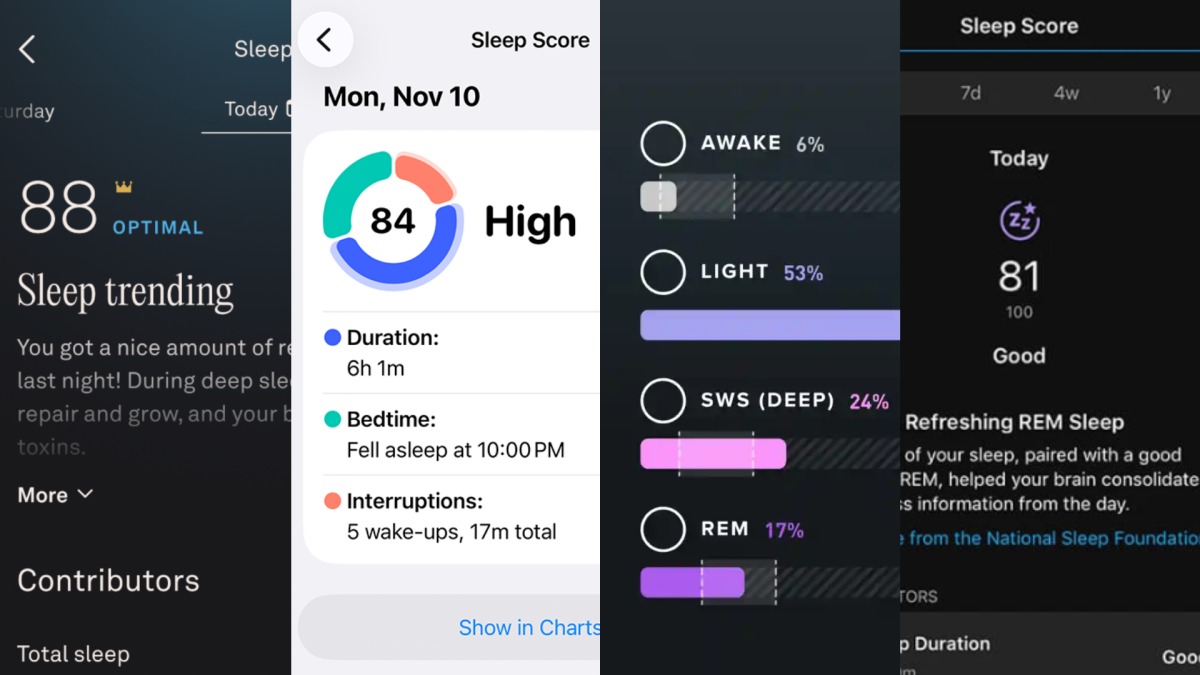
Credit: Screenshots courtesy of Oura, Apple, Whoop, and Garmin.
Sleep scores may be one of the most-checked metrics in wearable health tracking, but the companies behind them haven’t agreed on a shared language. A Garmin wearer with a 75 is in “Fair” territory. An Oura wearer with a 75 is doing “Good.” An Apple Watch user with a 75 might see “OK” or “High” depending on which software version they’re running. Where are these numbers coming from, and what are they actually telling you?
Each platform uses different scales, labels, and underlying signals to arrive at that single morning number. Here’s a breakdown of how the most popular wearables calculate your “sleep score,” and what that score means for you.

What your “sleep score” actually means
For all the scoring systems below, know that it’s impossible for a sleep score to be truly “accurate.” Your device tracks how long you seemed to be asleep, and makes guesses as to how much of that time was spent in light sleep, deep sleep, and REM sleep. Then, it distills it into a single composite score, which might have more to do with branding decisions than clinical science.
So while the data that is going into your score (like your heart rate) might be accurate, it’s important to understand that the score itself is a made up number. Sleep tracking, at its best, functions less like a medical test that you pass or fail, and more as a way to see patterns over time.
How an Oura Ring calculates your sleep score
Let’s start with Oura, since it’s widely considered the best sleep tracker out there. Oura’s Sleep Score ranges from 0 to 100, with three broad zones for scoring:
-
85–100: Optimal. An 85 or higher means all your metrics appear reasonably healthy. Oura even marks the day with a crown icon in the app.
-
70–84: Good. Your sleep was good, but not great. You’re adequately rested and prepared for most daily activities, but there’s still room to improve your overall sleep quality.
-
Under 70: Pay Attention. Scores below 70 indicate that you may benefit from prioritizing rest and recovery.
According to Oura, your Sleep Score is built from seven contributors: total sleep time, sleep efficiency (the percentage of time actually spent asleep), restfulness, REM sleep, deep sleep, sleep latency (how long it takes to fall asleep), and timing (whether your sleep aligns with your body’s natural circadian rhythm).
Oura has been shown to be the most accurate of all the wearables on this list, largely because it reads from your finger, which provides stronger optical signal than a wrist.
One important note: Scores of 100 are designed to be rare rather than regular. If you’re never cracking 85, that’s not unusual, either. Sleep naturally fluctuates, and there may be periods where your sleep is better or worse. Again, it’s more useful to be interested in your trends over time than any single night.
How a Whoop calculates your sleep score
Whoop gives you two numbers—a Sleep Performance percentage and a Recovery score—and it expects you to read them together.
Sleep Performance is expressed as a percentage from 0–100%, measuring how much of the sleep your body needed you actually got. It’s calculated using sleep sufficiency (the percentage of needed sleep you got), sleep consistency (how your bedtime compares to the previous four nights), sleep efficiency (the percentage of time in bed actually spent asleep), and sleep stress (time spent in physiologically high-stress states during the night).
Recovery is the broader daily readiness score, also expressed as a percentage, and this is the number most Whoop users check first. Recovery is color-coded into three zones: Green (67–100%) means you’re well recovered and primed to perform; Yellow (34–66%) means your body is maintaining and ready for moderate strain; Red (0–33%) signals that rest is likely what your body needs.
Whoop says it compares your metrics to your own baseline rather than to a fixed population standard, which means your 70% Recovery and a friend’s 70% Recovery may reflect totally different states.
Whoop also stands out for avoiding a single “sleep was good/bad” verdict. The sleep performance percentage tells you about quantity and consistency relative to your personal need, while the Recovery score tells you how your body responded. Most people consider Whoop and Oura to be neck-and-neck for the top sleep trackers.
How a Garmin calculates your sleep score
Now onto the smartwatches. Garmin offers perhaps the most traditional scoring system of the group. Each morning you receive a sleep score on a 0–100 scale, and based on that score, you’re assigned one of four rankings:
-
90–100: Excellent
-
80–89: Good
-
60–79: Fair
-
Below 60: Poor
For Garmin, the nightly sleep score is calculated based on a blend of how long you slept, how well you slept, and “evidence of recovery activity occurring in your autonomic nervous system derived from heart rate variability data.” What that last point should mean is Garmin tracks the change in time between heartbeats during sleep, and factors that in when scoring your overall sleep quality. In theory, this should account for something like your nervous system staying elevated all night, even if you were physically still.
Garmin also has a Body Battery reading, which shows how well your energy reserves recharged overnight. This it comes from a combination of your heart rate, heart rate variability (HRV), and movement data. When your sleep score is low, your Body Battery typically is too.
Garmin (along with the rest of the smartwatches below) is probably best considered as a smartwatch that happens to track sleep, as opposed to a dedicated sleep tracker, like Oura or Whoop.
What do you think so far?
How an Apple Watch calculates your sleep score
Apple’s Sleep Score is the newest entry on this list, arriving in September 2025. But even with this most recent update, Apple’s sleep scores are considered to be way too generous.
Your score is calculated based on sleep duration (worth 50 points), bedtime consistency (worth 30 points), and interruptions—how often you wake up and how long you stay awake (worth 20 points). The current five-tier scale, as updated in watchOS 26.2, looks like this:
Compared to the other trackers on this list, Apple’s score seems to focus on habits around sleep (enough hours, consistent timing, minimal waking) rather than trying to take a stab at sleep stages.
How a Fitbit calculates your sleep score
Fitbit was one of the first mainstream wearables to introduce an official sleep score, and its system remains pretty clean and consistent. Your overall sleep score is a sum of individual scores in sleep duration, sleep quality, and restoration, for a total score of up to 100. Fitbit says most people score between 72 and 83.
The four ranges:
-
90–100: Excellent
-
80–89: Good
-
60–79: Fair
-
Below 60: Poor
Fitbit defines Sleep Duration as total time asleep relative to your goals; Sleep Quality assesses how much time you spent in deep and REM stages; and Restoration (the most distinctive element) looks at your sleeping heart rate versus your daytime resting heart rate and how much time you spent tossing and turning. A higher restoration score comes when your sleeping heart rate dips meaningfully lower than your resting heart rate.
One catch: To see a detailed breakdown of your restoration score, you need a Fitbit Premium subscription. Basic users see the total score, but the granular component breakdown is paywalled.
What does a score of 75 mean on each platform?
Just for fun, let’s take a look at how these different companies interpret the same number. Here’s what a 75 might mean, depending on your wearable:
-
Oura: Good sleep, adequately rested.
-
Garmin: Fair, meaning some things could be better.
-
Apple Watch: Just above midpoint of the “OK” tier.
-
Fitbit: Near the top of “Fair,” below the “Good” threshold.
-
WHOOP: Not directly comparable, since it’s percentage-based).
The bottom line
No sleep score, across any of these platforms, is a clinical measurement. They are estimates derived from wrist (or finger) sensors, algorithms built on population data, and proprietary definitions that no company fully discloses. Two people who slept identically might score differently, and the same person might score a 90 one night and a 65 the next with no clear explanation.
Again, the more useful way to read these scores is as a trend signal over time, not a verdict on any single night. To get the most out of your sleep scores, I explain the best practices for sleep tracking here.