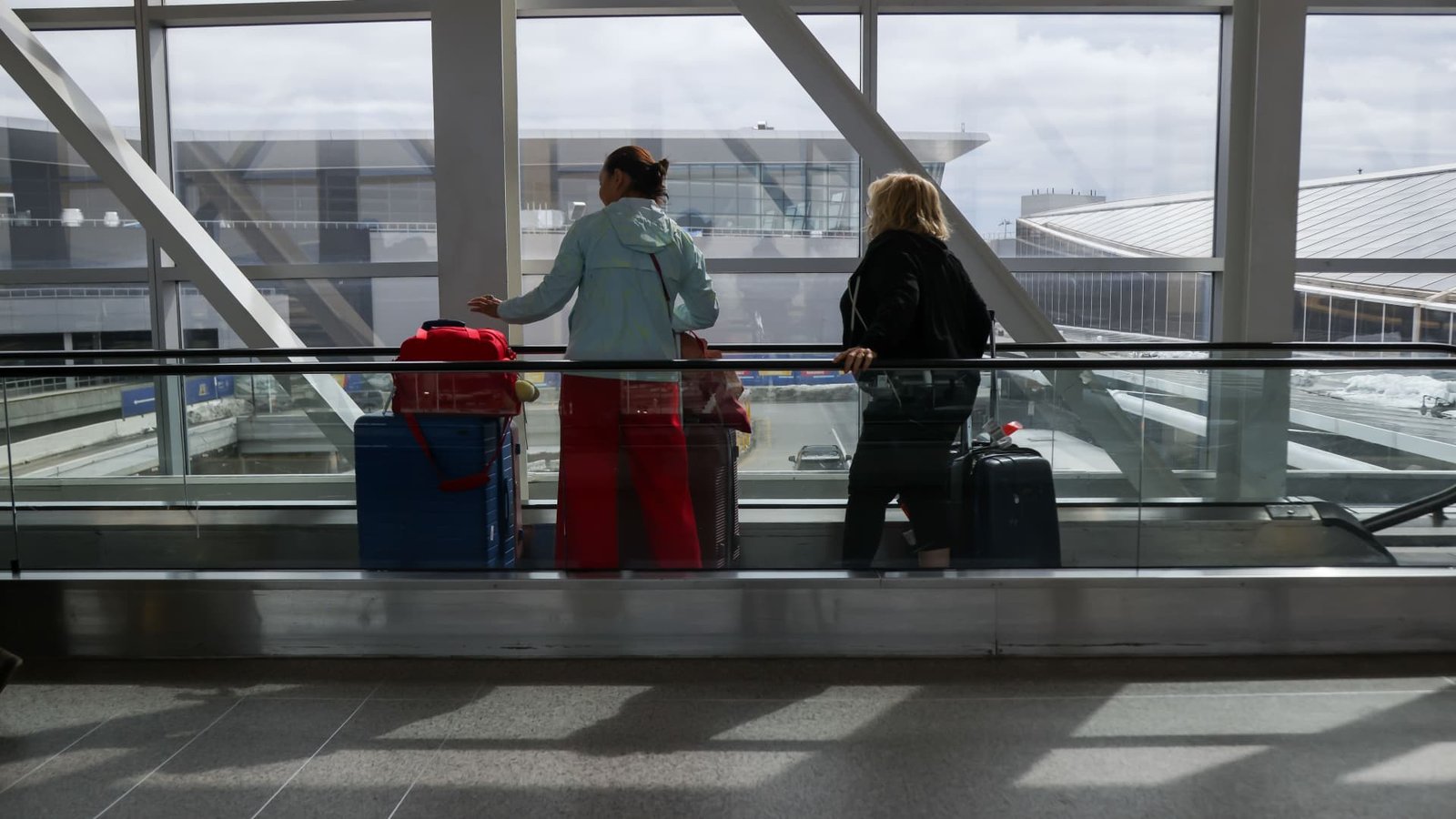
Travelers in Terminal 1 at John F. Kennedy International Airport (JFK) in New York, US, on Sunday, March 1, 2026.
Michael Nagle | Bloomberg | Getty Images
For budget conscious travelers, it’s gotten harder to escape the rising cost of airfare in recent weeks.
Airlines are raising bag fees, adding fuel surcharges and cutting flight schedules to manage the fallout from the Iran war.
Average economy fares rose to $998 for round-trip international flights as of March 30, up from $774 on Feb. 23, before the war started, according to data from Kayak, a travel search engine. Domestic fares increased to $350 from $336.
Airlines have raised prices for consumers largely to offset the higher cost of jet fuel, one of the largest costs for airlines, according to travel experts.
Before a two-week ceasefire announced late Tuesday, Iran had effectively choked off traffic through the Strait of Hormuz, a waterway used to ship about a fifth of the world’s oil supply.
Jet fuel prices have nearly doubled since the Iran war began, to $4.81 per gallon on Tuesday from $2.50 on Feb. 27, according to an Argus Media jet fuel price index.
If jet fuel prices stay elevated for a full year — at a level roughly $2 per gallon higher than before the war — airfares would have to increase about $50 for each one-way fare, or about 17%, Deutsche Bank analysts wrote in a report on Tuesday.
“The most notable response to the surge in jet fuel prices has been fare increases (and fuel surcharges in international markets),” they wrote.
U.S. carriers such as Delta Air Lines, JetBlue Airways, Southwest Airlines and United Airlines recently raised fees to check bags.
Some airlines have also said they will cut flights that have become temporarily unprofitable due to higher fuel prices. United CEO Scott Kirby said the airline would trim off-peak flight schedules, especially on Tuesdays and Wednesdays, during the second and third quarters this year.
While there will still be flights available on those days, a reduced schedule means there will likely be more demand for those fewer seats — and higher prices, experts said.
“That will have a big impact on the price-sensitive traveler,” since flying on Tuesdays, Wednesdays and other off-peak times is generally a dependable way to score cheaper tickets, said Katy Nastro, a travel expert at Going, a travel deal website.
Oil prices retreated on Wednesday after the ceasefire announcement, though analysts said it’s unlikely airfares and ancillary fees would normalize quickly, even if the ceasefire holds. Higher fees may be particularly sticky, especially if travel demand doesn’t fall, they said.
If that’s the case, don’t fret: There may still be ways for budget-conscious travelers to find a decent deal on flights, experts said.
“The playbook hasn’t gone fully out the window,” Nastro said. “Travelers still have some options.”
Lock in a good price
Travelers wait in line to go through security in Terminal 5 at John F. Kennedy International Airport on March 27, 2026 in New York, New York.
Michael M. Santiago | Getty Images
For domestic flights, the lowest prices tend to be 23 to 51 days before departure, according to Google Flights. Those for international flights are generally 49 days or more before departure, it said.
Airfares tend to rise steadily beyond those tipping points, as a flight nears.
However, airfare is often volatile — and that’s especially the case these days, Nastro said. Given this dynamic, it’s less likely that travelers will score last-minute deals, she said.
Travelers who see a price that fits their budgets would be wise to jump on it, Nastro said.
“The only predictable thing you can do is lock in that affordable flight today,” she said.
Consider single instead of round-trip tickets
“Many people think it’s cheaper to purchase airline tickets together as a round trip, but sometimes finding the cheapest flights comes from purchasing two single one-way tickets,” Lourdes Losada, director of the Americas at Skyscanner, a travel search engine, said in an e-mail.
For example, a round-trip flight from Los Angeles to Las Vegas might cost $50. But a one-way flight to Las Vegas and a one-way return flight to Los Angeles might each cost $20 — a savings of 20%, Losada said.
Flexibility can be a ‘superpower’
A man looks at a departure board displaying multiple canceled and delayed flights at Ronald Reagan Washington National Airport on March 16, 2026 in Arlington, Virginia.
Andrew Harnik | Getty Images
Flexibility is often a traveler’s best friend, experts said.
That flexibility generally means being strategic about when and where you fly, and it can take many forms, they said:
- Travel days and dates: Despite pared back flight schedules for some airlines, travelers will still likely see affordable prices for flights on Tuesdays and Wednesdays, Nastro said. Sundays tend to be among the most expensive, she said. Likewise, try to avoid peak times of the year to travel and look for opportunities to travel during shoulder or off-peak seasons. For those hoping to take a summer trip, generally avoid traveling in July and perhaps opt instead for early to mid-June or the very end of August, which tend to be less busy, Nastro said.
- Alternate destinations: Flexibility with travel destination is “key” to finding the best flight deals, Losada said. “It lets you capitalize on discounts and explore locations you may not have otherwise considered,” she said. For example, instead of Paris, travelers can try Lyon or Marseille for affordable French culture; or Eindhoven or Rotterdam in the Netherlands instead of Amsterdam; or Fukuoka or Sapporo in Japan instead of Tokyo, Losada said.
- Airline: Being flexible with an airline, instead of swearing allegiance to one, can help travelers find better airfares, Nastro said. “For a budget traveler, if you’re not tied to an airline, that will be your superpower,” she said.
Take advantage of search engines that allow you to compare prices on different days and to various destinations, experts said.
Consider a layover
Jackyenjoyphotography | Moment | Getty Images
Adding a layover instead of flying nonstop to a destination is a reliable way to save money, experts said. Doing so saves fliers about 22%, on average, according to Google Flights data.
Of course, travelers need to weigh the risks and opportunity costs of doing so.
This year has already seen significant travel disruption — and thousands of delayed and canceled flights — due to events including the Iran war, cartel violence in Mexico and the U.S. military operation in Venezuela.
If travelers have a layover, disruptions can throw an entire itinerary out of whack, experts said.
One type of economy fare may be better
Booking “main economy” — instead of the typically cheaper “basic economy” — can, perhaps counterintuitively, save you money in the long run, Nastro said.
It’s somewhat of a gamble, though.

If prices fall after a traveler buys their ticket, travelers with a main economy fare can take advantage of the ability to make changes to their ticket, Nastro said. In this case, travelers can get their ticket repriced at the lower fare, usually by the airline providing a credit for the difference, with the traveler able to use it within a year of issue, she said.
For example, if a $250 flight later drops by $50, the traveler can call and get it repriced to $200 — and can use that $50 for future flights, she said.
“So, you’re getting ‘cash’ back even if it’s only redeemable through the airline,” she wrote in an e-mail. “There is no limit how many times you can do this (aka you can still take advantage if that price drops again, but airlines don’t publicize this.”
You may find deals elsewhere
While many airlines are “hamstrung by fuel prices” and feel the need to raise prices, other key aspects of a travel itinerary like tours and hotels may offer deals to juice consumer demand, said Sally French, a travel expert at NerdWallet.
“We’re seeing more and more crazy deals that are targeted at U.S. travelers for U.S. travel,” French said. “I’m seeing the best deals this summer since Covid,” she said.
For example, in Las Vegas — which French said is notorious for “nickel and diming” travelers — she pointed to a recent offer by MGM Resorts International, which is charging $330 plus tax for a two-night all-inclusive stay on the Las Vegas Strip at either the Luxor Hotel & Casino or Excalibur Hotel & Casino. French said that deal might normally cost more than $900.
“I think that’s Vegas saying, ‘Yes, we need to get people in,'” French said.