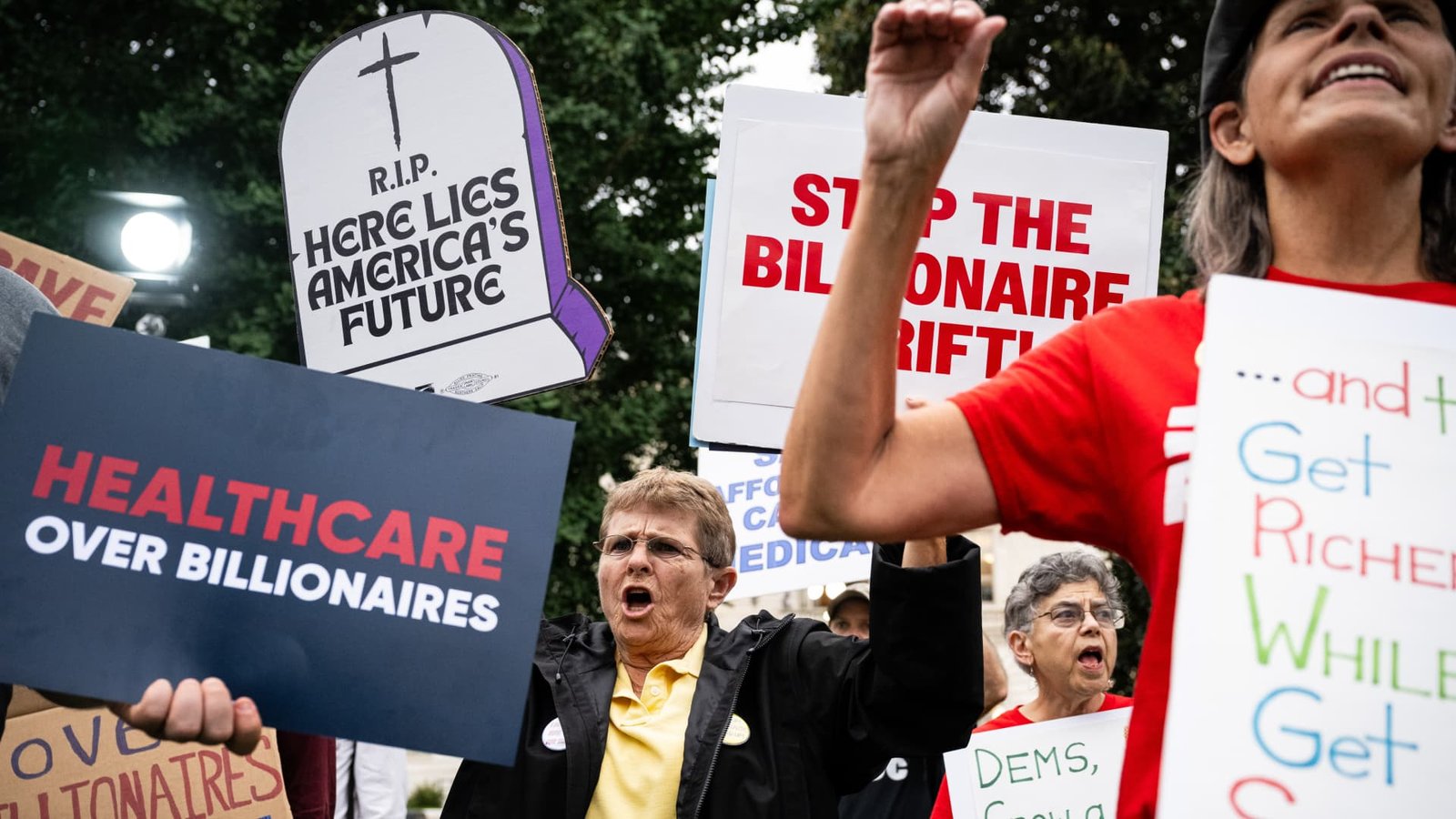
Demonstrators hold signs during a rally for healthcare funding outside the US Capitol in Washington, DC, on Sept. 30, 2025.
Photographer: Graeme Sloan/Bloomberg via Getty Images
Millions of people are likely to drop their health insurance now that enhanced premium subsidies for consumers who buy coverage on the Affordable Care Act marketplace have expired. That could increase costs for remaining enrollees, leading some experts to warn of a potential “death spiral” in the ACA market.
The lapse of enhanced premium tax credits at the end of 2025 led insurance premiums to more than double for the average subsidy recipient, to $1,904 per month in 2026 from $888 last year, according to estimates from KFF, a nonpartisan health policy research group.
Young, relatively healthy people are the most likely to drop their policy if they deem premiums to be too high and think coverage is not worth the cost, economists said.
That would leave an older, sicker population of enrollees, who are more likely to use their insurance and require costly care, economists said — which might prompt insurers to raise premiums further to offset the higher costs in a self-reinforcing cycle.
“If these [relatively young, healthy] individuals, whose health care costs are lower on average, exit the risk pool, the average cost of care will increase and thereby cause premiums to increase further,” Meredith Rosenthal, chair of the Department of Health Policy and Management at Harvard University’s T.H. Chan School of Public Health, said recently in a written interview with the university.
“The worry is that this process can spiral (known as a “death spiral”) and lead to further disenrollment and even higher premiums,” she said.
Millions of young people may drop ACA coverage
An Obamacare sign at a Miami insurance agency on Nov. 12, 2025.
Joe Raedle | Getty Images
About 22 million Americans received enhanced premium subsidies in 2025.
The Urban Institute and The Commonwealth Fund estimate that 7.3 million people will leave the ACA marketplace in 2026 due to the loss of enhanced premium subsidies. About 5 million of them would go uninsured, they wrote in a joint analysis, rather than find insurance elsewhere.
Young adults would see the largest increases in being uninsured, they said.
In fact, 19- to 34-year-olds account for nearly half — about 2.3 million — of the anticipated increase in the number of uninsured people, according to Jessica Banthin, a senior fellow at the Urban Institute and co-author of the analysis.
By comparison, about 500,000 of those who will be uninsured are 55 to 64 years old, Banthin said.
“It all comes down to who really feels like they need to have health insurance,” said Emma Wager, a senior Affordable Care Act policy analyst at KFF.
There’s evidence insurers raised premiums for 2026 due to a riskier population of insured consumers, experts said.
Insurers raised their gross premiums by an estimated 26% for 2026, on average, according to KFF. This is the total premium, including the consumer’s share and whatever is covered by premium tax credits.
Insurers indicated in filings to state regulators that 4 percentage points of that 26% is due to their expectations that healthier people would drop coverage if the enhanced premiums tax credit lapsed, Wager said.

The rest of the increase is due to other factors inflating the cost of health care, like new specialty drugs becoming available, the cost of labor and consolidation among medical providers, Wager said.
The public will get a clearer picture of how many people dropped their ACA marketplace coverage and the demographics of those individuals when data becomes available over the summer, Wager said.
Why death spiral concerns may be premature
Colorado residents fill out cards and share their stories for content to send to congressional representatives regarding health-care cuts on Nov. 1, 2025, the first day of ACA open enrollment, in Northglenn, Colorado.
Tom Cooper | Getty Images Entertainment | Getty Images
Some policy experts say that warnings of a death spiral in the ACA marketplace are premature.
For one, the disappearance of enhanced subsidies seems to be a one-time shock to the system, they said.
“I think the death spiral concern is understandable, but may be a slight exaggeration,” Michael Gusmano, a professor of health policy at Lehigh University, wrote in an e-mail. “What seems likely is that the loss of people from the overall pool will lead to increases in price — and this will further erode the willingness of people to sign up.”
Additionally, the way premium tax credits were designed should prevent a death spiral, policy experts said.
The tax credit structure caps households’ out-of-pocket expenses for insurance premiums as a percentage of household income. For example, the enhanced federal subsidies capped outlays at 8% of household income, while the lowest earners paid 0%.
While the enhanced subsidies have disappeared, the standard premium tax credits — which have been in place since 2014 — remain.
Now, out-of-pocket premiums are capped at roughly 10% of annual income for qualifying consumers. The cap declines on a sliding scale, down to about 2% for lower earners.
The more money you take away from the subsidies the greater the prospect of death spiral is.
Gerard Anderson
professor of health policy and management at the Johns Hopkins Bloomberg School of Public Health
These income caps would likely prevent a death spiral, economists said. If insurers raise premiums, those increases are borne largely by the federal government via tax credits, not consumers, they said.
“All those higher premium costs mostly get translated into higher government subsidies,” John Graves, a professor of health policy and medicine at Vanderbilt University, wrote in an e-mail.
Millions fewer people may enroll, but there would still be “stable risk pools” by virtue of the income caps, he wrote.
Consumers least likely to sign up
Patients are prepared for surgery on the opening day of UCI Health – Irvine in Irvine, CA on Dec. 10, 2025. Officials opened what is described as the country’s first all-electric acute care hospital.
Paul Bersebach/MediaNews Group/Orange County Register via Getty Images
Aside from young consumers, those least likely to sign up or re-enroll in ACA marketplace coverage are people who no longer qualify for any premium tax credits, experts said.
These are consumers who earn more than 400% of the federal poverty line, which equates to $62,600 for a one-person household.
Many of these households qualified for enhanced subsidies but are no longer eligible — meaning they must pay the full, unsubsidized insurance premium out of pocket.
The Urban Institute and The Commonwealth Fund estimate that the average annual premium for consumers over the subsidy cliff jumped to about $8,500 in 2026 from about $4,400 in 2025.
In 2025, about 3% of ACA enrollees — nearly 725,000 people — earned between 400% and 500% of the federal poverty line, for example, according to a Bipartisan Policy Center analysis of federal data.
How an ACA death spiral becomes more likely
Something that policy experts say would be more likely to trigger a death spiral: Converting the current subsidy structure into a fixed-dollar payment for consumers, an idea that Republican lawmakers and President Donald Trump have broached.
In that case, the premium increase would be borne entirely by individuals rather than by the federal government, Graves said.
“The more money you take away from the subsidies, the greater the prospect of death spiral is,” said Gerard Anderson, a professor of health policy and management at the Johns Hopkins Bloomberg School of Public Health.