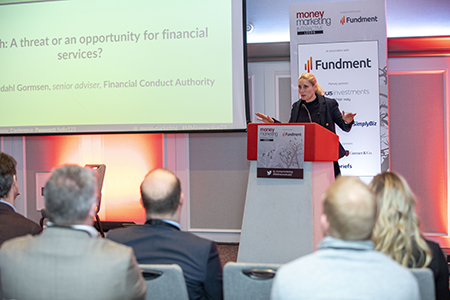
If you look up the definition of ‘formidable’, you may very well find a picture of Dr Liza Lovdahl Gormsen.
The senior adviser to the Financial Conduct Authority commanded the hall at Money Marketing Interactive Leeds on 11 May. It was ten past four in the afternoon but the audience listened with focused attention.
Gormsen gave her opinion of Big Tech in a tone best described as ‘frosty’. It emerged she is suing Meta, formerly Facebook, on her own initiative outside her role with the FCA.
The topic could not have been more timely with the seeming explosion of artificial intelligence (AI) chatbots.
Too much of the time I see platforms act in a way that is about self-preservation
Gormsen clarified some potential misconceptions advisers may have about the FCA’s line on Big Tech. She told the room the body was “not here to regulate big technology firms”.
Only regulated firms must follow the FCA’s rules, and Big Tech firms have very different business models. They have vast quantities of data that they use to take advantage of their competition.
Gormsen also spoke of the eruption of AI, saying the number of companies using it had more than doubled, from around 30% to 70% of firms.
Annuity comeback
Another hot topic at MMI Leeds was the annuity versus drawdown debate that has resurfaced in the context of higher interest rates. Billy Burrows, dubbed the ‘father of annuities’, gave an in-depth assessment of their near-term prospects.
The FCA is not here to regulate big technology firms
The Retirement Project founder admitted that annuities had been through bad times over the past few years, such as the Brexit vote in 2016 and the Covid pandemic in 2020. It also has not helped that certain national titles tend to write negative articles that put annuities in a bad light and say they are poor value for money, Burrows added.
Nonetheless, he made the case for them, saying: “With an annuity there is no investment risk and many clients like annuities because it gives them peace of mind and security. You can’t put a price on that.”
The emotional side
The human side of cashflow planning, despite its use of a lot of maths, was also a prominent theme at MMI Leeds.
Lyndhurst Financial Management financial planner Rory Albon said cashflow modelling was intended to help advisers rather than supersede them.
Every financial adviser should have cashflow planning, but it should not be the whole conversation
“I provide the emotional side of things and get [client] engagement on a one-to-one level.”
Albon argued Google cannot replace advisers on occasions such as when clients wish to know if it is a good time to invest in niche areas — for example, venture capital trusts. That is when a financial adviser becomes vital, he observed.
Dynamic Planner head actuary Steph Willcox, who joined Albon on the same panel, went into the detail of the kind of emotional support advisers give clients.
Willcox said advisers must reassure clients that they can handle investment losses amid high inflation, and help them build emotional resilience to cope in tough times.
Dynamic Planner even has an in-house psychologist to help its advisers build their clients’ emotional resilience.
No company can get things 100% right all the time because people can leave for a million and one reasons
Albon emphasised every financial adviser “should have cashflow planning, but it should not be the whole conversation”.
Golden apprenticeships
One way to increase the number of financial advisers in the UK is through apprenticeships, according to Financial Planning Apprenticeships Trailblazer chair Tom Hegarty.
Following the implementation of the Retail Distribution Review at the end of 2012, the number of advisers dropped sharply to just over 22,000, Hegarty said. This is worsened by the fact a lot of advisers are set to retire in the next 10 years.
Hegarty pointed out academies are usually attached to big financial institutions, which train graduates who ultimately work for their advice arm.
So apprenticeships can help the smaller advice firms because they “cost-effectively train and develop employees to become fully qualified to the desired level and learn the knowledge, skills and behaviour to become financial advisers,” Hegarty said.
When it comes to poor customer service levels, we tend to see the same names
He added: “Apprenticeships could make a significant difference to the number of advisers.”
There are over 600 professional apprenticeships available following the introduction of the Apprenticeship Levy in 2017. But a problem with adviser apprenticeships is they have a “reasonably high” drop-out rate, said Hegarty, and that can be costly for the sponsoring employer. They require a commitment from both the candidate and the backer.
Despite the challenges, apprenticeships are a good way to boost the profession, Hegarty maintained. He quoted Virgin Group founder Sir Richard Branson, who once said: “Train people well enough so they can leave, but treat them well enough so they don’t want to.”
Tough on platforms
One part of the profession that is deemed to be letting down advisers is platforms. A panel at MMI Leeds said IFAs needed to challenge platforms a lot more about poor service levels, and be careful who they partner with.
Fundment chief product officer Andrew Tiley, DD Hub director David Lee and Platforum research director Richard Bradley discussed the problems in the platform sector.
Tiley said: “Too much of the time I see platforms act in a way that is about self-preservation. They make it difficult for customers to move. For example, they make fees so cheap it makes it hard for the customer to justify leaving.”
Apprenticeships could make a significant difference to the number of advisers
Bradley was more sympathetic towards platforms because the list of “basic services” advisers expect from them is a long one.
“These range from tax wrappers to decumulation and model portfolio services. When it comes to poor customer service levels, we tend to see the same names.”
Company culture
Verve Group chief engagement officer Natalie Bell gave a presentation about company culture. She explained why culture, alongside values, is so important, and how Covid changed things.
Prior to the pandemic, the culture at The Verve Group was built on physical presence, said Bell, but now, after speaking to its staff, the firm has realised they want flexibility. It says it is “fine with a hybrid working system” and it wants “to be direct with what people really value”.
Many clients like annuities because it gives them peace of mind and security. You can’t put a price on that
So the company has gone “huge on its wellbeing programme” and does “a lot of employee surveys”.
The past few years have not been plain sailing at The Verve Group, however. Bell also spoke about staff resignations and said no company can get things 100% right all the time because “people can leave for a million and one reasons”.
This article featured in the June 2023 edition of MM.
If you would like to subscribe to the monthly magazine, please click here.
The post MMI Leeds: Prepare for an AI revolution appeared first on Money Marketing.