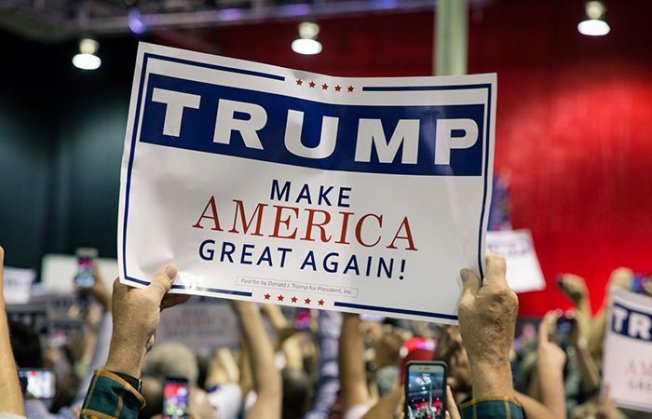
Markets experienced extreme levels of panic after Donald Trump shocked the world with his 2 April ‘Liberation Day’ speech. Plunging stock prices and signs of instability in the US Treasury market have since triggered a series of backsteps by the White House and a powerful rebound taking the S&P 500 back into positive territory for the year.
However, tariff levels remain historically high, and investors will be watching growth and inflation data closely to assess lasting damage. Given expensive US market valuations and ‘stagflationary’ impulses, a bear market could still be on the cards.
Before the announcement, US equities were already weakening, with the first 100 days of Trump’s presidency the worst since Nixon’s second term in 1973. Our proprietary measure of investor sentiment fell to four standard deviations below normal in the ensuing panic – a reading comparable to the Covid-19 onset in 2020 and worse than the start of the global financial crisis in 2007.
It’s quite something when one man’s zero-sum view of global trade can result in an effect similar to a once-in-a-century pandemic or a once-in-a-century financial crisis. But panics can be great buying opportunities and, true to form, markets have snapped back. Where does this leave us now?
It’s worth remembering that Trump’s trade deals, in contrast with recent UK-EU moves, are intended to worsen trade, not improve it
Positivity could continue. Large US policy shocks may be less of a feature as the US mid-term elections approach. Equity markets could rally further if the tariff and deportation agenda is deemphasised in favour of tax cuts and deregulation. All the while, the AI revolution continues apace, boosting corporate earnings.
However, for us, it feels too much like the victory of hope over experience to assume policy shocks are behind us. The tariff landscape remains fraught and the threat of escalation is real. US treasury secretary Scott Bessent recently suggested the higher tariff levels initially announced could still apply for those who “do not negotiate in good faith”.
Also, it’s worth remembering that Trump’s trade deals, in contrast with recent UK-EU moves, are intended to worsen trade, not improve it. At the currently proposed levels, US tariffs are still significantly higher than anything we have seen in nearly a century (Chart 1).
The Investment Clock model that guides our asset allocation is in ‘Stagflation’ (Chart 2), reflecting a weakening global growth backdrop with inflation pressure. This is usually a bad backdrop for stocks but the data going into this model has not yet factored in where tariffs ultimately end up, nor their eventual impact.
Trump and Truss: A tale of two economic disasters
If we see a global recession, growth will weaken and inflation will most likely fall as commodity prices slide. This would move us into the ‘Reflation’ phase where central banks tend to cut interest rates and government bonds outperform stocks.
A ‘muddle through’ scenario could be bad for stocks in a different way. If US growth picks up again, tariffs could see a sharp rise in inflation move us back into ‘Overheat’, putting US rate hikes on the table. We’d expect serious friction with the Federal Reserve should this scenario play out.
In short, it depends on what happens next. Deep uncertainty argues for broad diversification, including inflation hedges like industrial commodities, geopolitical hedges such as gold, and recession hedges like government bonds, alongside a core holding in stocks. Faster moving events and a more pronounced business cycle also call for active management.
While the recent recovery in stocks is welcome, it is not a signal to become complacent. Powerful cross currents are at play. The AI boom could power further strong returns for investors, but the global economy is grappling with the aftershocks of a trade regime in flux.
For now, the message is one of watching and waiting – hopeful, but with eyes wide open.
Trevor Greetham is head of multi asset at Royal London Asset Management