On Monday, TRON announced a significant expansion of its AI Fund, increasing its allocation from $100 million to $1 billion, signaling a major strategic shift toward the emerging agentic economy. This move reflects a growing conviction that the convergence of artificial intelligence and blockchain technology will require a new generation of financial infrastructure built specifically for autonomous systems.
The expanded fund will focus on investments and acquisitions of early-stage companies developing core components of this ecosystem. TRON is prioritizing areas considered foundational to machine-driven economic activity, including agent identity systems, stablecoin-based payment rails, tokenized real-world assets, and developer tooling for autonomous financial systems.
The underlying thesis is clear: as AI agents become increasingly capable of participating in economic processes, they will require programmable, permissionless infrastructure to transact, manage assets, and verify identity without reliance on traditional intermediaries. Blockchain networks, particularly those with established liquidity and scalability, are positioned to support this transition.
By scaling its capital commitment tenfold, TRON is not only reinforcing its early positioning in this narrative but also aiming to play a central role in shaping the infrastructure layer of a rapidly evolving digital economy.
TRON Doubles Down on AI–Blockchain Convergence Thesis
The announcement further emphasizes that this expansion builds on a thesis first outlined in 2023: the convergence of AI and blockchain will create structural demand for programmable, permissionless financial infrastructure. What began as an early conviction has now evolved into a strategic commitment, with TRON positioning itself for a future where AI agents actively participate in the global economy.
This vision is anchored in three core theses. First, stablecoins are the most viable form of money for agent-to-agent commerce. While AI systems cannot access traditional banking rails, they can operate digital wallets, making stablecoins the default settlement layer. Second, stablecoins also serve as the primary payment infrastructure for individuals and small teams, particularly as AI enables lean, high-efficiency operations without reliance on intermediaries.
Third, tokenized equity is positioned as the ownership layer of the agentic economy. As AI agents manage and transact value, they require programmable, divisible, and continuously transferable ownership structures—capabilities inherent to tokenized assets.
TRON’s positioning is reinforced by scale. With over 370 million user accounts, more than $21 billion in daily transaction volume, and over $85 billion in circulating USDT, the network already operates one of the largest stablecoin liquidity layers. This existing infrastructure provides a foundation for agent-driven financial systems to scale efficiently.
TRON Tests Key Resistance as Price Recovers Within Range
TRX is currently trading around the $0.30–$0.31 range, showing signs of recovery after a prolonged corrective phase that followed its late-2025 highs near $0.36. The chart reflects a transition from a clear downtrend into a more range-bound structure, with price gradually stabilizing after forming a base near the $0.27–$0.28 zone.
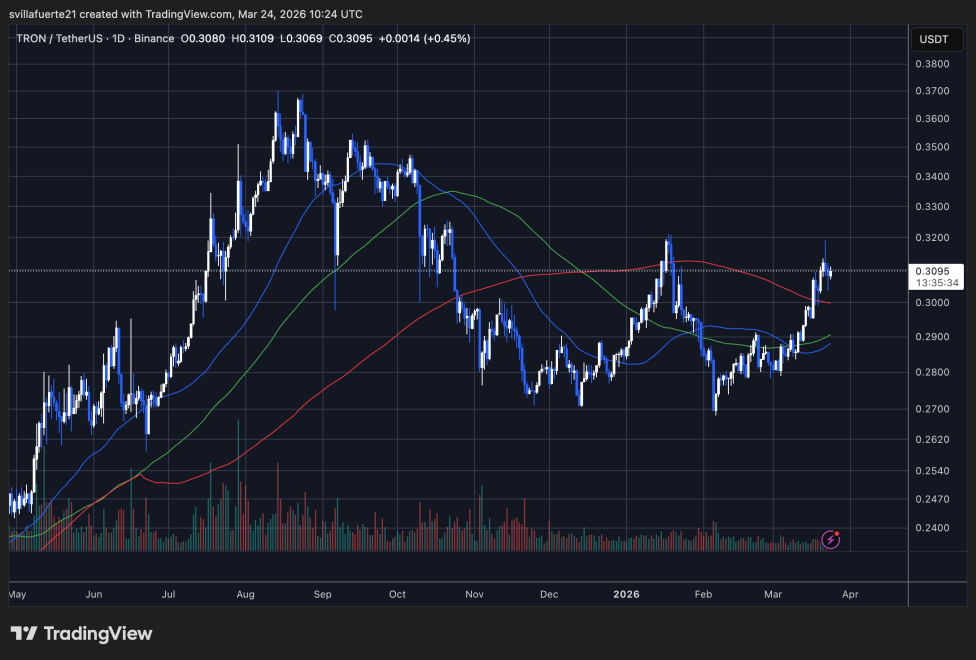
From a technical perspective, TRX is now testing a critical area. Price has moved back above the short-term moving averages (50-day and 100-day), which are beginning to flatten, indicating a potential shift in short-term momentum. However, the 200-day moving average remains overhead, acting as dynamic resistance and capping further upside.
The recent upward move appears constructive but not yet decisive. Price has approached the $0.31 region multiple times, suggesting that this level is functioning as immediate resistance, while the $0.28–$0.29 zone now acts as short-term support.
Volume trends show moderate participation during the recovery phase, lacking the strong expansion typically associated with breakout conditions. This suggests that the current move may still be in the early stages of accumulation rather than a confirmed trend reversal.
A sustained break above $0.31–$0.32 would be required to confirm bullish continuation, while failure to hold above $0.29 could reintroduce downside pressure.
Featured image from ChatGPT, chart from TradingView.com

Editorial Process for bitcoinist is centered on delivering thoroughly researched, accurate, and unbiased content. We uphold strict sourcing standards, and each page undergoes diligent review by our team of top technology experts and seasoned editors. This process ensures the integrity, relevance, and value of our content for our readers.