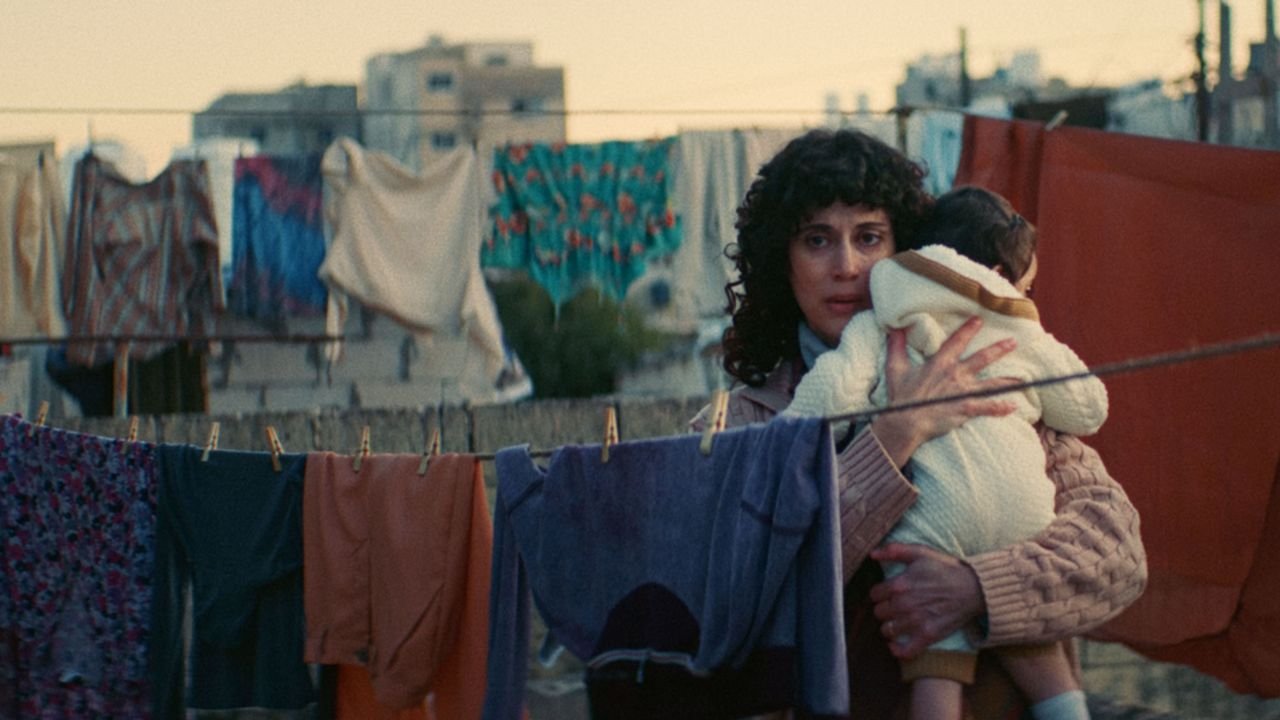
Palestinian-American filmmaker Cherien Dabis has spent the past year on the road promoting All That’s Left of You, her sweeping, Oscar-shortlisted family epic about Palestinian displacement. From screenings in Malaysia to the Czech Republic to Iceland (where Björk made a surprise audience appearance), it’s been an exhausting circuit that has also become unexpectedly intimate. “I’ve had people all over the world come to me afterwards and just cry in my arms,” she says.
For Dabis, who was raised in Ohio, movement and restriction have always been intertwined. At just eight years old, she and her family were held by Israeli soldiers for 12 hours at a border crossing while traveling to the West Bank from Jordan. The experience made her understand that Palestinians have always been forced to travel differently, their lives constrained by siege, checkpoints, border crossings, permits, and visa restrictions. Growing up in the States, Dabis says she felt like an outsider, with the question of home eventually becoming less about place than feeling: her mom’s voice on the phone, her husband, the feeling of flying 30,000 feet in the air, elements of New York City, where she’s currently based.
It’s these themes that have shaped her career as a filmmaker, and All That’s Left of You is her deepest exploration of intergenerational trauma—and yet another exercise in adaptability. Originally set to shoot in Palestine in late 2023, Dabis and her crew had to relocate after October 7. They rebuilt sets across Cyprus, Greece, and Jordan, filming in a refugee camp within sight of the West Bank. The relocation became a “spiritual test,” forcing Dabis to transform every obstacle into an opportunity, and to “find Palestine everywhere but Palestine.”
Celebrating her award-winning film amid the devastation in Gaza has been complicated, she says. But what steadies her is the thought that grief and joy can coexist, and that “being joyful is a form of resistance.” She’s determined to push past closed doors in an industry reluctant to promote Palestinian narratives, and to keep exploring separations by borders—a future project is a love story about an immigrant couple in the US torn apart during Trump’s first Muslim ban. As for her memories of Palestine? “The breeze,” she says. “Sticking my head out the window and feeling the warm air in the summertime. And the smell of the land, there’s just something so visceral about it.”
In the below interview, Dabis, who has also worked on television shows like Ramy and Only Murders in the Building, reflects on exile, the meaning of home, and the challenges of making the film, which is currently showing in select US theaters.
You’ve spoken about a traumatic border-crossing experience when you were eight years old that shaped your understanding of travel and identity. How do you look back on that moment?
That was a moment where I understood viscerally what it meant to be Palestinian. As an eight-year-old, I thought, “Oh, we are so misunderstood. People don’t like us.” That became a part of my identity, this need to show who we really are. Especially as a Palestinian-American who grew up in a media landscape that was dehumanizing, surrounded by news headlines that were not authentically portraying us, but rather showing dangerous stereotypes, and misrepresenting us. All of it contributed to me wanting to tell our authentic stories.
Your earlier films tended to explore diaspora. This film is fully in Arabic, and set in Palestine. Are you unlocking a new phase of your career here?
This film was exploring a different facet of who I am, the part of me that feels rooted in the Arab world and connected to the land, and who has absorbed that generational and collective trauma. My previous films were exploring the outer layer of who I am—the Palestinian-American who can’t fit in. I wanted comedy in those films, and to bring some levity and humor to them, which was necessary before making a dramatic film like this. All That’s Left of You was a deepening of my identity and the inheritance of trauma that came with that identity.