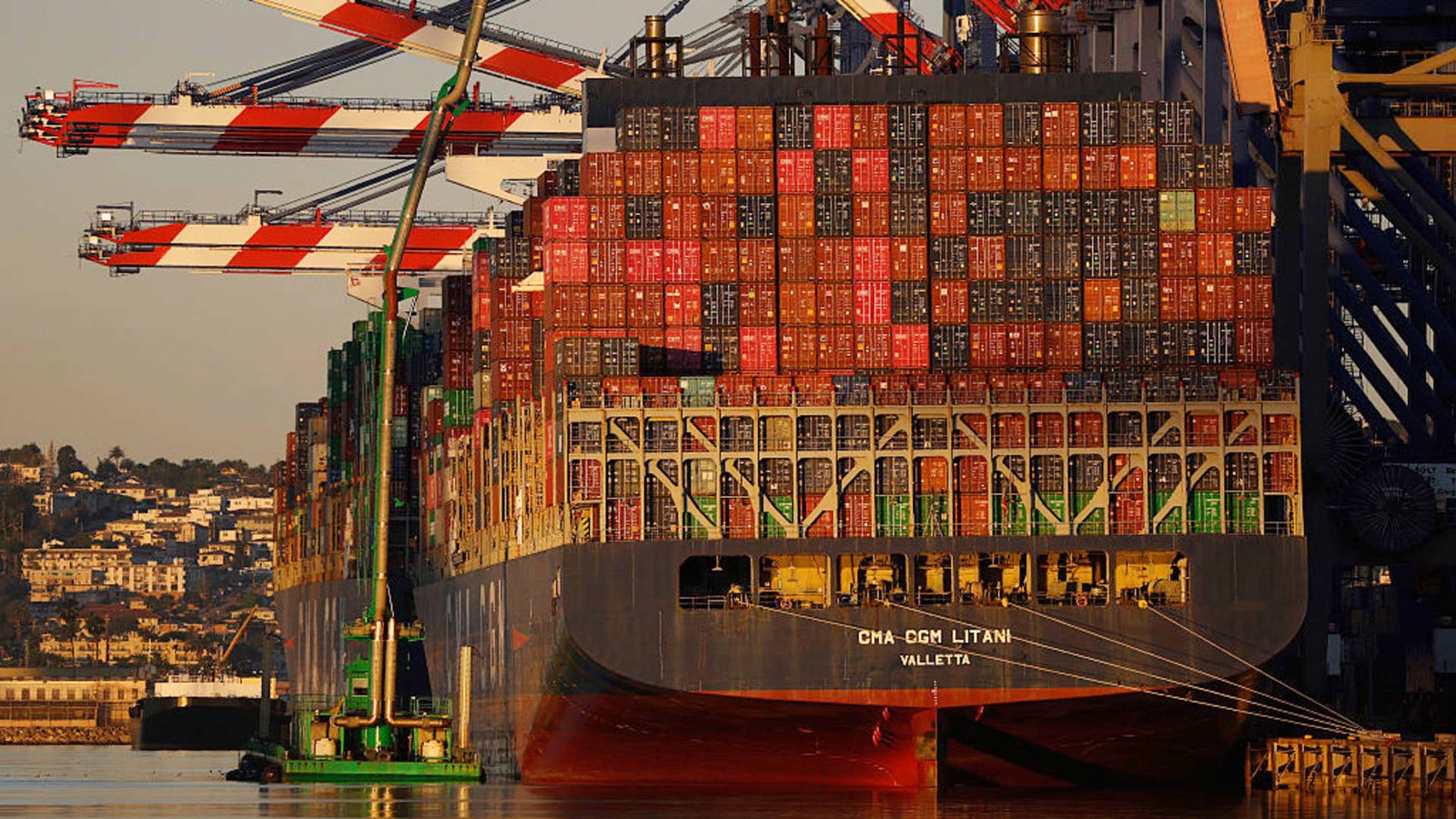
A container ship is seen docked at the Port of Los Angeles on March 13, 2026 in Los Angeles, California.
Justin Sullivan | Getty Images
Tariffs are expected to cost the average household several hundred dollars to perhaps more than $1,000 this year, according to various economic analyses.
But each household may wind up paying more or less based on a variety of factors, including family size, geography and typical purchases, economists said.
Low earners are also likely to feel the impact more than wealthier ones, they said.
The cost of tariffs for households
Tariffs are a tax on imports. They’re generally paid by the U.S. entity importing the foreign goods.
The Federal Reserve Bank of New York found in a recent paper that U.S. firms and consumers bore “the bulk” — roughly 90% — of the economic burden of tariffs imposed in 2025.
The extent to which businesses pass through some or all of those import taxes to consumers via higher prices fluctuates by company, economists said.
Under the current tariff regime, the average household will pay an extra $570 in 2026 due to tariffs, according to a March 9 analysis by the Yale University Budget Lab, a nonpartisan policy research center.
Quickly thereafter, the Trump administration put a temporary 10% universal tariff on imports from all countries, with some exceptions. President Donald Trump announced that these tariffs would increase to 15% but that change isn’t yet official.
There are also levies on steel, aluminum, automobiles, copper, trucks, buses, wood products and semiconductors, among other things.
Ultimately, there’s “lots of variation” in the ultimate financial burden of tariffs on households, said John Ricco, associate director of policy analysis at the Yale Budget Lab.
Family size and geography
The biggest driver is household or family size, Ricco said.
The average U.S. household has about three people in it, Ricco said.
However, households with more people would likely buy more than a family with fewer people — and would therefore generally be exposed to higher tariff costs relative to smaller families, he said.
Where consumers live also matters, Ricco said. For example, a 1% price increase in California is a much higher dollar figure than in Kansas due to the relative costs of living in those states, he said.
What you consume
A employee on the Peugeot vehicle assembly line at the Stellantis NV auto plant in Sochaux, France, on Thursday, Oct. 3, 2024.
Bloomberg | Bloomberg | Getty Images
“Depending on the kinds of goods you consume, you could see higher or lower cost burdens,” Ricco said.
For example, tariffs tend to affect physical goods more than services, such as travel, entertainment and dining out, economists said.
Of course, that’s not to say services aren’t affected at all. Tariffs on agricultural products can filter through to a restaurant’s bottom line, leading them to raise menu prices, for example. But goods take more of a direct hit, economists said.
Therefore, households whose consumption leans more heavily toward goods and less toward services are more exposed to the financial impact of tariffs, economists said.
It also depends largely on the categories of goods that households buy.
For example, families buying electronic equipment such as computers — which contain a lot of specialized metals that are exposed to tariffs right now — or clothing or automobiles are relatively more exposed to higher costs than other households that aren’t buying these products, Ricco said.
Impact depends on income
A cargo ship sits in New York Harbor on Nov. 19, 2025 in New York City.
Spencer Plat | Getty Images
Wealthier households tend to buy more than lower-earning households.
So, in dollar terms, higher earners are more exposed to tariffs: The average annual costs to households in the bottom 10% and top 10% by income are about $315 and $1,325, respectively, according to the Yale Budget Lab.
However, the narrative changes when costs are assessed as a share of overall household income.
That $315 represents a 0.8% reduction in after-tax income for the bottom 10% of households, according to the Yale Budget Lab. However, the $1,325 represents a loss of just 0.3% in after-tax income for the top 10% — less than half the burden of the lowest-income households.

This is why economists call tariffs a “regressive” tax: Because they place a larger relative cost burden on lower earners.
Lower-income households generally spend a greater fraction of their income than higher-income households, economists said. Higher earners devote a lower share of their income to necessities and have more disposable income to save and invest, in addition to buying things, they said.
Further, low earners tend to buy more goods and fewer services relative to high earners, economists said.
“Richer and poorer households buy different goods, different quality of goods, buy from different stores,” Mary Lovely, a senior fellow at the Peterson Institute for International Economics, a nonpartisan economic policy think tank, said in an e-mail. “Most importantly, poorer households spend a much larger share of their income and, thus, pay a larger share of their income in import taxes.”