
South Korea’s tax authority has begun preparations to implement its 20-22% tax on crypto income starting next year, fast-tracking the development of a tax base and tracking system to end years of delays for the Income Tax Act.
NTS Begins 2027 Crypto Tax Rollout Prep
On Wednesday, South Korea’s National Tax Service (NTS) announced it has begun “full-scale preparations” to implement the long-delayed Income Tax Act in January of next year, according to local reports.
In an NTS briefing, Park Jeong-yeol, Director of the Individual Taxation Bureau at the National Tax Service, affirmed that the agency plans to secure data from exchanges and establish a taxation system to ensure smooth execution of the comprehensive income tax filing scheduled for May 2028.
Since a law has been enacted to tax virtual asset income generated starting next year, we are preparing to accept filings starting with the 2028 (May) comprehensive income tax filing.
Under the Income Tax Act, crypto assets will be subject to a 20% income tax rate, up to 22% including local taxes, starting January 1, 2027, for profits exceeding 2.5 million won annually.
The tax authority reportedly intends to establish a tax base by formally receiving pertinent data from virtual asset exchanges, including Upbit, Bithumb, Coinone, Korbit, and Gopax. It also aims to establish a guidance framework specifically for taxpayers subject to virtual asset income tax and outline criteria for capital gains calculations.
In addition, the NTS is accelerating the development of its tax infrastructure. Last month, the agency announced it would develop an AI-driven system, the “Comprehensive System for Virtual Asset Transaction Analysis,” to track crypto investment gains.
As reported by Bitcoinist, the agency aims to launch the project’s pilot in November and a full-scale launch by the end of the year. It also plans to complete the system within the year by developing information exchange functions based on the Crypto-Asset Automatic Information Exchange System (CARF).
Lawmakers Push To Abolish Crypto Taxation
An official from the NTS said that they “plan to compile data from exchanges by January 2028 (tentative), review various cases to finalize the tax collection system, and complete preparations so that comprehensive income tax returns can be filed in May of the same year.”
Nonetheless, political uncertainties have made it unclear whether the tax will be implemented. Notably, the framework was initially expected to be implemented in 2022 but has been postponed three times.
Now, the People Power Party (PPP) has pushed to abolish the tax. PPP’s floor leader, Song Eun-seok, proposed a bill last month to amend the long-delayed Income Tax Act, seeking to remove all provisions governing the taxation of crypto assets in the legislation.
The lawmaker argued that imposing a separate income tax on crypto assets raises concerns regarding the fairness and consistency of the tax system, noting that the financial investment income tax was abolished to promote capital market development while protecting investors.
The Democratic Party of Korea (DPK) acknowledged PPP’s concerns about tax equity and the consistency of the Korean tax system. DPK’s Senior Deputy Floor Leader for Policy, Kim Han-kyu, affirmed that the ruling party would review the amendment now that it has been introduced.
However, he noted that the two parties previously clashed over delaying the Income Tax Acts, which may signal the proposed amendment could receive limited support from the DPK.
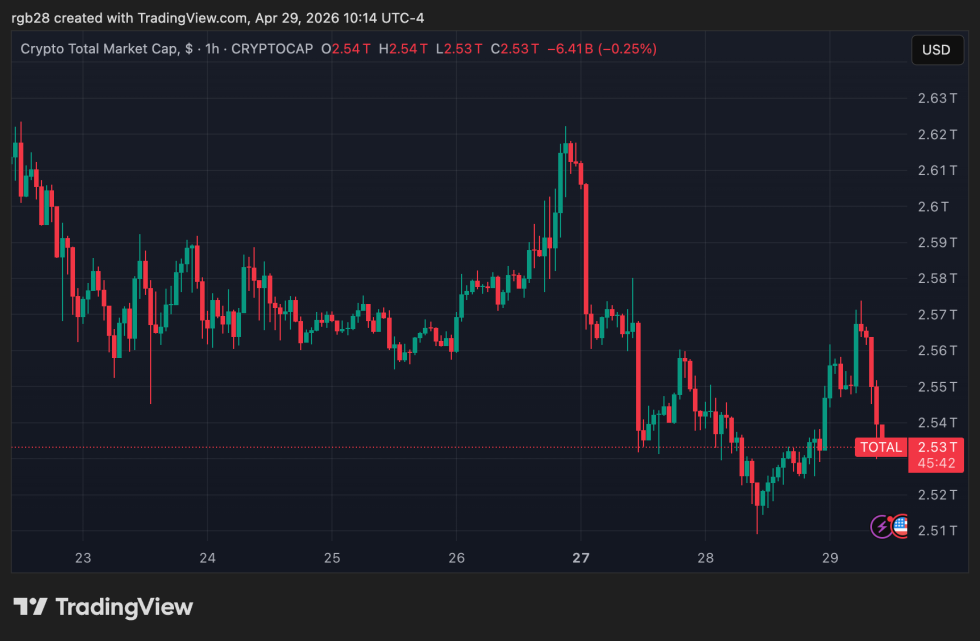
The total crypto market is at $2.53 trillion on the one-week chart. Source: TOTAL on TradingView
Featured Image from Unsplash.com, Chart from TradingView.com

Editorial Process for bitcoinist is centered on delivering thoroughly researched, accurate, and unbiased content. We uphold strict sourcing standards, and each page undergoes diligent review by our team of top technology experts and seasoned editors. This process ensures the integrity, relevance, and value of our content for our readers.