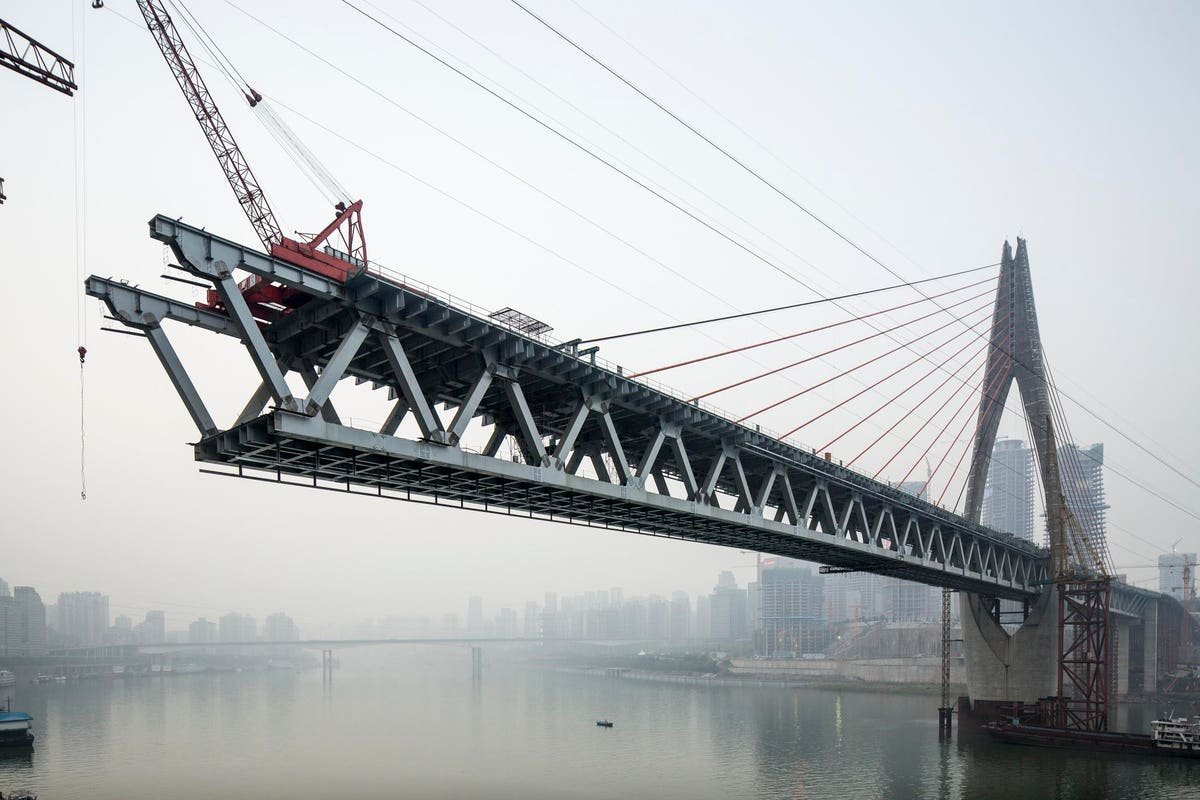
In Chongqing, the construction of massive new Dongshuimen Bridge above Yangtze River on hazy autumn … [+]
Over the last four decades, roughly, China’s meteoric GDP growth has been the envy of the world, setting unparalleled records and positioning the nation as an economic superpower. However, recent data reveals a significant slowdown, challenging the narrative of an unending upward trajectory. This downturn not only underscores the vulnerabilities within China’s economic model but also brings to light the unsustainable pace of its past growth.
As global analysts and investors grapple with these new findings, many are left pondering the implications for the future of the world’s second-largest economy and its potential ripple effects on the international stage.
China GDP Growth Per Year Plunges to Pandemic Levels
Examining the latest data, sourced from The World Bank, reveals that China’s biggest economic slowdown in recent history occurred during the period 2019-2020, when China GDP growth had fallen to just 2.24%, compared with 5.95% annual growth in 2018-2019 and 6.75% in 2017-2018. It then bounced back hard, rising to an annual growth rate of 8.45% from 2020 to 2021. But now, we can see that China’s GDP growth has dipped back down to pandemic levels, with its annual growth rate for 2021-2022 being only 2.99%.
To put these figures in perspective, the 2.99% GDP growth rate of 2021-2022 and the 2.24% growth rate of 2019-2020 are the smallest economic gains China has experienced since 1975-1976, when it experienced -1.57% annual growth. The lowest year-over-year GDP growth rate between 1975-1976 and 2019-2020 occurred in 1989-1990, when the Chinese economy saw its expansion slow to 3.92% growth annually. Otherwise, no period since 1976 has come close to the weak GDP growth of the past three years.
Looking back over the last two decades, for the period 2001-2002 to 2021-2022, annual GDP growth in China averaged approximately 8.44% a year. To put in perspective how huge that rate of growth is, the average annual GDP growth rate for the United States over the same 20-year period was roughly 2%. For years economists had talked about the “rise of China” and recent history proved them right.
The High Annual China GDP Growth Rates Since the 1970s Are Unsustainable
The problem is that these large annual GDP growth rates were a reflection of China’s economy finally kicking into gear after severe economic damage dealt by Mao’s leadership and unsound socio-economic campaigns. For example, Mao’s disastrous Great Leap Forward, from 1958 to 1962, brought China’s economy to its lowest of lows, at the cost of millions of lives. The World Bank’s annual percentage GDP growth rate data goes back to 1960-1961, and you can see in the numbers the destruction the Great Leap Forward wrought: Year-over-year, Chinese GDP fell by 27.27% from 1960 to 1961 — the worst annual growth rate since the data has been tracked; the bleeding was stemmed a bit, as China’s GDP growth rate was -5.58% for the period 1961-1962 versus -27.27% for 1960-1961.
Years later, Mao launched his “Great Proletarian Cultural Revolution” in 1966, which only truly ended with his death and the elimination of the “Gang of Four” in 1976. Indeed, the year-over-year period 1975 to 1976 saw China experience its first period of negative GDP growth (-1.57%) since the early years of the Cultural Revolution, when it was -5.77% from 1966 to 1967 and -4.1% from 1967 to 1968. Since 1976, the annual China GDP growth rate has never dipped into the negatives again.
With Deng at the helm, and under the slogan of “socialism with Chinese characters,” the Chinese economy made up for lost time under the Mao years. However, the very act of making up for lost time is a big part of the reason for China’s outsized year-on-year GDP growth rates: Deng and the Chinese economy were essentially starting from scratch, and from the bottom. There was nowhere to go but up and, thus, for decades now, the Chinese people and political leaders have accepted these massive year-over-year growth rates as the norm. Unfortunately, they are not the norm — they were abnormal products of a specific historical context.
The further that China advanced through the phases of the “Third Industrial Revolution” (i.e., digitalization, home computers, the internet and Web 1.0, followed by Web 2.0, social media, smartphones, and similar), the more it narrowed the historical gap between itself and the West. At the same time, however, this very progress — this narrowing of the gap — has seen increasingly diminishing returns.
In the 20 years from 2001-2002 to 2021-2022, China GDP growth peaked at an annual rate of 14.23% in 2006-2007; not coincidentally, the same time as the peak years of America’s unprecedented housing bubble. Though Chinese economic growth dropped down to the single-digits for most of the 2010s, it still stood in dramatically stark contrast to the economies of the U.S., the Eurozone, and other so-called “developed countries”, who were experiencing at best an unceremonious recovery or — especially in the case of the Eurozone debt crisis — continued stagnation or worse.
But before the pandemic reared its ugly head, China already could not sustain the growth rates of its past. From 2010 onward, annual China GDP growth stayed positive but lost steam with each passing year:
- 2010-2011 GDP growth: 9.55%
- 2011-2012 GDP growth: 7.86%
- 2012-2013 GDP growth: 7.77%
- 2013-2014 GDP growth: 7.43%
- 2014-2015 GDP growth: 7.04%
- 2015-2016 GDP growth: 6.85%
- 2016-2017 GDP growth: 6.95%
- 2017-2018 GDP growth: 6.75%
- 2018-2019 GDP growth: 5.95%
- 2019-2020 GDP growth: 2.24% — Covid pandemic begins
Recent Developments Affecting China GDP Growth
Although China has faced turbulent economic episodes in the past, such as the 2008-2009 global financial crisis and the 2015-2016 devaluation of the yuan that led to investor panic and massive outflows of capital, the mechanisms that the CCP used to counter those threats cannot simply be played back again. For example, energizing China’s real estate sector and heavy infrastructure expenditure had helped mollify worries about the country’s economic stability in those crises. But those measures also ultimately created the current property market bubble; they have maxed-out the use of infrastructure-led growth as a strategy; and, of course, saddled the nation with huge levels of debt.
Real estate was for years one of the biggest areas of growth in the Chinese economy and, according to the Financial Times, typically was responsible for more than a quarter of economic activity in China. But beginning with default of real estate developer China Evergrande in 2021, Chinese real estate has found itself trapped in the morass of a serious liquidity crisis. The latest victim of this crisis is Country Garden, a gigantic private property developer that posted an estimated $6.7 billion loss for the first half of 2023. Xi Jinping’s regime had begun clamping down on the levels of lending and borrowing since the early days of the pandemic. This credit crunch worked in conjunction with broader, structural problems, perhaps most famously embodied in “China’s Ghost Cities”: Row upon row of fully constructed yet completely empty residential and commercial buildings.
Another major area of concern is China’s weak levels of household consumption. Basically, Chinese households are not, and have not been, spending enough to significantly contribute to overall economic growth. China has the second-largest economy in the world and yet its level of household consumption as a percentage of GDP is far below that of the No. 1 largest economy — the U.S. — and below 8 out of the top 10 largest economies, as measured by GDP in constant 2015 U.S. dollars: