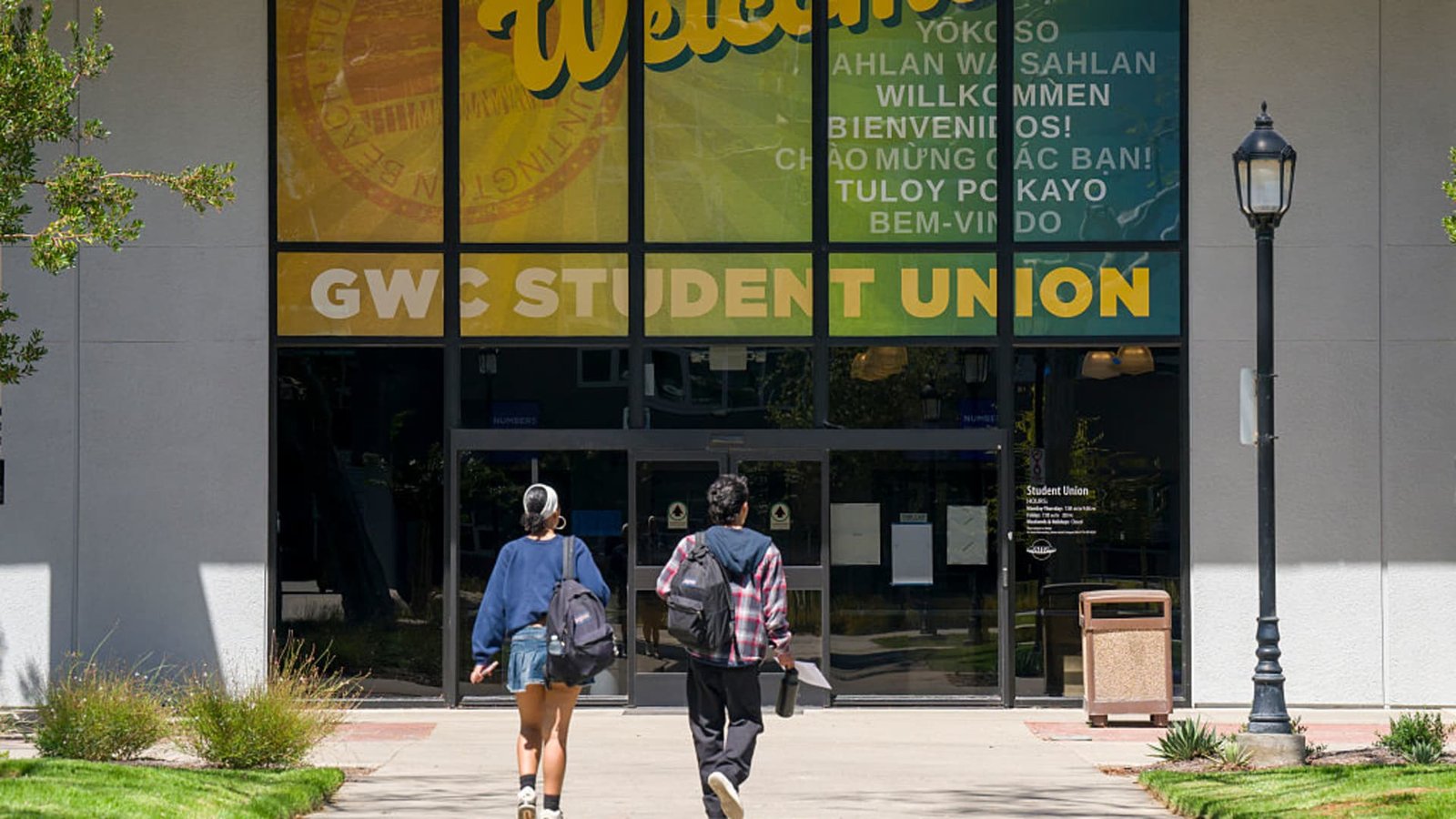
Golden West College students walk to the GWC Student Union in Huntington Beach on Wednesday, Sept. 3, 2025.
Leonard Ortiz | Orange County Register | MediaNews Group | Getty Images
More high school graduates are pursuing a two-year degree over a four-year college path, recent studies show.
Ballooning college costs and the student loan debt that accompanies a degree are partly to blame. New borrowing limits for 2026 under President Donald Trump‘s “big beautiful bill” are another factor. Plus, students are increasingly seeking job training and career-driven pathways to secure a foothold in today’s challenging labor market.
Students aged 18 to 20 represented the largest share of first-time associate degree earners in the 2024-25 academic year — accounting for nearly one-third, according to a new report from the National Student Clearinghouse Research Center. For the first time, this age group surpassed those aged 21 to 24, the report found.
Typically, community college students tend to be older than students at four-year colleges or universities, but over the last decade, the number of 18- to 20-year-olds who received an associate degree jumped nearly 50%, the report found.
About 2 million students earned a bachelor’s degree as their highest academic credential in 2024-25, while 865,400 earned an associate degree, up 2.8% and 2.6%, respectively, from the previous year, according to the NSCRC’s Undergraduate Degree Earners report.
Another 579,400 students earned an undergraduate certificate as their highest award, notching a 3.2% increase from the year before and a decade-high.
“More students are earning certificates and degrees earlier, and that shift reflects how postsecondary pathways are changing and starting sooner than they once did,” Matthew Holsapple, the National Student Clearinghouse Research Center’s senior director of research, said in a statement.
The trend is likely to continue. In the fall, community college enrollment rose 3% from the prior academic year, compared to a 1.4% increase at public four-year colleges, according to an earlier report also from the NSCRC. Enrollment in private four-year nonprofit institutions fell by 1.6% over the same period.
“The data shows students gravitating toward more practical, career-oriented pathways,” said Christopher Rim, president and CEO of college consulting firm Command Education. Certificate programs jumped 6.6% last year, and trade schools are seeing noticeable growth as well, he said.
“Students are increasingly pursuing continuing education that they believe directly correlates to employment outcomes,” Rim said.
The advantages of a two-year degree
Some of the benefits of community college are obvious.
Noticeably, the cost: At two-year public schools, tuition and fees averaged $4,150 for the 2025-2026 academic year, according to the College Board. Alternatively, at four-year public colleges, in-state tuition and fees averaged $11,950, and at four-year private schools, $45,000.
Under President Donald Trump‘s “big beautiful bill,” which Congress passed last year, students enrolling in workforce training programs at community colleges may also be eligible for Pell Grants, a type of aid awarded solely based on financial need. The grants are worth up to $7,395 for the 2025-26 academic year. Previously, these funds were only available to degree-seeking undergraduate students.
Further, shorter programs can be just as effective when it comes to employability in certain industries, according to Eric Greenberg, president of Greenberg Educational Group, a New York City-based consulting firm.
“It means less tuition and, in many cases, it means the same output,” Greenberg said.
“Are these degrees looked at as shortcuts? The answer is, not necessarily,” he said. “There’s a market out there for skillsets that don’t necessarily require a larger number of years.”
In some cases, community college is considered a stepping stone to a four-year school.
Starting at a community college and then transferring is often recommended as one way to get a bachelor’s degree for significantly less money.
However, research suggests this is not as successful a pathway as experts have hoped.
Nationwide, only about one-third of students who start at community colleges ultimately transfer to four-year schools, according to several long-term studies. Although the research also shows that students who complete an associate’s degree at a community college before transferring have higher success rates.