(Bloomberg) — European stocks declined as the prospect that central banks will keep interest rates high to fight inflation hurt sentiment.
Most Read from Bloomberg
Construction shares and utilities led the retreat in Europe’s Stoxx 600 Index. Modest gains for US contracts followed heavy losses on Wall Street Thursday as traders responded to the hawish tone from Federal Reserve this week. The S&P 500 dropped 1.6% in its worst day since March, while the tech-heavy Nasdaq 100 fell 1.8%.
The latest sign of resilience in the US labor market reinforced the case for the Fed’s stance of holding interest rates higher for longer. Applications for US unemployment benefits fell to the lowest level since January last week, figures out Thursday showed.
The Bloomberg dollar index edged higher. Treasury yields were broadly flat after the rate on the 10-year note reached 4.5%, the highest level since 2007, in the wake of the strong labor data.
“Stock markets are struggling to gain a foothold as investors rotate to cash and bonds, with bonds now offering similar returns for less risk in many jurisdictions,” analysts at Rand Merchant Bank in Johannesburg said in a note. “Investors are growing increasingly nervous over the prospects for growth in equity markets as the threat of stagflation remains a reality for many countries, with higher rates and higher oil and food prices driving the narrative.”
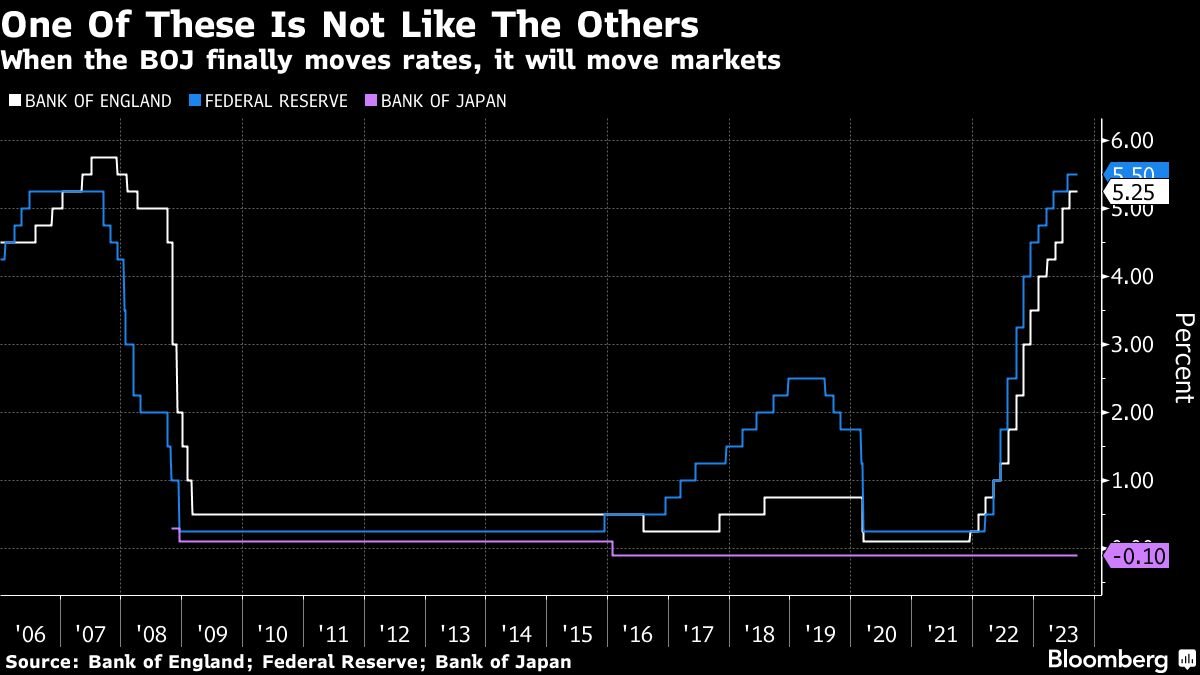
The yen weakened after the Bank of Japan held interest rates, its 10-year yield target and forward guidance unchanged. The central bank reiterated its expectation that inflation is decelerating.
In Asian stock trading, a region-wide equity index retraced early declines. Chinese shares rallied to cap a run of daily declines with tech particularly well bid.
The advance for Chinese stocks likely reflects “short covering on expectations of more policy support measures over the weekend, just like the government’s moves in every weekend this month,” said Steven Leung, an executive director at Uob Kay Hian Hong Kong Limited. Still, while “economic figures have shown some improvement, investor confidence remains weak,” he said.
Oil rose, in part supported by news that Russia would ban exports of diesel-type fuel and gasoline. European natural gas prices fell as Chevron Corp. and labor unions in Australia agreed to end strikes at major export plants that roiled the market for more than a month.
Key events this week:
-
China’s Bund Summit, Friday
-
Eurozone S&P Global Eurozone PMIs, Friday
-
US S&P Global Manufacturing PMI, Friday
Some of the main moves in markets:
Stocks
-
The Stoxx Europe 600 fell 0.5% as of 8:12 a.m. London time
-
S&P 500 futures rose 0.2%
-
Nasdaq 100 futures rose 0.3%
-
Futures on the Dow Jones Industrial Average were little changed
-
The MSCI Asia Pacific Index rose 0.2%
-
The MSCI Emerging Markets Index rose 0.7%
Currencies
-
The Bloomberg Dollar Spot Index was little changed
-
The euro was little changed at $1.0665
-
The Japanese yen fell 0.5% to 148.37 per dollar
-
The offshore yuan rose 0.2% to 7.2994 per dollar
-
The British pound fell 0.1% to $1.2284
Cryptocurrencies
-
Bitcoin was little changed at $26,611.99
-
Ether rose 0.3% to $1,592.29
Bonds
-
The yield on 10-year Treasuries declined two basis points to 4.48%
-
Germany’s 10-year yield was little changed at 2.74%
-
Britain’s 10-year yield declined two basis points to 4.29%
Commodities
-
Brent crude rose 0.4% to $93.68 a barrel
-
Spot gold rose 0.3% to $1,925.82 an ounce
This story was produced with the assistance of Bloomberg Automation.
Most Read from Bloomberg Businessweek
©2023 Bloomberg L.P.