Unlock the Editor’s Digest for free
Roula Khalaf, Editor of the FT, selects her favourite stories in this weekly newsletter.
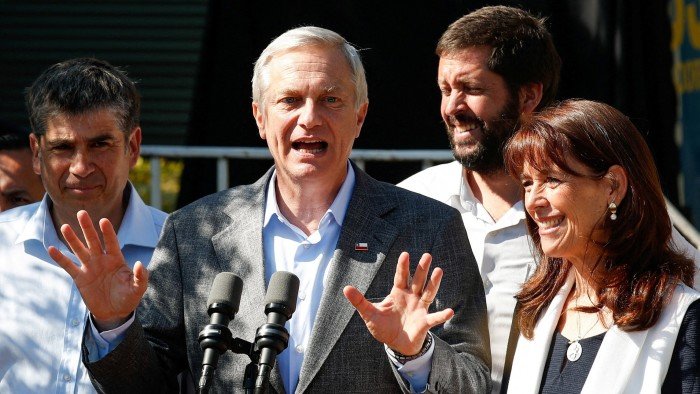
Veteran far-right politician José Antonio Kast is the favourite to win Chile’s presidency after 70 per cent of voters backed right-leaning candidates in a first round election, sending him into a run-off vote against a Communist candidate next month.
With 96 per cent of votes counted, Kast, founder of the ultraconservative Republican party, scored 24 per cent of the vote, according to Chile’s electoral service. Jeannette Jara, a member of Chile’s Communist party, representing the ruling leftwing coalition, scored 26.8 per cent of the vote.
Pollsters say it will be far easier for Kast than Jara to pick up the roughly 45 per cent of votes won by three other opposition candidates, giving him a clear advantage in the second round on December 14.
“Chile has truly woken up,” Kast told supporters after the result. “Millions of Chileans have chosen to embrace a project that opposes this failed government.”
A Kast victory would mark a sharp change in direction for Chile, six years after mass protests over inadequate public services and high living costs powered the election of current leftwing president Gabriel Boric, who is constitutionally barred from seeking a second consecutive term.
Boric’s efforts at social reforms to combat inequality have been eclipsed by an unprecedented wave of organised crime, as gangs from Venezuela and elsewhere arrived in Chile in recent years. Pollsters say crime and immigration, which has surged during Venezuela’s economic collapse, were voters’ top concerns.
The performance by Jara, who served as Boric’s labour minister and won a primary in June to become the left’s sole representative, was worse than expected and will make it “almost impossible” for her to catch up with Kast, said Robert Funk, associate professor of political science at the University of Chile. “The right has done historically well,” he added. “It’s quite clear what’s going to happen.”
Chile’s traditional centre-right coalition, Chile Vamos, plummeted to fifth place, with its candidate, Evelyn Matthei, 72, winning 12.7 per cent. Matthei pledged her support for Kast.
Kast, 59, has promised to take swift action on crime and illegal migration, by creating new maximum-security prisons, increasing penalties for gang-related crime, and deporting undocumented migrants. He has also pledged to slash $6bn in public spending over 18 months, which many economists have criticised as unrealistic.
Next month’s run-off will be the most polarised election in 35 years of democracy in Chile, though both Jara and Kast have moderated their positions to secure centrist voters.
Kast, a devout Catholic and father of nine, has played down the conservative family values that were a major part of his two previous presidential campaigns, including his opposition to Chile’s partial legalisation of abortion. He has also avoided speaking about his support for former dictator Augusto Pinochet.
Jara, 51, a member of Chile’s hardline Communist party since the age of 14, has pledged to maintain fiscal balance, while introducing a monthly minimum “living income” of $810, bumping up incomes via subsidies and direct state transfers. Her core security pledge is a plan to weaken gangs by tackling money laundering.
“Almost half of Chileans didn’t vote for me or Kast, and from tomorrow we will go out to speak to and listen to them carefully,” Jara told supporters after the result.
Anti-establishment candidates fared well amid frustration with traditional parties’ failure to prevent the security crisis and resolve long-standing cost of living problems, analysts said.
Franco Parisi, a right-leaning populist businessman, came third, with an unexpectedly large 19.6 per cent of the vote, while Johannes Kaiser, a libertarian congressman and a former YouTube personality, picked up 13.9 per cent.
A new obligatory voting system boosted participation, with more than 13mn ballots cast, compared with 7.1mn in the first round in 2021.
Early vote counts for congressional elections, in which all lower house seats and half the upper house seats were up for grabs, suggested the right would have a majority in both houses.
“The problem for Kast will be that the rightwing bloc in congress is made up of three coalitions, some moderate, some populist, some hard right, with different ideas of how the right should use that majority,” said Patricio Navia, a Chilean political analyst.
He added: “It will be a bigger challenge to unite the right rather than to defeat the left.”