
The federal government allows employees covered by the Federal Employees Retirement System (FERS) and who are unable to work due to either a mental or a physical condition to retire under what is called a FERS “disability retirement.” Since it is in the best interest of both an employee’s agency and the employee to remain gainfully employed as long as the employee can provide useful and efficient service, disability retirement should be considered as a last option. Disability retirement should be used only when attempts have been made to preserve an employee’s federal employment, and those attempts have failed.
This column is the fourth of four columns presenting FERS disability retirement rules and discusses the calculation of the FERS disability annuity and availability of other benefits during FERS disability retirement.
A FERS disability annuity is calculated in one of three ways depending on the employee’s age when the employee is approved for a FERS disability retirement. In most cases, a FERS annuitant’s disability annuity is initially computed, recomputed immediately after the first 12 months of retirement, and finally when the disability annuitant becomes age 62.
Calculation of the Disability Annuity for FERS Employees Younger Than Age 62 at the Time of Retirement (and Ineligible for an Immediate FERS Retirement)
The FERS disability annuity is computed differently depending on a FERS disability annuitant’s age, the amount of the disability annuitant’s Social Security monthly disability benefit – assuming that the disability annuitant has been approved by the Social Security Administration for Social Security disability benefits – and the amount of the disability annuitant’s FERS-covered service.
In most cases, FERS-covered employees who qualify for disability retirement are younger than age 60. They do not have enough years of FERS-covered service to be eligible for immediate and unreduced FERS retirement. As such, their FERS disability annuity is computed during three stages of their retirement as follows:
3 Stages of FERS Disability Retirement
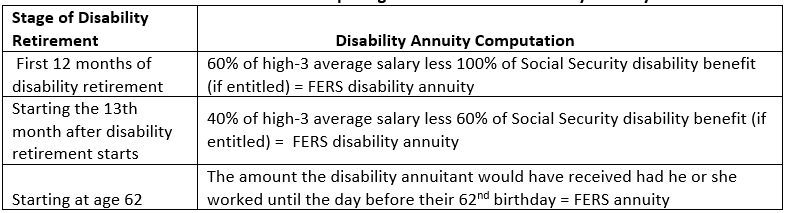
• Stage 1 (first 12 months of disability retirement). The FERS annuity is computed as 60% of the disability annuitant’s high-three average salary minus 100% of the disability annuitant’s Social Security disability benefit for any month in which the disability annuitant is entitled to Social Security disability benefits.
Advertisement

• Stage 2 (starting in the 13th month of disability retirement and continuing through the month before the month the annuitant becomes age 62). The FERS disability annuity is computed as: 40% of the disability annuitant’s high-three average salary minus 60% of the disability annuitant’s Social Security disability benefit for any month the disability annuitant is entitled to Social Security disability benefits.
• Stage 3. When a FERS disability annuitant becomes age 62, the annuitant’s disability annuity will be recomputed using an amount that the disability annuitant would have received had he or she continued working until the day before their 62nd birthday and then retired under FERS non-disability provisions.
However, if the disability annuitant is entitled to the retired FERS employee’s immediate and unreduced FERS annuity (equal to 1 percent of the annuitant’s high-three average salary multiplied by the annuitant’s years of FERS service), then the retired employee will receive that annuity. Years of FERS service include temporary service and/or military service for which a full deposit was made, and unused sick leave hours converted to months and days of service.
When a FERS disability annuitant becomes age 62, the annuitant’s disability annuity will be recomputed by OPM’s retirement office using an amount that the disability annuitant would have received had he or she continued working until the day before their 62nd birthday and then retired under FERS non-disability provisions.
In the computation of the disability annuity at the time the disability annuitant becomes age 62, OPM’s retirement office increases the disability annuitant’s FERS service time by the number of years the disability annuitant received the FERS disability annuity. The high-three average salary will be increased by all FERS cost-of-living adjustments (COLAs) which occurred during the time the disability annuitant received a disability annuity. The FERS “basic” annuity formula (equal to 1 percent of the FERS employee’s high-three average salary multiplied by the total years and months of service) is then applied by OPM’s retirement office. The total months of service include temporary time and military service for which a full deposit was made, and unused sick leave hours. If the actual service time, plus the credit for the time receiving a disability annuity, equals 20 or more years, then the accrual factor increases from 1 percent to 1.1 percent.
The following table summarizes the formula used in the calculation of a FERS disability retirement annuity:
FERS Formula for Calculating a FERS Retiree’s Disability Annuity
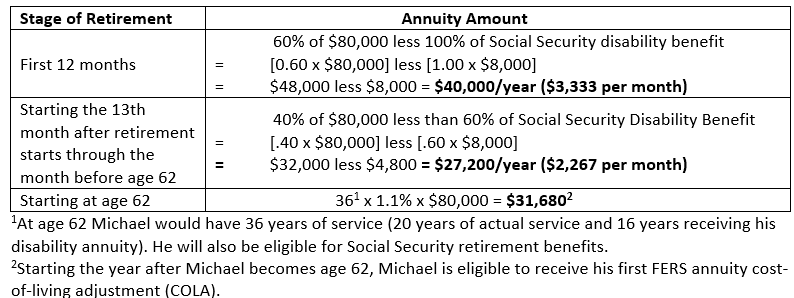
The following example illustrates the various calculations associated with a FERS disability retirement annuity:
Michael, age 46, has been approved for a FERS disability retirement. He also applied for and was approved for Social Security disability benefits. Relevant information:
Years of service under FERS before being approved for FERS disability retirement: 20
High-three average salary: $80,000
Social Security disability benefit: $8,000 per year
Michael’s FERS Disability Annuity Amounts at Various Stages of Michael’s Disability Retirement
The following is a summary of other benefits available with FERS disability retirement:
1. If a married FERS employee is approved for a FERS disability retirement, then the employee can choose to give a spousal survivor annuity, either the maximum (50 percent) spousal survivor annuity or the less than maximum (25 percent) spousal survivor annuity. In either case, the retired FERS employee’s annuity will be reduced by either 10 percent (maximum spousal survivor annuity) or five percent (less than maximum spousal survivor annuity).
2. If a FERS employee wants to pay a deposit for temporary service that occurred before Jan. 1, 1989, and/or to pay a deposit for post-1956 active-duty military service, the deposit(s) must be paid in full before separation from federal service. This is the case even though both deposits will not be used in the retired employee’s FERS annuity calculation until age 62.
3. A FERS disability annuitant is eligible to retain all federal employee insurance benefits (health, life, dental, vision and long-term care) throughout retirement (assuming they met the prerequisites to keep the health insurance (FEHB program) and/or life insurance (FEGLI program) before retiring).
4. Penalty-free traditional TSP withdrawals can be made by a FERS disability annuitant if the annuitant retires from federal service sometime during or after the year they become age 55. If the annuitant meets the definition of fully disabled and retires from federal service before age 55, the disability may qualify for penalty-free TSP withdrawals.
 Edward A. Zurndorfer is a CERTIFIED FINANCIAL PLANNER®, Chartered Life Underwriter, Chartered Financial Consultant, Registered Health Underwriter and Enrolled Agent in Silver Spring, MD. Tax planning, Federal employee benefits, retirement and insurance consulting services offered through EZ Accounting and Financial Services, located at 833 Bromley Street Suite A, Silver Spring, MD 20902-3019