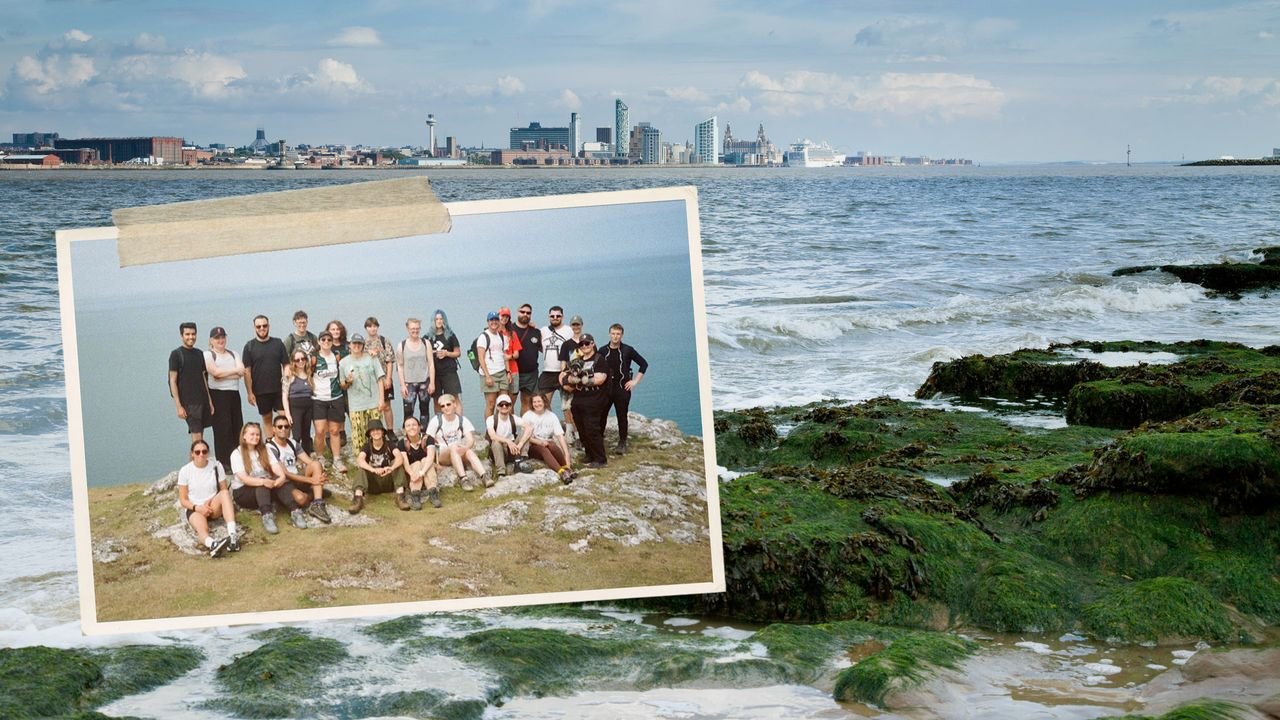
Cooke, like a lot of now-Liverpudlians, originally grew up on the Wirral. “Being queer in the countryside, that can be a bit… well…” started Cooke, nodding knowingly.
I encouraged her to elaborate, though I knew exactly what she’d meant. It’s a common pattern in both of our countries: Queer kids from small, rural areas long to escape to the city, where there’s a greater promise of community.
Cooke sees another possibility: “We, as queer people, shouldn’t concede the countryside.”
Cooke is a long-haired femme with the privilege of someone who could pass as straight—she knows she doesn’t have the same experience of being perceived and judged as some of her fellow hikers. “When you look more physically queer, or physically trans, and you want to go on a walk, but you might be walking alone, or with a small group, and you might think, What are people’s reactions gonna be?” she says, noting that bathrooms along trails might not be single-stall or gender neutral. “It can be a really intimidating thing.” This is where being in a group offers value greater than connection: It becomes fortification to get out into these spaces and enjoy them.
“Why have we told ourselves that we’re not allowed in these spaces?” asks Cooke. “Mushrooms don’t have any gender, and we’ve got gay dad penguins raising eggs together. Queer people are natural, beautiful, and as varied as nature.”
What my fellow hikers loved most about the group was equally myriad. Some rejoiced in the opportunity to share their pronouns while knowing they’d be respected. Others felt relieved that they wouldn’t be dealing with the clique-iness of other hiking groups they’d tried, while a few enjoyed the flexibility to both socialize and keep to themselves when they wanted to. One co-organizer, Matt Hunt, said this freedom to be introverted is appreciated: “When everyone was eating lunch, I just went and fed the ducks.”
“To be fair,” Cooke joked, “you’d probably have done that back when it was just six of us, too.”
I brought my toy poodle mix, Gus, along for emotional support, but it turns out I needn’t have been so nervous about showing up solo. Call it a small world, but almost immediately I ended up running into a couple of my fellow roller derby players from the intro-level training group I’d been attending for the past year. They had both been on a few Merseyside Queer Hikes before and thoroughly enjoyed them. We fell into an easy side-by-side formation as our group began winding our way toward the coast. I made fast new friends with a few hikers who laughed when they saw Gus sniffing at a full-sized standard poodle on the trail: “It’s like Pokemon levels,” one of them joked.
As we wound our way along the coastline at a gentle, rolling incline, the route allowed us to see all the way out to Wales, given it was such a clear day (“a queer day?” I heard somebody joke). A long walk is more conducive to low-pressure socializing with strangers than, say, an event at a bar, where you’re all sitting at tables, awkwardly facing each other, or anxiously thinking of your own answers to contrived icebreakers. On a walk, conversations ebb and flow like tides. There were at least a couple hikers who kept their headphones on, simply enjoying the safety and comfort that comes from being buffeted along the route by fellow friendly gays. I enjoyed that feeling as well: not having to worry about whether I was walking for hours in the wrong direction, because a couple of confident leaders up front were paving the way. And this isn’t just a fun social outing. It can also function as an important resource for mental and physical health. One woman told me she had been recommended to the Queer Merseyside Hikers group by her therapist.