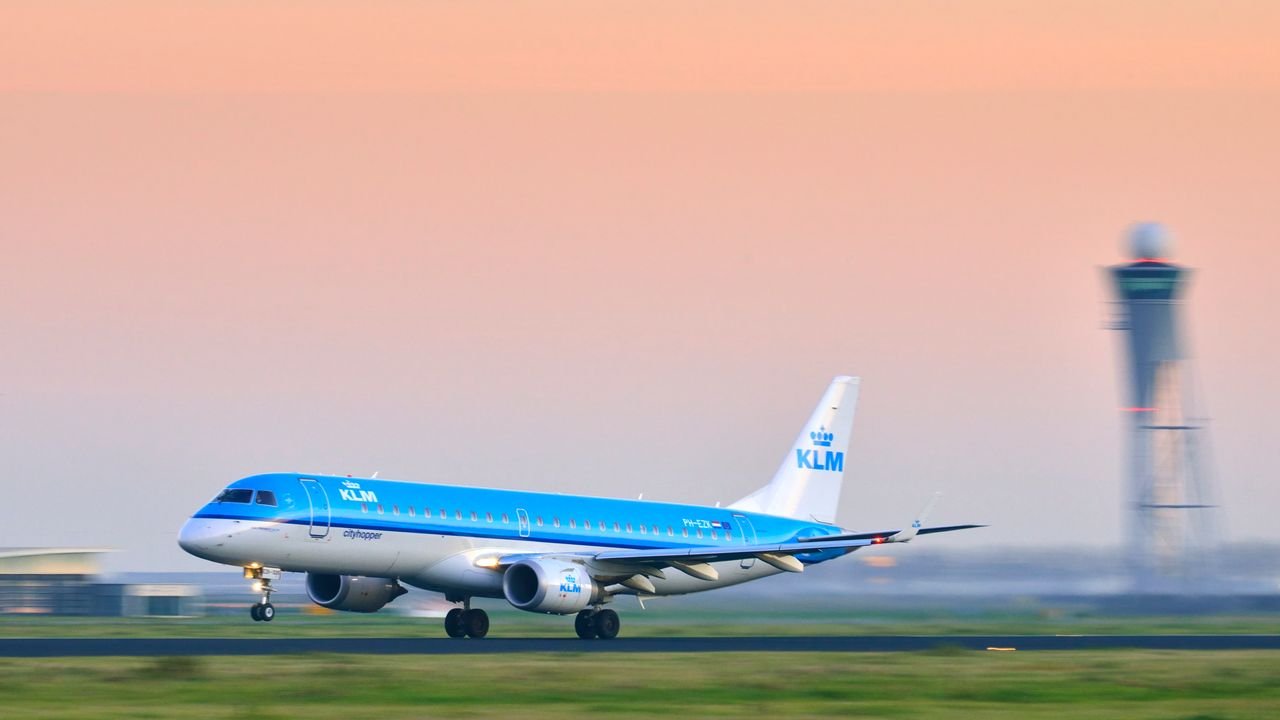
KLM has canceled more than 150 flights over the coming month as the cost of jet fuel continues to spike. The airline did not immediately comment on a specific date range for the impacted flights.
The Dutch airline released a statement on April 16 announcing the decision. The affected routes are to European destinations KLM provides regular daily service to such as London and Düsseldorf. While the cancellations impact a total of 80 return flights to and from Amsterdam Airport Schiphol, they account for less than one percent of the airline’s total European flight inventory. “Passengers affected by these changes will be rebooked onto the next available flight,” KLM press officer Hugo Lantain confirmed in a statement to Condé Nast Traveler, “Travelers can usually be accommodated quickly.”
The cancellations come as the Iran war and the subsequent 48-day closure of the Strait of Hormuz (which is now reported to be open as of April 17, 2026) caused the price of jet fuel to spike around the globe. And with very little oil currently moving through the vital waterway, several airlines around the world are facing the possibility of a global shortage. In an exclusive interview with the Associated Press on April 16, International Energy Agency head Fatih Birol estimated that European countries have “maybe six weeks or so” of remaining jet fuel before conditions escalate to “the largest energy crisis we have ever faced.”
However, KLM clarified that the latest adjustments to its flight schedule are not due to fuel shortages, but cost-saving measures. “This concerns a limited number of flights within Europe that, due to rising kerosene costs, are currently no longer financially viable to operate,” the statement says, “There is no kerosene shortage.”
“The logic appears to be protecting the core of the network while removing marginal frequencies that are harder to justify under current fuel costs,” explains Christopher Anderson, a professor specialized in operations, technology and information management at Cornell University, “In a hub-and-spoke system, that is often the first place airlines look, because they can consolidate demand without visibly dismantling the long haul network.”
KLM’s latest statement follows the carrier’s announcements of its Middle East flight cancellations to Dubai, Riyadh, and Dammam. As of March 19, the carrier has suspended all flights to Riyadh and Dammam until May 16. Per an April 9 statement, KLM also extended its suspension of flights to Dubai to until June 14. Prior to the start of the conflict, the airline flew to Dubai daily.
Around 20% of the world’s oil and natural gas flow passes through the Strait of Hormuz, and its closure has caused a drastic spike in fuel costs. Earlier this month, Reuters claimed that “jet fuel prices have spiked, pushing up operating costs, with European prices doubling and Asian prices up almost 80% since US and Israeli strikes on Iran began in late February.”
KLM is not the first airline to cancel flights over rising fuel costs. Air New Zealand has also made changes to its domestic schedule citing rising fuel costs.
“I do think this raises the likelihood that other carriers could take similar steps if higher fuel costs persist. Airlines can pass through some of the increase to passengers, but not all of it, particularly in competitive short-haul markets,” says Anderson, “That means some combination of modest fare increases, tighter schedules, and selective cuts is more likely than a blanket pricing response. For travelers, the impact is often less about a dramatic disappearance of service and more about fewer daily options and reduced recovery room when something goes wrong.”
A version of this article was originally published on Condé Nast Traveller Middle East. Additional reporting by Kat Chen.
For the latest developments across the region, follow our live coverage here: