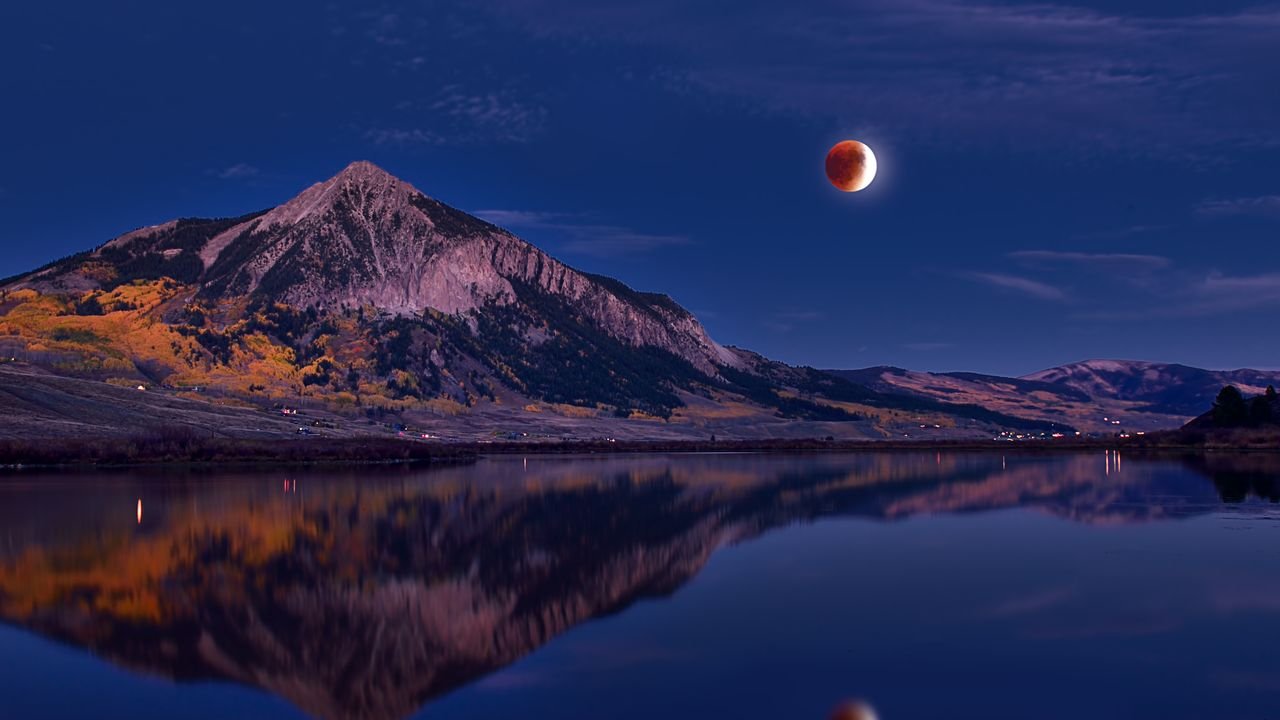
On Tuesday, March 3 (or just before midnight on March 2 or just after midnight on March 4, depending on time zones), skywatchers around the world will be treated to a total lunar eclipse. For nearly an hour, the full moon will slip into Earth’s shadow and glow a rusty hue or what’s referred to as a ‘blood moon’. What’s more—along the East Coast of the United States, early risers could witness something even more unusual: a rare sky spectacle known as a selenelion. Below, everything you need to know about when and where to catch the show—the last total lunar eclipse until New Year’s Eve 2028.
What is a total lunar eclipse?
A lunar eclipse occurs when the sun, Earth, and moon align just right, with our planet positioned squarely between the sun and the full moon. As the moon moves through Earth’s shadow, sunlight filtering through our atmosphere bathes it in shades of red and orange, turning the moon blood red.
Lunar eclipses unfold in stages. First, the moon enters the faint outer shadow of the Earth, or the penumbra, where dimming is subtle; this is the penumbral eclipse. As it moves deeper into the full shadow, or umbra, a partial eclipse begins, with a curved shadow slowly swallowing the lunar disk. The full eclipse, or totality, begins when the moon moves completely into the umbra, turning its usually white surface a dim reddish-orange.
When and where can I see the eclipse?
Unlike with total solar eclipses, which are only visible along a small path, total lunar eclipses are visible anywhere the moon is visible. This week’s total lunar eclipse can be seen across the Americas, the Pacific, Australia, and Asia. You won’t need any special gear like eclipse glasses—it’s safe to look at a lunar eclipse with the naked eye, and the use of binoculars or a telescope is fine, too.
The entire eclipse will last 5 hours, 39 minutes, while totality will last 58 minutes. For most viewers in the Americas, the eclipse will begin after midnight on March 3; in western locations like Hawaii, it’ll begin late at night on March 2. On the other side of the Pacific, the eclipse will start in the evening on March 3, and in some cases (such as in New Zealand), run into the early hours of March 4.
Here’s the exact timing of the eclipse in Coordinated Universal Time (UTC). To find out the timing in your location, use a time zone converter.