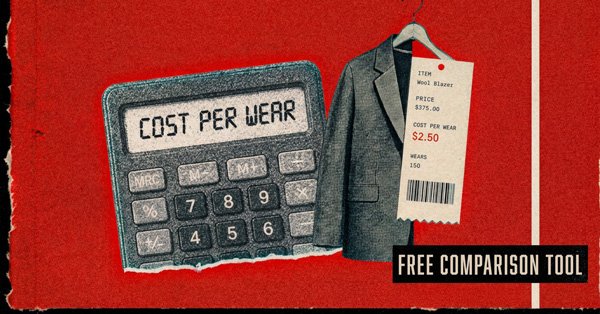
A calculator and field guide to when the math actually helps, when it’s just flattering you into a purchase, and what gets lost when style becomes a spreadsheet.
If you’ve spent any time around online menswear, you’ve already met this idea. It runs through the buy-it-for-life threads, the capsule wardrobe subreddits, and the comment sections under every nicely-made coat or well-built pair of boots.
The pitch is almost always the same. Yes, the upfront price is a lot, but spread across enough wears and enough years, it actually saves you money compared to buying cheaper things more often. A $40 shirt worn twice cost you $20 every time you wore it. A $400 jacket worn 400 times cost you a dollar. Same closet, very different math.
Cost per wear calculator. Enter price, expected wears per year, and years of use to see the true cost.
Cost per wear
The real price of a thing is what it costs you every time you put it on.
Cost per wear
Over 250 wears, this works out to less than a pack of gum each time you wear it.
Try a preset
Spending to save, the line usually goes. It’s the favorite mental move of anyone trying to talk themselves into a piece of clothing that costs more than their last three put together.
And sometimes that’s true. Sometimes the $400 boots really do come out cheaper than five rounds of disposable pairs. But sometimes the math is just permission. It can become a form of Shopper’s Logic, sometimes lovingly/derisively referred to on social media as Girl Math: the half-joking name people give the small mental contortions we all do to make a purchase feel like a deal. Returns count as unexpected income. If you pay in cash, it’s basically free because it doesn’t hit the digital number on the bank account. The expensive thing is actually the cheap thing if you say it enough times.
Cost per wear can easily become a version of the same trick. Sometimes the math is real… sometimes it’s a story you’re telling yourself to close the sale you’ve already decided on.
Which brings us to the calculator above. The point of the tool is not to turn every clothing decision into a spreadsheet. It’s to help you ask a better question before you buy: is this thing infrastructure, an event, or joy?
Where the math is helpful
The framework is at its most useful when you point it at workhorses like boots, jeans, a navy blazer, an overcoat, or a watch. The kind of things you actually wear all the time, across years, where the denominator is real and predictable and big.
A good example is the boots problem, which Terry Pratchett wrote into one of his Discworld novels back in the early nineties, long before personal finance writers got around to it. The character Sam Vimes lays out the math:
A poor man buys cheap boots that fall apart in a year. A richer man can afford good boots that last a decade. After ten years, the richer man has spent less on boots than the poor one, even though his pair cost more at the register.
Pratchett was making a bigger point about how expensive it is to be poor, but the smaller point is the one we care about here, which is that sticker price and real price are different numbers.
Sticker price says the cheap pair is cheaper. Cost per wear says they aren’t, by a long way. Anyone who has bought three pairs of cheap shoes in the time it would have taken to wear out one good pair already knows this in their bones.

It also catches what cheap-at-transaction fast fashion actually costs you. A $20 shirt that pills after six wears is, on a per-wear basis, more expensive than a $90 shirt you wear 12 times per year for two years. The framework punishes disposability honestly. It doesn’t care about the tag, it cares about the math.
And maybe the most useful thing it does that stings a little, is help you spot the closet ghosts. The most expensive item you own is whatever you spent real money on and never wore. Infinite cost per wear. Most of us have at least one or two of those, looking at us from a hanger.
Similarly, and often how its used by style writers and influencers, is as a metric for sharing their best historical purchases. Pulling the items from their closet they have actually worn the most over the years, doing the CPW math, and using that as a mindset for approaching your own wardrobe. This is helpful in a course correcting sort of way: If you’re finding your most worn items were also not the ones you invested most in, it means the lens you’re using may need adjusting.
Perhaps the single most practical application of that idea is the replacement upgrade. When you’ve worn out a version of the same chambray button up, or run a hardy shawl-collar cardigan into the ground across enough seasons that you’ve made it part of your personality, you aren’t guessing at how often you’ll use the next one. You the evidence on the bottom of the hamper. That’s the rare, objective case where spending more on a better replacement pencils out, because the math is built on what you’ve already done rather than what you imagine you’ll do.

Where math leads you astray
The trouble with cost per wear is that almost nobody opens a calculator before deciding to buy something. They open it after they’ve decided, then back into a wears-per-year figure that makes the number look reasonable. That’s a story you’re telling yourself like any good sales person would, not prudent spending analysis. You’ve already decided…you’re just dressing the decision up.
The math also depends on a denominator that is, frankly, a guess. You don’t actually know how many times you’ll wear a thing. You’re optimistic at the register and realistic six months later. I have also had a number of buys I was sure I’d wear regularly, which turned out to mean “several” because, in practice, the fit or style or whatever I just couldn’t make work the way I hoped.
There’s a subtler version of the same trap, and it’s the Bizarro mirror image of the replacement-upgrade argument from earlier. The math takes for granted that your personal style in year three is going to be the same as your taste at the register, and very often it isn’t.
A $500 field jacket that divides out at 200 wears over a decade is doing so on an unstated bet that the version of you who wants a field jacket today is the same version of you who will want one three years from now. For some people that’s a safe bet. For anyone who has cycled through a couple of aesthetics over the years (which, if you’re reading menswear sites, is probably most of us), it isn’t. With a worn-out replacement, your past behavior makes the denominator trustworthy.
With an exploratory purchase, your past behavior should make you skeptical of it. The calculator can’t know the difference.
It also ignores the cash. Cost per wear doesn’t pay your credit card bill. A $1,200 coat at $2 a wear is still $1,200 you don’t have anymore. The per-wear framing has a way of making real money feel theoretical, and theoretical money is the kind people get into trouble with.
This brings us to the deeper question, the one the calculator can’t answer, is what a piece of clothing is actually for?
Some clothes are infrastructure, some are events, some are joy
Most of the writing about cost per wear treats every garment as a utility being depreciated over its useful life. That works for boots. It works less well for a watch you’ll leave to your kid, or a jacket you bought on a trip that you can still smell when you put it on.
The calculator treats “wears” as fungible units, but they aren’t.
Wearing a tuxedo at your wedding is not the same kind of event as whether you can justify wearing a Merz b. Schwanen t-shirt around the house. Some clothes are supposed to have a high cost per wear, because they’re doing a job nothing else can do, and they’re doing it at the only moment that matters.
Infrastructure clothing is the right place for cost per wear. Boots, jeans, a coat, a watch, your everyday clothing. These staple items have a job, they show up every day, in a specific aesthetic, and they should be evaluated on how cheaply they do that job over a long period of time. Some things like a legit leather jacket get better the more you wear them. Spend more, get more, wear it for years, win the math.
Event clothing is something else. A dark suit you wear three times a year or a heavy overcoat you only need when it actually gets cold. These pieces are supposed to be expensive per wear, because they’re doing something specific at a specific moment, and nothing else in your closet can stand in for them.
What matters more than the math
And then there’s the joy category, which the calculator can’t really see. This is the part I keep coming back to, because I think it matters more than the math. A vintage piece you found and could not leave behind or the strange jacket you wear once a year or a watch you bought because it makes you happy when you look down at your wrist.
The right denominator for these isn’t wears. Trying to amortize joy on a spreadsheet is how you end up not buying any of the things that make your life feel like yours.
Different frameworks for different jobs. Don’t put a workhorse on a joy budget, and don’t put a joy purchase on a workhorse spreadsheet. They’ll both leave you feeling like you spent your money wrong.
How I’d actually use the thing
A few honest rules of thumb, none of which are rules.
- Use it before, not after. The calculator is a flashlight, not a hammer: Once you’ve spent the money, putting the math on the receipt doesn’t help much. If the math shames you into wearing something you justified at purchase, you’re wearing the wrong thing and succumbing the Sunk Cost Fallacy.
- Use a realistic number of wears, not a justifying number. The trick is to look at your actual life, not the imagined version of your life where you finally start wearing blazers. If your honest answer is “8 times a year,” put in 8 times a year.
- Include maintenance, especially for anything tailored or delicate. The maintenance toggle is there because dry cleaning, resoling, alterations, and leather care are real costs, and they can easily double the per-wear figure on a wool suit, and a real hidden difference between buying the “cheap” machine washable cotton sweater and the “premium” dry clean only cashmere sweater.
- Compare within a category, not across the closet. A pair of boots and a tux are not in the same conversation. Cost per wear is better for ranking apples against apples, less useful for fruit salad.
And maybe the most important one. Notice when the math is telling you something you don’t want to hear. If you punch in honest numbers and the answer is $10 a wear for something that doesn’t feel like a $10-a-wear item, that’s the tool doing its job. Sometimes the point is to put it back on the rack.
A last thought, mostly to myself
I don’t think the math is wrong. I think the math has a job, and the job is smaller than it looks. It tells you whether something is a sensible workhorse. It doesn’t tell you whether a thing belongs in your life.
That second question is the more interesting one, and it deserves its own piece, which I’ll get to. For now, the calculator is up at the top, and I’ll be linking to it from style and deals posts going forward. Punch in the numbers realistically.
Then go put the thing on, and don’t think about the math.