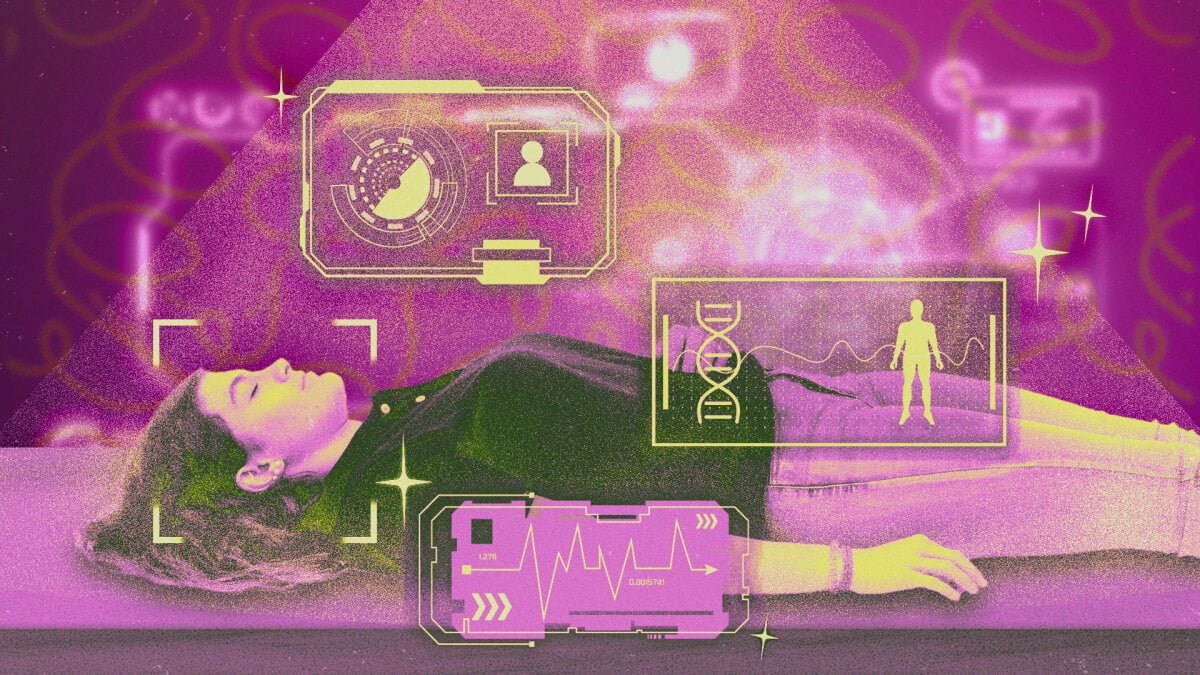
We’re living through a full-fledged skinny epidemic. Even if seeing celebrities get thinner and thinner doesn’t mean anything to you, notice how marketing for various weight loss products is getting increasingly ubiquitous. When I look around, the onslaught doesn’t stop with all the ads for GLP-1s. What has really caught my eye recently is how I—a fitness writer who happens to be pretty thin—keep receiving targeted ads for different types of “AI body scans.” These services take a few different forms (which I dive into below), but what they all try to sell is the same idea: Apparently, I don’t know enough about my body. It turns out I need to know my body fat percentage, muscle mass, visceral fat, and of course, my “biological age.”
Before I break down what exactly these AI body scans can (and cannot) tell you, know that this is not some takedown of AI tools being used by radiologists to spot cancer from a CT scan. What I’m focusing on here is all the false advertising for consumers like me, people naturally drawn to the shiniest tools to understand every little thing about their bodies. But before I build my health decisions around a number on a screen, I have to wonder about the gap between what these tools promise and what they actually deliver.
What are AI body scans, exactly?
Body composition scans are nothing new—it’s the AI angle that’s giving the market a fresh angle. The term “AI body scan” covers a range of technology, from clinical-grade DEXA machines used in research hospitals, to apps that claim to estimate your body fat from a selfie.
At the serious end sits the DEXA scan (Dual-Energy X-ray Absorptiometry). Originally developed to measure bone density, DEXA uses two low-dose X-ray beams to distinguish between bone, fat, and lean tissue with genuine precision. It can identify visceral fat (the dangerous kind that accumulates around organs), regional fat distribution, and bone density. A single session might cost between $40 and $300 out-of-pocket, depending on where you go and whether any insurance applies. A company like BodySpec, for instance, has built businesses around making DEXA more accessible, performing around a thousand scans a day and building what it describes as the “largest proprietary DEXA dataset” in the world.
Below DEXA on the precision ladder sits “bioelectrical impedance analysis” (BIA). BIA is the technology powering most “smart scales,” gym body composition stations, and many of those consumer-level AI scanners that keep targeting me with ads. BIA works by passing a small electrical current through your body and measuring how it travels. Fat resists electrical current; lean tissue (mostly water) conducts it well. From this resistance, the device estimates body composition.
Then, at the bottom of the technical hierarchy, sit the phone camera apps. Translating a 2D image into a body fat percentage or visceral fat estimate requires assumptions that are generous at best. These apps may be useful as very rough awareness tools, but so is a photograph.
Another note on “AI” in this context
Again, it’s worth being specific about what AI is actually doing in most of these products, because as always, the word can mean a lot of things. In the better DEXA-based services, AI is being used to process and contextualize large datasets, helping users understand their results in comparison to relevant populations, flagging trends over time, and personalizing recommendations. For instance, BodySpec describes using AI to give its scanning service a kind of institutional memory for each client, stitching together health history and personal context so that consultations feel personalized at scale.
In consumer devices, “AI” most often means that an algorithm has been trained on a dataset to estimate body composition. But the AI is only as good as the underlying measurement, and those underlying measurements might not be accurate in the first place.
What an AI body scan cannot tell you
Let’s take a look at where the marketing diverges from the medicine, and where some skepticism is warranted. A body composition scan cannot tell you about your insulin sensitivity, inflammation, thyroid function, cortisol levels, or dozens of other physiological variables that determine your actual metabolic health. Two people can have identical DEXA results (same muscle mass, same body fat, same visceral fat reading), but one can have pre-diabetes while the other doesn’t.
“I had two people with similar scan results, but very different metabolic health once labs were checked,” says Dr. Raymond Douglas, a board-certified oculoplastic surgeon and professor at Cedars-Sinai Hospital in Los Angeles. “And if you’re making lifestyle choices based on a scan number alone, you may be fixing the wrong problem.”
What’s more, that sort of interpretation of scan results assume the reading was accurate in the first place, which isn’t always the case. “I have years of experience with seeing patients who have high muscle readings but are simply water-retained,” says Dr. Alexander Acosta. “If you have retained more water, say from a salty lunch or your period, the machine is likely to report a 5% increase in muscle mass.” This is especially relevant for those BIA products, like the smart scales you might see at the gym. Your hydration state—which fluctuates throughout the day, with exercise, with diet, with hormonal cycles—skews the result.
Perhaps no feature of these AI scanners is more aggressively marketed than “biological age.” The marketing angle makes sense: What if you find out your body is actually half your age on paper? It’s no mystery how this number has a way of inspiring either relief or dread, and it often inspires purchases.
Biological age is usually calculated by an algorithm that compares your information with population averages, and those averages are limited. “From my experience, the algorithms don’t take into account your genetic background and inherited metabolic rate. The computer may tell a 30-year-old they have a 50-year-old heart due to stress,”Acosta says. “I have actually seen these numbers change by five years after a bad night’s sleep.” A number that swings five years based on one night’s sleep isn’t a number worth obsessing over, if you ask me.
What do you think so far?
What body scans are actually good for
One way to approach all this is to think of body scans as a tool to track trends over time, rather than expecting to have your world rocked from a single session. “Muscle trending up, visceral fat trending down—those are worth paying attention to,” Douglas says. “The mistake most people make is treating a single session like a full medical workup.”
If you scan under consistent conditions every few months, you could glean a lot of useful information from the patterns that appear. Are you gaining lean mass while losing fat? Is your visceral fat creeping up despite stable weight? These are questions a body composition scan, done repeatedly, can help answer in ways a bathroom scale cannot.
“A DEXA scan provides a much clearer picture of what is actually happening in your body by measuring body fat percentage by area, lean mass, bone density, and visceral fat,” says Elaine Shi, CEO and co-founder of BodySpec. “It moves us away from guessing based on proxies like BMI—which is outdated and doesn’t represent diverse populations—and allows us to make decisions based on clinical-grade insights.” For example, Shi says people taking GLP-1 medications for weight loss can lose a significant proportion of their reduction in lean muscle mass rather than fat, which could point to a metabolic problem that would be invisible on a regular scale.
If you’re going to use DEXA, use it over the course of several months. Numerous scans taken under consistent conditions (same time of day, same hydration status, same proximity to exercise) could show patterns worth paying attention to. If you’re going to use BIA devices, understand that the readings are noisy. Don’t scan after a salty meal, after intense exercise, or during a phase of hormonal flux and expect accuracy. If you’re interested in inflammatory markers, fasting glucose, insulin, lipid panels, thyroid function, a body composition score is no substitute for bloodwork.
“Treat the scan as an awareness tool, then combine it with blood tests, blood markers of inflammation, and lifestyle habits to draw conclusions,” says Douglas. You should also be especially skeptical of biological age scores. A single number generated by comparing your data to population averages on a given day is not a substantial medical insight. And when you see an ad for a phone camera app that claims to measure your visceral fat with AI, ask what the underlying measurement is. If there is no good answer (which there won’t be from a 2D image), the so-called AI has nothing real to work with.
The bottom line
The move away from BMI and toward actual body composition measurement is promising for a lot of people. If your doctor sends you to a DEXA scan to assess your bone density and you’re interested in other insights about your body composition along the way, consider your scan results as part of a bigger trend over time. Your body composition score may be a great starting point, but you still want a human healthcare professional to make sense of the results.
At the end of the day, snake oil will always thrive in the wellness industry. These days, every snake oil salesman under the sun knows to slap on the term “AI-powered” to add authoritative language to imperfect products. Before you spend hundreds of dollars on a body scan (or waste your time and energy with a phone app), consider the limitations of these readings—and be honest about what exactly you’re trying to discover here. A scan that cannot distinguish between muscle and retained water, whose biological age score shifts five years with poor sleep, and whose readings vary with what you ate for lunch might not be giving you the answers about your body that you crave.