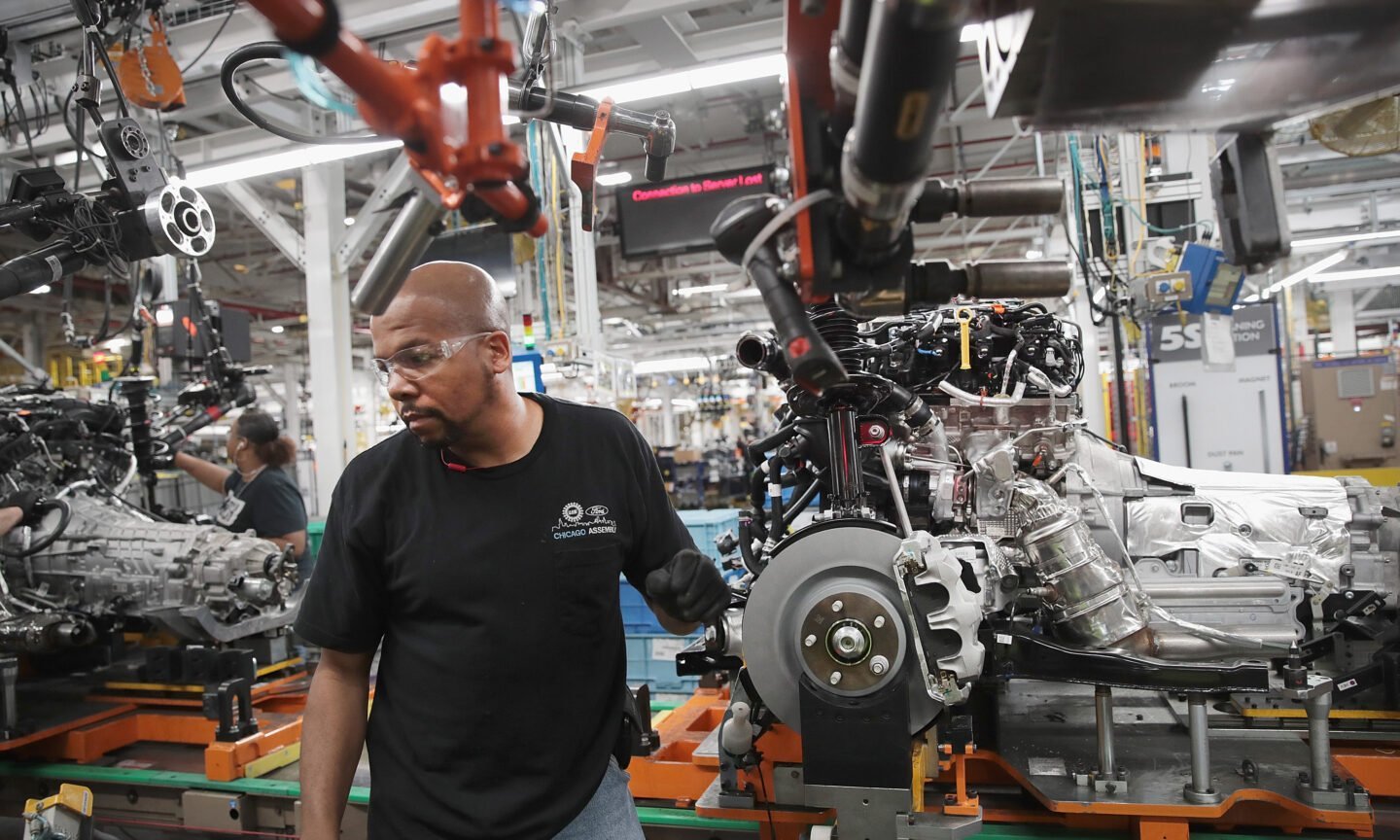
While it’s well off its peak, manufacturing remains one of the largest sectors of the U.S. economy, contributing to about 10% of the country’s overall output. But global supply chain dynamics make it difficult to measure precisely which products qualify as “made in America,” according to the U.S. Commerce Department.
That’s because much domestic manufacturing relies on foreign parts and materials that are imported into the United States for assembly. Those assembled consumer products may then be sold in the U.S. or exported to other countries. But some products are still produced entirely in the U.S.
U.S. manufacturers source 69% of what’s known as “intermediate inputs,” — the energy, raw materials, parts and semi-finished goods — from U.S. suppliers, according to the Commerce Department. But one third of parts are imported from other countries.
Here are the top three subsectors of manufacturing in the U.S. as of 2023, according to the National Institute of Standards and Technology of the U.S. Department of Commerce:
-
Food, beverage and tobacco products
-
Computer and electronic products
Other areas of manufacturing include:
-
Motor vehicles, bodies and trailers, and parts
-
Other transportation equipment
-
Fabricated metal products
-
Miscellaneous manufacturing
-
Nonmetallic mineral products
-
Electrical equipment, appliances and components
-
Furniture and related products
How much does the U.S. import and export?
Imports are goods that one country purchases from another country, while exports are goods that one country sells to another country. The latest U.S. Bureau of Economic Analysis (BEA) data shows:
Exports in September 2024: $267.9 billion — a decrease of $3.2 billion compared to August.
Imports in September 2024: $352.3 billion — an increase of $10.3 billion compared to August.
Top import partners 2024 year-to-date
Top export partners 2024 year-to-date
Source: U.S. Census Bureau and the U.S. Bureau of Economic Analysis.
How many manufacturing jobs are in the U.S.?
October 2024 manufacturing positions in the U.S.: 12.9 million
The manufacturing industry is the fifth largest employer in the U.S., according to the U.S. Census Bureau data. In 2022, there were 15.2 million workers employed in U.S. manufacturing positions — that’s nearly one in 10 (9.6%) workers among all industries.
By comparison, in November 1943 — in the midst of the World War II boom — 38.8% of what was then a much smaller workforce was employed in manufacturing.
In raw numbers, manufacturing employment has declined from its peak in June 1979 when there were 19.5 million workers in the manufacturing industry, according to BLS data.
The early 2000s saw the biggest drop in manufacturing employment: In January 2000, some 17 million workers were employed in manufacturing positions, and that number plummeted by 34% to 11.5 million workers by March 2010 — a low not seen since 1945, following the end of World War II. Employment in the industry steadily grew over the next decade before dropping again to 11.4 million in April 2020 due to the coronavirus pandemic. Since that low in 2020, manufacturing employment has grown 12.7%.
Most manufacturing firms are small: Among 238,851 such firms, the overwhelming majority (93.4%) have fewer than 100 employees, according to an analysis of Census data by the National Association of Manufacturing. But most workers — about two-thirds — are employed by large firms. Two manufacturing subsectors dominate the industry: transportation equipment and food.
An April 2024 report by Deloitte and The Manufacturing Institute estimates that manufacturing could need 3.8 million more workers from 2024 to 2033. It also projects that half of skilled open positions — about 1.9 million jobs — could go unfulfilled due to a “skills and applicant gap.”
Where are most U.S. manufacturing jobs?
Indiana has the highest concentration of manufacturing jobs — more than twice the national average, according to the BLS. In general, most U.S. manufacturing is done in the Midwest. More than one-quarter of all manufacturing jobs in Indiana are in transportation equipment manufacturing. The other states with manufacturing employment well above the national average are Wisconsin, Iowa and Michigan.
How manufacturing impacts GDP
In 2023, manufacturing contributed $2.3 trillion or around 10.2% of the total U.S. GDP, according to the National Institute of Standards and Technology (NIST), part of the U.S. Commerce Department.
How U.S. manufacturing compares to the rest of the world
The U.S. isn’t the powerhouse it once was when it comes to manufacturing, but it’s still no slouch when compared to other industrialized nations.
The U.S. holds 12% of the world’s manufacturing, according to the Center for Economic and Policy Research, a nonpartisan think tank. That’s more than Japan (7%), Germany (5%), Korea (3%) and India (3%). In fact, the U.S. is second only to China, which boasts 35% of the world’s share of manufacturing.
Since 2000, manufacturing output has declined in the U.S., largely due to competition from China. By 2030, China is expected to dominate 45% of the world’s share of manufacturing, while the U.S. is expected to decline slightly and make up around 11% of all manufacturing, according to a 2024 analysis by the United Nations Industrial Development Organization.
Can tariffs boost U.S. manufacturing?
Global supply chain disruptions during the coronavirus pandemic illustrated how reliant the U.S. is on other countries, especially China, to import goods, as well as parts for assembly of U.S.-manufactured products for sale to consumers. The U.S. cannot and does not produce everything it needs to meet business and consumer demands.
Since global supply chains are inherently interdependent, tariffs can make goods more expensive. Tariffs are essentially a tax on foreign countries’ imported goods. They’re used to raise revenue, protect domestic industries or as a punitive measure. In response to tariffs, foreign countries usually raise the price of goods and materials, which means higher costs get passed onto domestic producers, manufacturers and consumers.
Former President Donald Trump has promised that his plan for a 10% or 20% across-the-board tariff on all foreign imports — plus a larger tariff for imports from China and automobiles from Mexico — would spur manufacturing output in the U.S. Economists argue that Trump’s tariff plans would likely reignite inflation and are unlikely to have a significant impact on the manufacturing industry.
A 2019 paper by the Federal Reserve Board analyzed the effect of Trump’s 2018 tariffs on the U.S. manufacturing sector. It found that import tariffs could protect some U.S. manufacturers from foreign competition, but any gains are offset by increased costs — including retaliatory tariffs — that could hurt U.S. manufacturers’ ability to compete in exporting to foreign markets and sales in the U.S. The Federal Reserve Board found that Trump’s 2018 tariffs led to “relative reductions” in manufacturing employment and increases in producer prices due to increased costs by foreign producers and retaliatory tariffs.
(Photo by Scott Olson/Getty Images News via Getty Images)