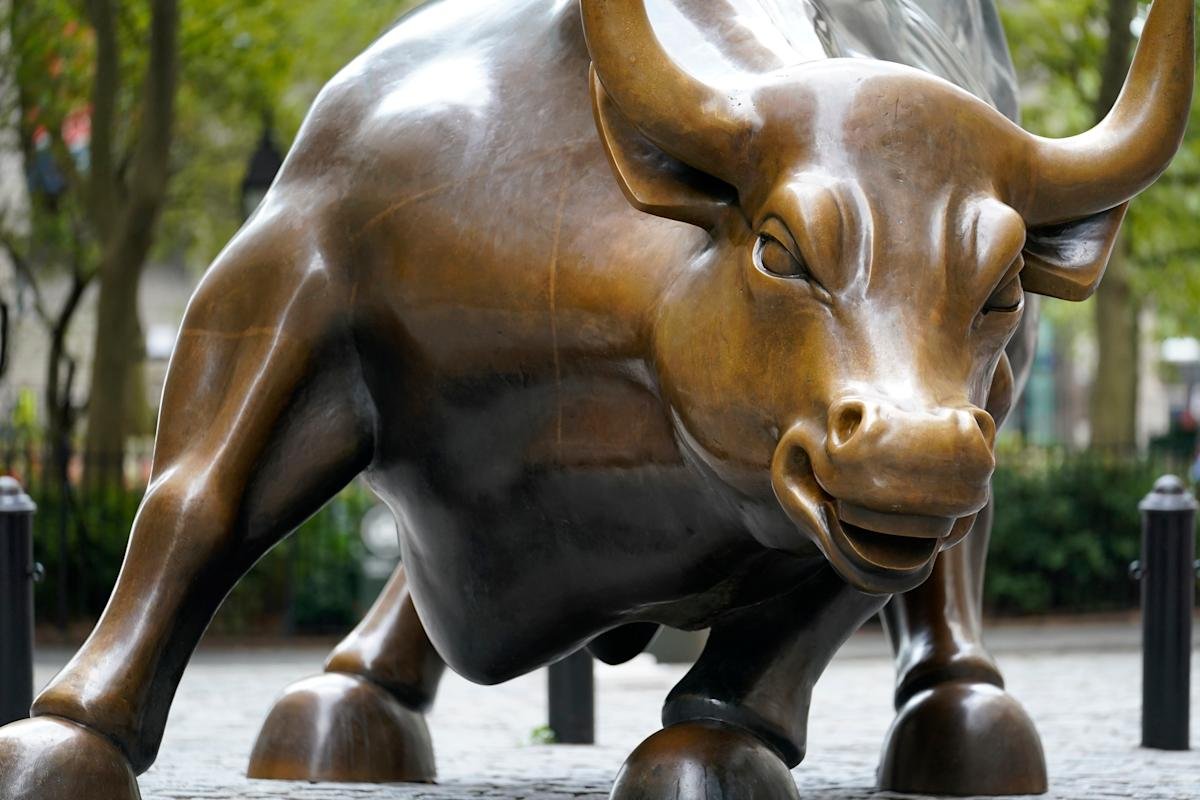
A bull market is an extended period of rising stock prices and investor optimism. It’s not entirely clear where the names “bull market” or “bear market” come from, but one common explanation is that it stems from the confidence a bull projects as it charges forward with its horns thrust upward, while a bear tends to slash its paws in a downward motion.
We’ll cover what constitutes a bull market, the difference between a bull market and a bear market, some historical examples, and strategies for investing in a bull market.
Learn more: How to start investing: A 6-step guide
There’s no exact definition of a bull market. But generally, a bull market is a period when stock prices, as measured by a major index like the S&P 500 or the Dow Jones Industrial Average, increase by at least 20% over recent lows in a short period of time.
Bull markets are usually defined by high investor sentiment. You’ll often see a spike in buying activity as more investors are drawn to the market. The increased demand for stocks drives prices higher.
Interest rates are often low during a bull market, which makes it cheaper for businesses to borrow money and expand. High confidence coupled with low borrowing costs also translates to a rise in initial public offerings (IPOs) when stocks are bullish.
Bull markets are associated with other positive economic indicators, like strong corporate earnings, high consumer confidence, gross domestic product (GDP) growth, and low unemployment.
Learn more: Create a stock investing strategy in 3 steps
A bull market can be tricky to recognize, particularly at the beginning and end. The late Sir John Templeton, an acclaimed value investor, once said, “Bull markets are born on pessimism, grow on skepticism, mature on optimism, and die on euphoria.”
Essentially, a bull market begins when stocks are recovering from a bear market. Some investors see a buying opportunity, spurring a gradual uptick in demand and prices, but many remain pessimistic in the early stages. Many investors remain hesitant until after prices have moved up substantially.
Learn more: Robo-advisor: How to start investing right away
Economic indicators, like GDP growth and unemployment numbers, may be weak at this point if the economy is recovering from a recession or a major downturn. For instance, a bull market began in March 2009 following the 2008 financial crisis, but unemployment didn’t peak until seven months later.
Of course, bull markets don’t last forever. Pinpointing when prices have peaked is something you can only do in retrospect. One reason is that short-term stock market fluctuations are normal and don’t necessarily reflect a long-term trend. So it’s impossible to know whether stocks have hit what will turn out to be a short-lived rough patch or if it’s the end of a bull market.
Learn more: Is the stock market open today?
Both bull markets and bear markets are normal parts of stock market cycles. While a bull market is a prolonged increase in stock prices, a bear market is often defined as a drop of 20% or more in a major stock index.
Bear markets are often associated with a slowing economy or the fear that tough times are ahead, though the stock market and the economy don’t always move in lockstep. Bear markets tend to occur when consumer confidence is falling, GDP growth is slowing, and unemployment rates and inflation are rising.
Learn more: What is a bear market, and are we in one?
The good news is that bull markets tend to be significantly longer than bear markets. Since 1946, the S&P 500 has experienced 11 bear markets, with an average length of 16 months, according to research by Fisher Investments. The average bull market spanned more than five years in that period.
Learn more: Panic of 1907: The stock market crash that brought us the Fed
The S&P 500 hit rock bottom in the wake of the 2008 financial crisis on March 9, 2009, at 672. The index went on a 131-month bull run — one of the longest bull markets in history — that didn’t end until Feb. 19, 2020, when it hit 3,393 before stocks began crashing due to panic over the spread of COVID-19. The S&P 500 soared by over 400% during that stretch of nearly 11 years.
Note that the economy remained in recession for several months after the bull market began, and recovery was weak at first, with GDP growing at only 2% annually for the first four years after that.
A few other examples of bull markets include:
-
Post-World War II: Between June 1949 and August 1956, the S&P 500 grew by 266% as the federal government balanced its budget and consumer spending skyrocketed.
-
The Reagan years: The S&P 500 increased by 229% between August 1982 and October 1987, which is often attributed to President Reagan’s tax policies and deregulation efforts. The bull market ended abruptly with the Black Monday stock market crash on Oct. 19, 1987.
-
1990s dot-com era: The S&P 500 had gains of 417% between the end of the Cold War in 1991 and March 2000, when the dot-com bubble burst.
Learn more: When the Fed lowers rates, how does it impact stocks?
U.S. stocks were generally considered to be in a bull market as of September 2025. Over nearly three years, from Oct. 13, 2022, to September 29, 2025, the S&P 500 is up about 90%.
That’s not to say the market hasn’t experienced turbulence during that time. Between February and April, stocks fell about 20%, largely due to worries over President Trump’s tariffs. However, stocks quickly recovered, reaching new highs again in June, and have continued to trend upward since then.
Learn more: How Trump’s tariffs affect your money
No one wants to sell low, so a bull market is an ideal time to look at your short- and medium-term needs and shift some of your assets to cash or low-risk investments, if necessary. For example, if you’re planning to retire in the next couple of years, you might consider selling some stocks. Doing so can give you a larger cash cushion, which is valuable if a bear market strikes while you’re living off your retirement account.
Learn more: Alternatives to having a financial advisor: How to build wealth without one
If you have a target asset allocation — say, 75% stocks and 25% bonds — you may find that your portfolio’s stock allocation drifts substantially above your target. A portfolio that once had 75% stocks may now have 85% or 90% stocks due to rising prices, a phenomenon known as asset drift. Be sure to rebalance your portfolio periodically to maintain your targets.
Dollar-cost averaging is when you invest a specific amount at recurring intervals, regardless of what’s happening in the stock market. Though you’ll pay more to invest in a bull market, you’ll also lock in some lower prices when the market is down. Many investors find that this strategy takes some of the emotion out of investing.
Try not to worry about timing the market or missing out on a bull market. The S&P 500 has grown by an average of 10% annually, which translates to serious growth over the long term, no matter how you time your investment.
Tim Manni edited this article.