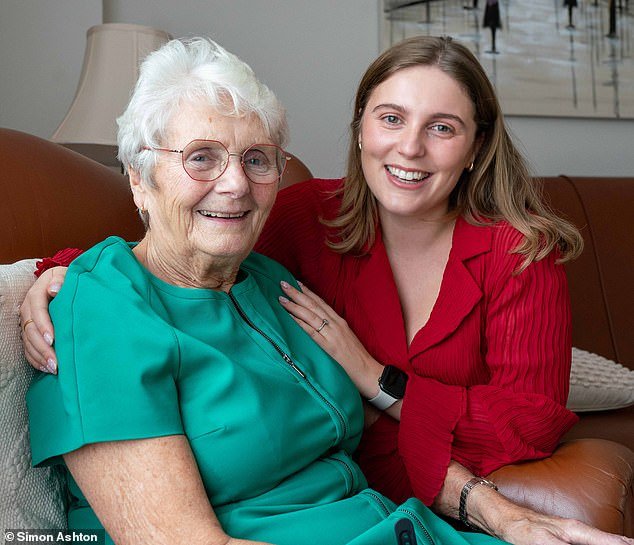
Margaret Hulley likes to use cash as much as possible. The 86-year-old withdraws it from her local bank branch in Sheffield when she needs it.
While she will visit the cash machine from time to time, she spends on a card only occasionally – usually to buy something from Amazon or for a grocery shop, which her granddaughter, Katie Lee, has helped her to set up.
Margaret says: ‘If you have cash in your purse, then once it’s finished, that’s done. When I was brought up, if you didn’t have the money for it, you didn’t have it. You had to save.’
But her cash use is bucking the trend. Figures released this week by banking industry group UK Finance revealed cash is now used for less than 10 per cent of all payments for the first time.
Cash was used for nearly half of all transactions a decade ago, but now this has shrunk to just nine per cent.
The UK Finance report said age was the ‘most accurate predictor’ of cash use, with the younger generation leading the way in ditching it – 40 per cent of under-25s spend with physical money only once a month or less.
Two of a kind: Margaret will have takeaway coffees only as a treat and Katie is paying off her mortgage with a social media trick
Katie, 26, rarely carries cash and mostly doesn’t even use a bank card. Most of her payments are done by tapping her phone, where she uses Apple Pay.
Thanks to a variety of apps, she also uses her phone to check her savings, stocks and shares Isa, and make mortgage overpayments.
She argues that avoiding cash and using technology helps rather than hinders her budgeting.
Katie says: ‘I learned about making overpayments on social media. My generation are lucky we have access to so much information. It’s easy to find little tips and tricks.’
So, who is right? The 80-something grandmother who believes cash is still king, or the 20-something granddaughter who says mobile payments are best for budgeting?
We spoke to both, so you can decide if younger savers have something to learn from their elders, or whether the TikTok generation have it all sorted.
WE WOULD MAKE DO AND MEND, NOT LIKE TODAY
Born in 1939, Margaret grew up with rationing. ‘It was austere, and we didn’t have a lot of luxury – but it was the same for everyone,’ she says. ‘I learned how to cook economically. We darned our socks and fixed a button when it came off. We would make do and mend. Not like people today.’
Margaret married Michael Graham, now 94, when she was 20. Thanks to careful budgeting, the couple saved enough for a deposit on a £650 two-bed terrace. Watching the pennies continued and it was two years before they could afford to install an indoor bathroom by building a dividing wall in the spare bedroom.
‘Every penny was allocated, for groceries, electricity and gas. I’d bake cakes and knit all the children’s clothes. If you had enough you might go on a caravan holiday, but if not, you did without,’ she says. ‘I think our children and grandchildren have seen that, and the way we managed our money.’
After their third child was born, Margaret took jobs cleaning and working in a factory, before joining the local GP surgery where she became practice manager. Michael Graham worked as a National Coal Board engineer.
He was largely in charge of family finances and the couple were serious savers. Michael gave up smoking when money was tight, while thrifty Margaret cut costs by batch cooking. Rather than hire tradespeople, they would do tasks like wallpapering themselves.
Buying anything on credit was avoided but not unheard of. The first time they did this was for bedroom furniture. A £20 Bosch radio was next. Margaret says: ‘It was always one thing at a time, and it would upset my husband until it was paid off.’ She says that the modern world seems to take spending and making things last more lightly. Margaret says: ‘Now, it feels like a throwaway society. Young people waste money on everything – it’s all tattoos and takeaways. I’ll have a coffee as a treat, but they don’t think anything of doing it every day.’
Today, the couple are still prudent but live comfortably. As well as a small income from her NHS pension, Margaret paid her Married Women’s Stamp, the forerunner of National Insurance contributions, so gets the full state pension. Michael Graham is also entitled to the full state pension, as well as a pension from his career with the coal board. Is there anything Margaret thinks she could improve on with her finances and that the younger generation do better? She says: ‘I’m not very good at comparing prices. Young people do their shopping online and get bargains, but I just like Marks & Spencer.’
IT’S A BALANCE BETWEEN SAVING AND PLEASURE
Katie lives a digital life but thinks this makes her engaged with her finances – and says saving matters. She saves 8 per cent of her salary into her company pension scheme, puts £200 a month into her employer’s share save scheme, and recently opened a stocks and shares Isa, into which she invests £75 a month.
Last year, she and her partner Charlie used Lifetime Isas to buy their first home – a three-bed semi-detached house in York for about £300,000. They opted for a 40-year mortgage term to make the monthly payments more affordable but hope that making overpayments will help them pay off the loan more quickly.
Margaret says she is baffled by the amount the couple had to pay for their home, while Katie says she got there thanks to having learned a lot about saving from her grandmother.
She carries flavoured syrup in her handbag to add to her takeaway coffee rather than buy the more expensive option, always looks for discount codes online, and sells old items on Vinted. Katie tries to avoid debt, but uses a credit card for online orders to avoid paying out from her salary for an item she may have to return.
She says: ‘Granny is a really good cook and I think she is the reason I don’t buy takeaways or ready meals. She and my mum drummed into me that you don’t need a new outfit for every occasion, and that if you buy cheap, you’ll buy twice.’
They might do things differently to previous generations, but research suggests that like Katie those aged 25 to 34 are on top of their finances. Some 67 per cent of this cohort regularly review and adjust their financial goals, compared to 49 per cent of people across all age groups, according to a survey of 2,000 adults by Aviva.
Katie also credits social media for many of her best money habits. It’s where she found out about making mortgage overpayments and automating her savings. Like 50 per cent of 25- to 34-year-olds, Katie has direct debits set up to transfer money to savings. A further 39 per cent use budgeting apps and tools to track their spending, set limits and monitor their progress, a survey by Aviva found.
A separate survey of 2,000 adults by wealth management platform Stratiphy found 47 per cent of those aged 18 to 34 have invested in the stock market in the past 12 months, compared to just 23 per cent of those over 55. Katie admits there is still room for improvement for her generation and says that those from her grandmother’s era benefit from not living an online life. She says: ‘If I see something I want, I usually just buy it. But I wonder if I’d still get it if I waited a week. Granny always waits to go to the shops and buy things in store. I should take more lunches to work rather than buying them, but it’s hard when you’re busy. It’s getting that balance between saving and enjoying life.’
Dr Eliza Filby, a historian and expert on generational change, says Katie isn’t unusual among her financially literate generation.
She says: ‘This generation has grown up in the shadow of economic instability – from the 2008 financial crisis, through Covid and the cost-of-living crisis – and as a result has become financially pragmatic and digitally confident. They’re not just reacting to financial pressures, they’re actively reshaping how they think about money and their futures.’
At home, Katie and Charlie make money decisions together and, while they don’t have a joint account, the outgoings are split equally, with transfers made to each other quickly and easily through their banking apps.
‘We are comfortable talking about money, and we support each other,’ says Katie. This is one thing Margaret admires about the younger generation. She says: ‘It seems more equal today. Katie and Charlie are more aware of each other’s earnings and share more. They’ve got everything planned before getting married.’
DIY INVESTING PLATFORMS

AJ Bell
AJ Bell
Easy investing and ready-made portfolios

Hargreaves Lansdown
Hargreaves Lansdown
Free fund dealing and investment ideas

interactive investor
interactive investor
Flat-fee investing from £4.99 per month

InvestEngine
InvestEngine
Account and trading fee-free ETF investing

Trading 212
Trading 212
Free share dealing and no account fee
Affiliate links: If you take out a product This is Money may earn a commission. These deals are chosen by our editorial team, as we think they are worth highlighting. This does not affect our editorial independence.