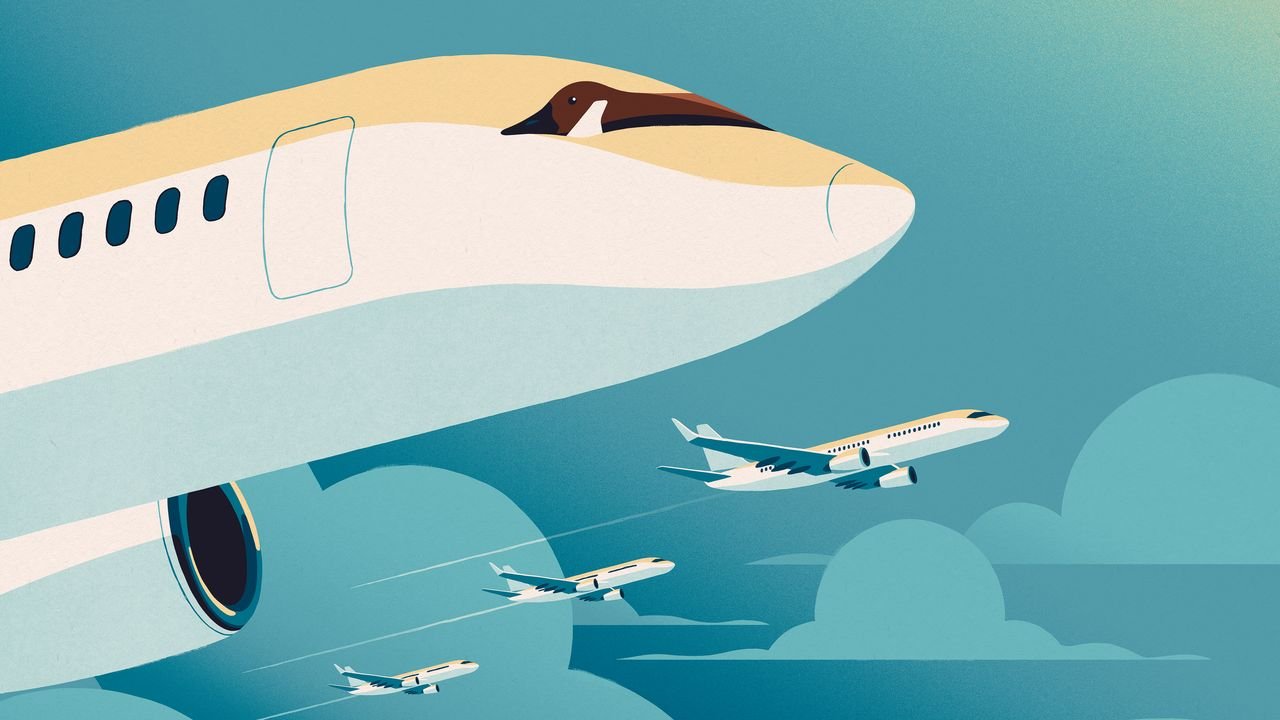
The unmistakable V-formation geese adopt in flight is more than a cool aerial trick. The entire flock benefits from upward air flowing off the lead bird’s wings, whose fellow fliers then get to save energy, especially on long journeys. This form of teamwork could also be one of the more simple ways for the aviation industry to reduce its carbon footprint, according to recent research.
Aircraft manufacturer Airbus is taking inspiration from nature to employ a similar technique on long-haul flights by the 2030s, accomplished through joint projects called fello’fly and GEESE—a fitting acronym for “Gain Environmental Efficiency by Saving Energy.” Flying is one of the most (if not the most) carbon-intensive activities a traveler can take—and operational initiatives like these are an important part of the industry’s goal to achieve net zero carbon emissions by 2050. While a majority of the aviation industry’s decarbonization will come down to sustainable aviation fuel (SAF), less costly shifts like this can help make flying more sustainable with the technology—and laws of physics—we already have.
Kevin May, a Delta A350 captain who is directly involved with the GEESE project, compares the flight pattern to cycling in tight packs. “[The front cyclist is] basically disrupting the airflow so that you can tuck in behind them and use less energy,” he explains. “We’re trying to do the same thing with airplanes.”
Flying this way could reduce carbon emissions by 5% per flight, which translates to a “conservative” estimate of 60,000 tons of fuel savings per year in the crowded North Atlantic, Airbus says.
The aviation industry is responsible for 3% of greenhouse gas emissions worldwide, a number that’s growing fast amid increasing demand for air travel. In 2024, international flights contributed to 60% of the total emissions from the aviation industry and the United States was the largest emitter of carbon dioxide related to air travel.
Air France, Delta, and other commercial airlines in the second half of 2025 tested the next phase of the Airbus concept: meeting up in flight and traveling together in pairs. “We know that if we can save fuel and do it safely, it’s helping everybody,” says May.
Learning from geese
Humans have drawn inspiration from birds for a long time, says Christina Harvey, who runs the Biologically Informed Research and Design (BIRD) lab at the University of California – Davis. “But as soon as we got up [in the air], I think we started to realize we have our own ability,” Harvey adds. “Birds don’t fly supersonically. Birds can’t carry 300 passengers across the Atlantic. We’ve come so much farther for our goals.”
In 2019, Airbus launched the fello’fly project to, as explained by Airbus GEESE project coordinator Laura Montironi, focus on safety and technical testing. In November 2021, Airbus flew two A350s from Toulouse, France, to Montréal, Canada, separated by only 1.2 nautical miles instead of the 5-nautical-mile distance typically maintained today. According to Montironi, 1.2 nautical miles is close enough to achieve 5% in energy savings without any changes to in-flight safety. Customers won’t even notice a difference, she says.
But airlines will have to reassure customers that flying closer together is still safe, explains Harvey, who is not involved with the fello’fly or GEESE projects. “We could be the best engineers and build the coolest planes, but some people are going to be too anxious to get on that plane if it is doing something different,” she says.
Rendezvous point
Airbus launched the GEESE companion project in 2023. GEESE brought in airline brands Air France, French bee, Virgin Atlantic, and Delta, as well as air traffic controllers and other airline operations teams to work with Airbus on real-world testing.
In the second half of 2025, GEESE finished a series of transatlantic test flights. The GEESE tests proved that two regular commercial flights taking off from and landing at different airports could meet at a certain rendezvous point in the sky and fly together.