
Zcash has plunged nearly 50% from its recent high after disclosure of a critical network vulnerability triggered panic selling, forced liquidations, and the exit of one of the privacy coin’s most prominent supporters.
Summary
- Zcash plunged nearly 50% after disclosure of a critical Orchard pool vulnerability and Arthur Hayes’ exit from the asset.
- Lookonchain data showed a whale withdrew 37,316 ZEC worth $13.1 million from Binance, suggesting some investors are buying the dip.
- Technical indicators remain bearish despite the rebound, with key resistance levels sitting at $420, $471, and $523.
According to crypto.news market data, Zcash (ZEC) crashed to an intraday low of $264.80 on June 5 before rebounding toward $380.
The selloff followed confirmation from Shielded Labs that a flaw in the network’s Orchard shielded pool could have allowed unlimited counterfeit ZEC to be created before an emergency fix was deployed.
Selling pressure for the privacy token also intensified as BitMEX co-founder Arthur Hayes disclosed that he had sold his entire ZEC position. In a post on X, Hayes acknowledged that exploitation appeared “extremely unlikely” but argued that privacy-focused assets require a higher standard of certainty.
“The privacy from AI, govt, big tech narrative demands perfection not improbability. I read about the exploit yday, and didn’t appreciate how it violated my narrative mental map. The…dump, made me rethink, and I had to take profit on the entire position.”
Not everyone rushed for the exit, however. Lookonchain data showed a newly created wallet withdrew 37,316 ZEC worth approximately $13.1 million from Binance shortly after the crash, suggesting at least some large investors viewed the decline as a buying opportunity rather than a reason to abandon the asset.
Whale accumulation emerges as traders target oversold conditions
On-chain activity shows a sharp divide between long-term believers and traders reducing exposure. While Hayes exited his position, the large Binance withdrawal arrived near the bottom of the selloff, coinciding with ZEC’s recovery from the $260 region.
Derivatives markets experienced one of the most violent resets in months. CoinGlass data cited earlier by crypto.news showed ZEC liquidations reached nearly $82 million during the crash as leveraged positions were wiped out across exchanges.
The three-day liquidation heatmap suggests much of the downside liquidity below $300 has already been cleared. Following the rebound, the largest concentration of short liquidation leverage sits between $370 and $390, with another significant cluster visible around the $450 region. If buyers maintain momentum above current levels, those zones could become magnets for price action as short sellers are forced to close positions.
Market participants are also watching whether fresh accumulation continues. The recent whale purchase occurred after one of the largest single-day declines in Zcash’s recent history, creating conditions that often attract opportunistic traders seeking oversold assets.
Technical structure remains damaged despite rebound
The four-hour chart shows ZEC plunging through several key Fibonacci support levels after news of the Orchard vulnerability triggered heavy selling. The decline briefly pushed the token to an intraday low near $265, just above the 0% Fibonacci retracement level at $253, where buyers stepped in and sparked a sharp rebound.
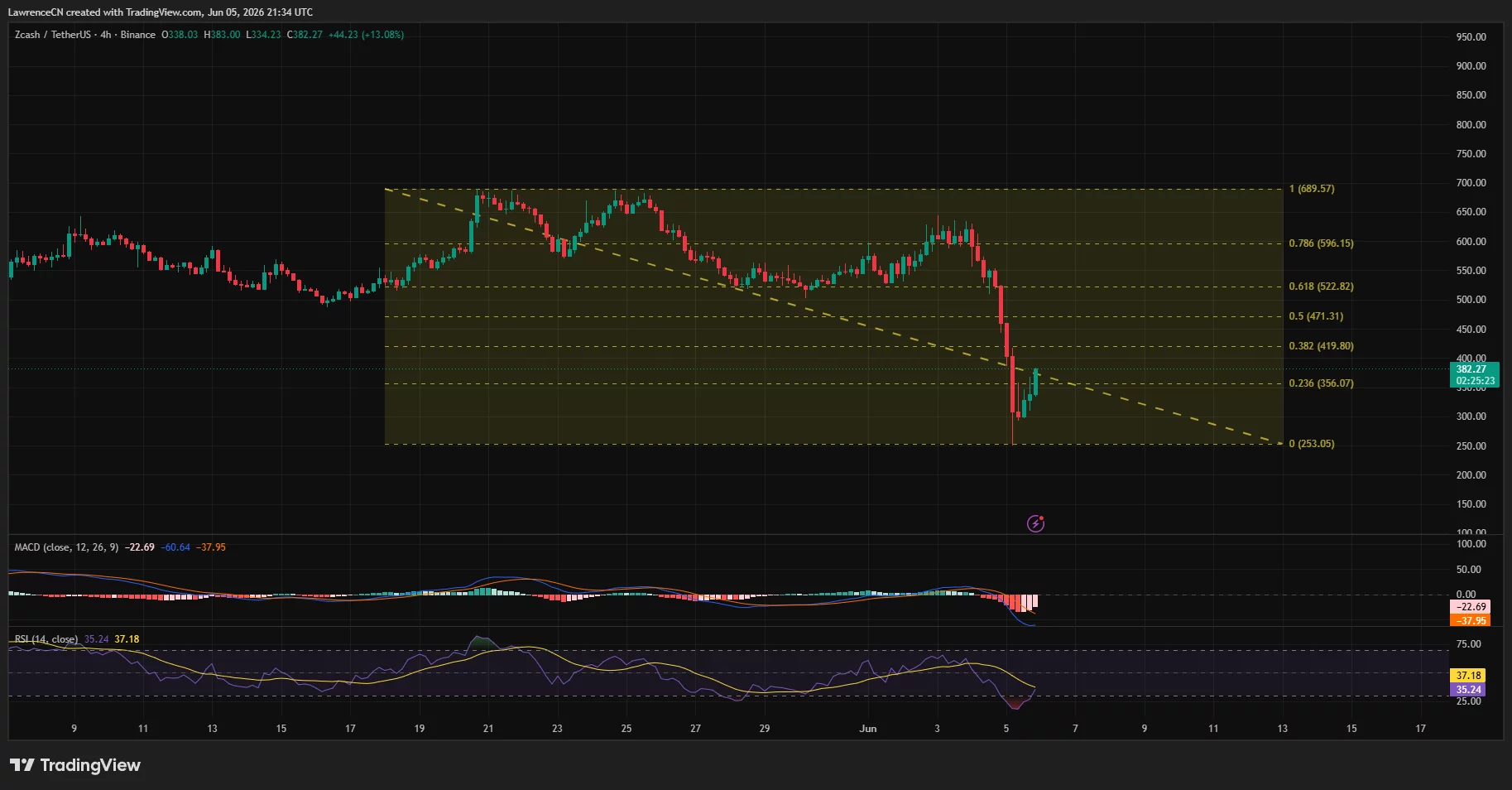
Recovery has since pushed the token back above the 23.6% Fibonacci retracement level near $356. A successful hold above that area could open the door toward the next resistance zone at $420, which aligns with the 38.2% retracement level. Beyond that, traders are watching $471 and $523, corresponding to the 50% and 61.8% retracement levels.
Momentum indicators remain mixed. The Relative Strength Index has recovered from deeply oversold conditions but remains below the neutral 50 level, showing that buyers have regained some control without fully reversing the trend.
Meanwhile, the MACD remains below the zero line even as bearish momentum begins to ease. The histogram has started contracting after reaching its most negative reading during the selloff, suggesting that selling pressure has moderated following the liquidation cascade.
As such, if Zcash price fails to hold above the $356 support zone could expose ZEC to another test of the $300 area and potentially the recent low near $253. Such a move would likely invalidate the current recovery attempt and place attention back on the unresolved uncertainty surrounding the Orchard vulnerability.
Disclosure: This article does not represent investment advice. The content and materials featured on this page are for educational purposes only.