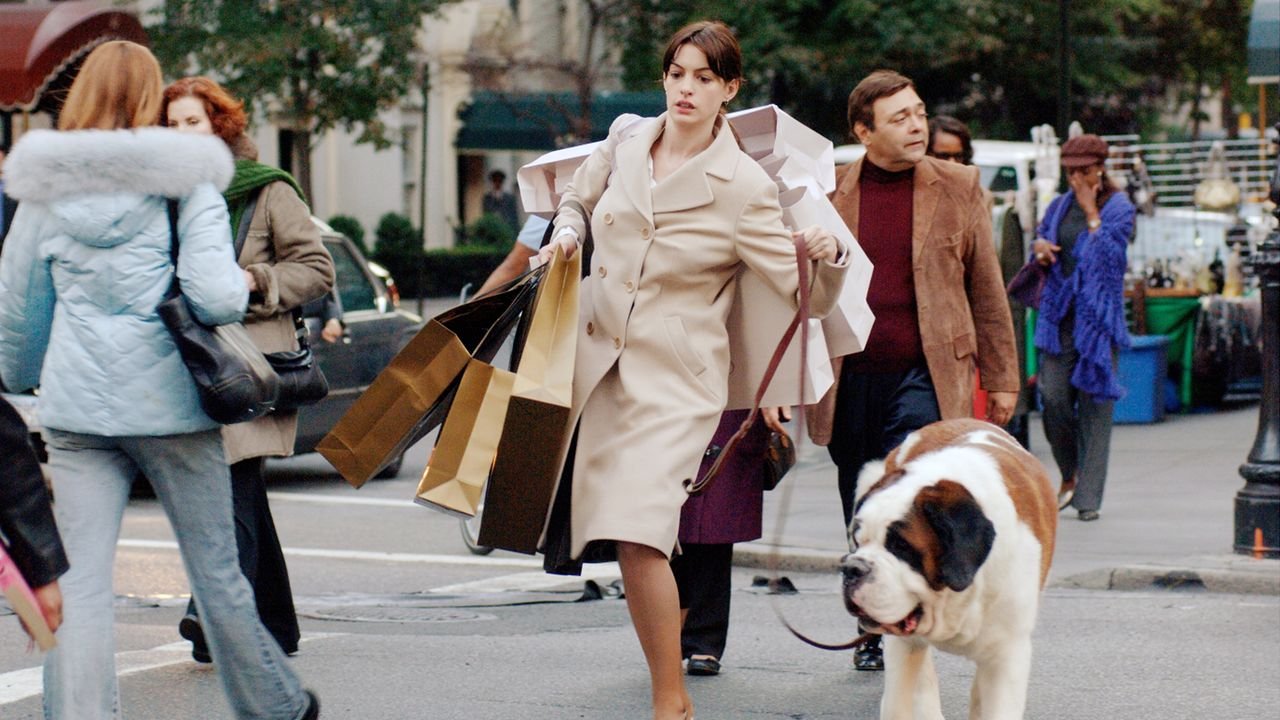
That KT Tunstall anthem kicks in, the screen splits, and suddenly you see it: women across Manhattan getting dressed for work—saturated lipstick, high heels, roaring zippers—while Anne Hathaway pulls on a lumpy sweater in an apartment that could only cost $1,500 a month if three people were splitting it. You know the rest. Meryl Streep in white hair and sunglasses. Stanley Tucci breaking bad news with singularly gentle aplomb. Emily Blunt one stomach flu from her goal weight. “Florals? For spring? Groundbreaking.”
The Devil Wears Prada, first released in 2006, grossed $326 million and did something no fashion brand has managed since: It made an entire industry legible to people who’d never read a masthead in their lives. The cerulean monologue became shorthand for any moment a boss made you feel catastrophically stupid about something you hadn’t realized you were supposed to know.
But rewatching it now—with a sequel, The Devil Wears Prada 2, arriving May 1—what lingers alongside the dialogue is the city to which it was indelibly pinned. Every scene lands on a specific block, a specific lobby, a specific restaurant in New York. Those locations tell a second story: what New York looked like when magazines and their editors ran the culture—and what happened once that stopped being the case. And while a lot of that New York no longer exists, some of it does. Let’s take a look at the original haunts of The Devil Wears Prada.

A million girls would kill to commute to this office
The lobby of 1221 Avenue of the Americas still has that corporate hush engineered by marble and money. The film called it Elias-Clark, the fictional publishing empire where Miranda terrorized assistants and designers with equal conviction. The building was never actually Condé Nast—too obvious—but the production needed something that looked like power from the sidewalk, and this 51-story McGraw-Hill tower delivered. Today its tenants include Deloitte and NBCUniversal; a $50 million plaza renovation is connecting it to the Rockefeller Center concourse below.
But of course Elias-Clark was always Condé Nast. Lauren Weisberger published the novel in 2003 after serving as Anna Wintour’s personal assistant at Vogue for a year, and the roman à clef fooled no one—least of all anyone who’d ever ridden the elevator at 4 Times Square and emerged spiritually altered. Runway was Vogue. Miranda Priestly was Wintour with plausible deniability and better lighting.