
As private credit valuations come under greater scrutiny, Kanav Kalia (pictured), managing director at Oxane Partners, explains why firms need connected operating infrastructure to support more timely, transparent and defensible valuation processes.
The growth of private credit is seeing valuations enter a new, more institutional phase. As the asset class expands across a wider investor base, firms are facing higher expectations around valuations, such as greater frequency, and stronger defensibility under stress events.
That is putting pressure on existing valuation processes. Spreadsheet-heavy models, fragmented review workflows, and valuation cycles built for a slower market are being stretched as portfolios become more complex and financing structures become more sensitive to net asset value (NAV) and collateral performance.
Essentially, a lot more is now being demanded from private credit valuation processes; along with producing valuation outputs more frequently, firms need to ensure those valuations hold up even when conditions change.
The shift beyond periodic valuations
Private credit has evolved faster than the valuation processes supporting it. Traditional review cycles and spreadsheet-led workflows are now being stretched as the asset class grows in scale and complexity. Lenders are asking sharper questions, and boards, auditors and limited partners expect greater transparency into how valuations are produced and reviewed.
Higher-frequency NAV expectations are one visible signal of this shift. But this shift is not only about valuation frequency, it’s also about how operationally ready firms are. Firms need valuation processes that hold up when market conditions change, sector assumptions move, collateral performance weakens or investors and lenders ask for sharper explanations.
That is because valuations now sit much closer to the core mechanics of private credit. Market volatility, regulatory scrutiny and the rise of retail-oriented and semi-liquid fund structures are pushing valuation expectations beyond the traditional quarterly cycle. Valuations are no longer only supporting investor reporting; they are increasingly shaping liquidity decisions, financing conversations and confidence in portfolio performance.
Valuations are therefore moving from periodic reporting workflows toward an ongoing operating capability.
Data trust is critical
A valuation mark is only as reliable as the assumptions and inputs it is based on. In private credit, those inputs often sit across borrower reports, collateral tapes, servicer files, covenant packages, facility terms, financial statements and internal assumptions.
When those inputs are fragmented, manually reconciled or trapped in inconsistent spreadsheets, the marks may still be produced, but the process becomes harder to trust and defend. It takes a lot longer with considerable manual effort to run the process. This becomes more critical as portfolios become more granular and valuation expectations become more responsive to changing market conditions.
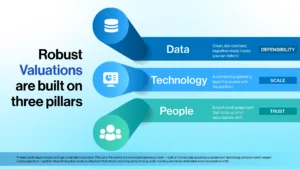
Robust valuations depend on trusted data before a period of stress or dislocation, not after one. If the underlying information is fragmented or siloed, firms lose time precisely when they need clarity.
Data is where the valuation process begins. It needs to be built on clean, standardised, ingestion-ready data, so it can support portfolio monitoring, credit workflows, reporting and valuation review in one connected operating layer.
Read more: The next frontier in ABF: A $20tn opportunity and the challenge of scale
The importance of transparency
Producing a valuation is only one part of the process. Firms also need to explain how they arrived at that valuation and support it when questions are raised.
Stakeholders increasingly want to understand the path behind the mark: what inputs were used, which methodology was applied, and how it was reviewed.
A valuation process is defensible only when the judgement behind it is visible, documented and traceable. The value of a clear decision trail becomes most visible when valuations are challenged. In those moments, firms need to show not only the mark, but the inputs, assumptions and rationale behind it.
That level of clarity does not come from disclosure alone. Transparency should be core to the operating discipline, not a mere compliance exercise. It gives valuation teams the confidence and control environment to support decisions clearly and consistently.
Read more: Are insurers ready for the Private Credit+ era?
Valuations under stress
In stable markets, fragmented processes and manual workarounds can remain hidden. In a volatile and stressed market, they surface quickly.
Sector weakness, borrower deterioration, liquidity pressure, and financing sensitivity can all challenge valuation assumptions. This is particularly relevant in private credit, where valuation judgement often depends on borrower-specific information, collateral performance and the unique risks of private instruments.
Therefore, a robust private credit valuation process needs more than just a model. It needs clear triggers for when assumptions should be revisited, how sector context is reflected and the ways these changes flow through fund, facility and borrower-level views.
The real test of valuation quality is whether the process can hold up when the credit environment shifts and assumptions come under pressure, an aspect that has become particularly relevant in today’s uncertain macroeconomic environment.
The need for a connected operating model
As private credit moves beyond just direct lending into broader Private Credit+ strategies across asset-based finance, fund finance, securitized products and other complex credit strategies, the operating environment itself becomes more interconnected. If the underlying assets, financing structures and data flows are more complex, valuations cannot continue to sit in isolation. Valuation quality becomes increasingly dependent on the operating model around it.
Valuation teams need connected visibility across portfolio performance, collateral data, borrower trends, credit facility terms, covenant movement, cash controls, reporting outputs, and scenario analysis. This is where the operating model becomes as important as the valuation methodology itself.
Oxane’s view of Private Credit+ reflects this reality. The market needs purpose-built technology, deep credit expertise, and an operating layer that connects valuations with portfolio monitoring, credit facilities, servicing, reporting, and risk workflows. Operational readiness cannot be achieved through disconnected valuation tools or spreadsheet-led workflows. Platforms like Oxane Panorama help firms move from fragmented valuation processes to a more connected, transparent and defensible operating model built for scale.
Read more: Where is the ‘Private Credit+’ technology infrastructure?
The next phase of valuation maturity
Private credit valuations are no longer just a scheduled reporting requirement. They are becoming a test of whether firms have the operating readiness to refresh valuations, explain the assumptions behind them and defend them when conditions change.
As the asset class continues to grow, the leading firms will be those that treat valuations not as a standalone process, but as part of a connected operating infrastructure built for scale, scrutiny and market volatility.
This is commercial content, produced in partnership with Oxane Partners.