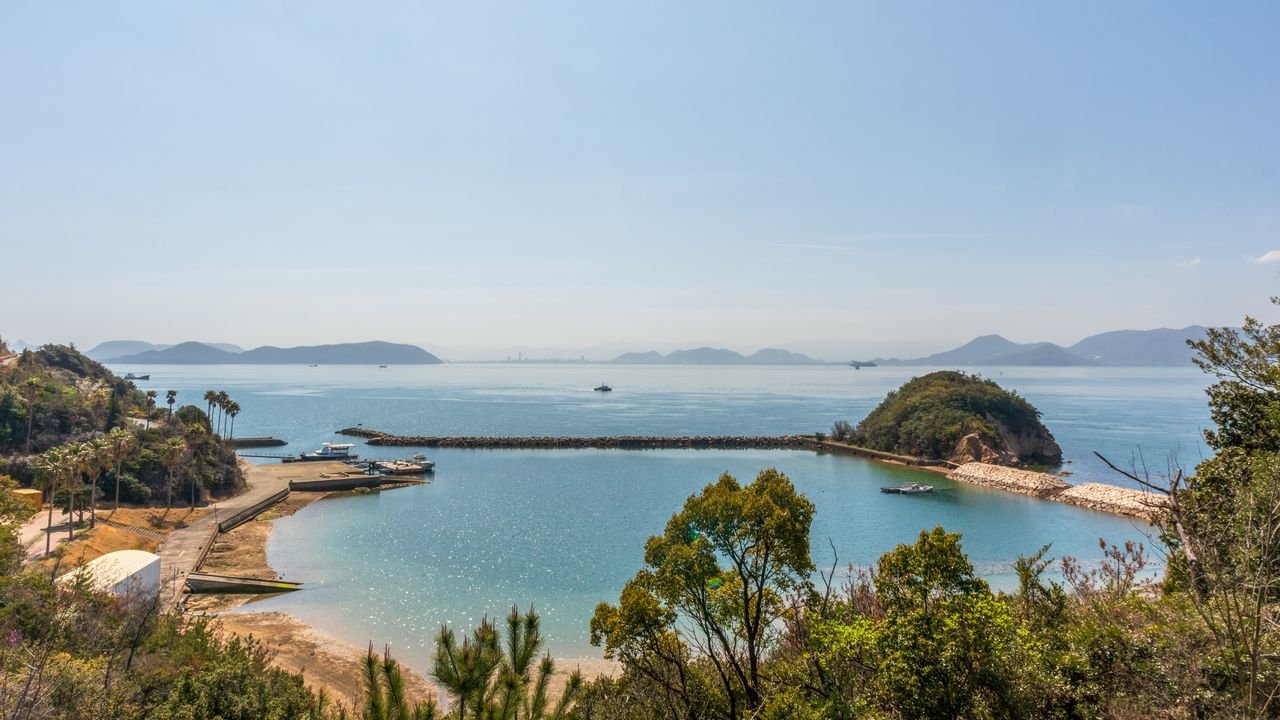
Naoshima is one of several art hubs in Setouchi, an archipelago made up of thousands of islands scattered across the Seto Inland Sea. The mild climate here makes for a verdant countryside that famously grows citrus and olives, but it has also over the past three decades become home to the Benesse Art Site, a network of museums, galleries, and sculptures covering the islands of Naoshima, Teshima, and Inujima. Naoshima, which holds the largest art collection, is its nucleus: Roughly 500,000 travelers visit each year to experience what has evolved into a sort of contemporary art Disney Land, where multi-million dollar sculptures rear out of its beaches and light installations become destinations unto themselves.
What began in the late 1980s as an art-led development initiative led by businessman Soichiro Fukutake—with the opening of the Benesse House Museum in 1992, housing works by the likes of Jean-Michel Basquiat and Robert Rauschenberg to be enjoyed by a small local audience—has since evolved into a vast regeneration project. It has transformed the region from a smattering of sleepy fishing villages facing industrial decline and an aging population into an international art destination with a Triennale and, come 2027, a Mandarin Oriental. Nine more Benesse museums have followed, several of which have been designed by the Pritzker Prize–winning Japanese architect Tadao Ando. The latest, which opened last year, is the Naoshima New Museum of Art, designed by Ando using his trademark concrete and dedicated entirely to works by Asian artists.

Stepping out of Miyanoura port on the western side of the island, I spot the Naoshima Pavillion, a diamond-shaped geometric mesh shelter designed by Sou Fujimoto—and one of the first works that greets visitors on Naoshima. Groups of tourists pass me by on both foot and bicycle as I make my way to the New Museum of Art, where an angular concrete slope with views of the coastline leads to underground exhibition spaces. On display in the museum lobby is a collection of black-and-white family photographs of Naoshima locals, taken with cameras handmade partly from driftwood found on the beach. Overseen by artist and gallerist Motoyuki Shitamachi and photographer Jeffery Lim, the project aimed to “explore how the museum can uniquely fit in with Naoshima that is rooted in the local community while being open to the world,” museum director Akiko Miki tells me.
Beyond that are several commissioned works, including a striking installation piece by Korean artist Do Ho Suh: a 16-foot long replica of a traditional Korean house built out of fabric. The Chinese artist Cai Guo-Qiang has taken over a gargantuan room to house his 2006 piece Head On, consisting of 99 life-size sculptures of wolves leaping ferociously through the air. I’m told by Hanae Kawai, the assistant to the museum director, that the idea of the museum was conceived, in part, so that Fukutake had somewhere to keep the artwork after he purchased it. Later on in our tour, she pauses in front of a bombastic Takashi Murakami painting depicting scenes of Kyoto City and points out a small detail: a figure resembling Fukutake himself. A cheeky wink, wink perhaps? The new museum, says Kawai, is “the pinnacle and culmination” of the businessman’s vision.