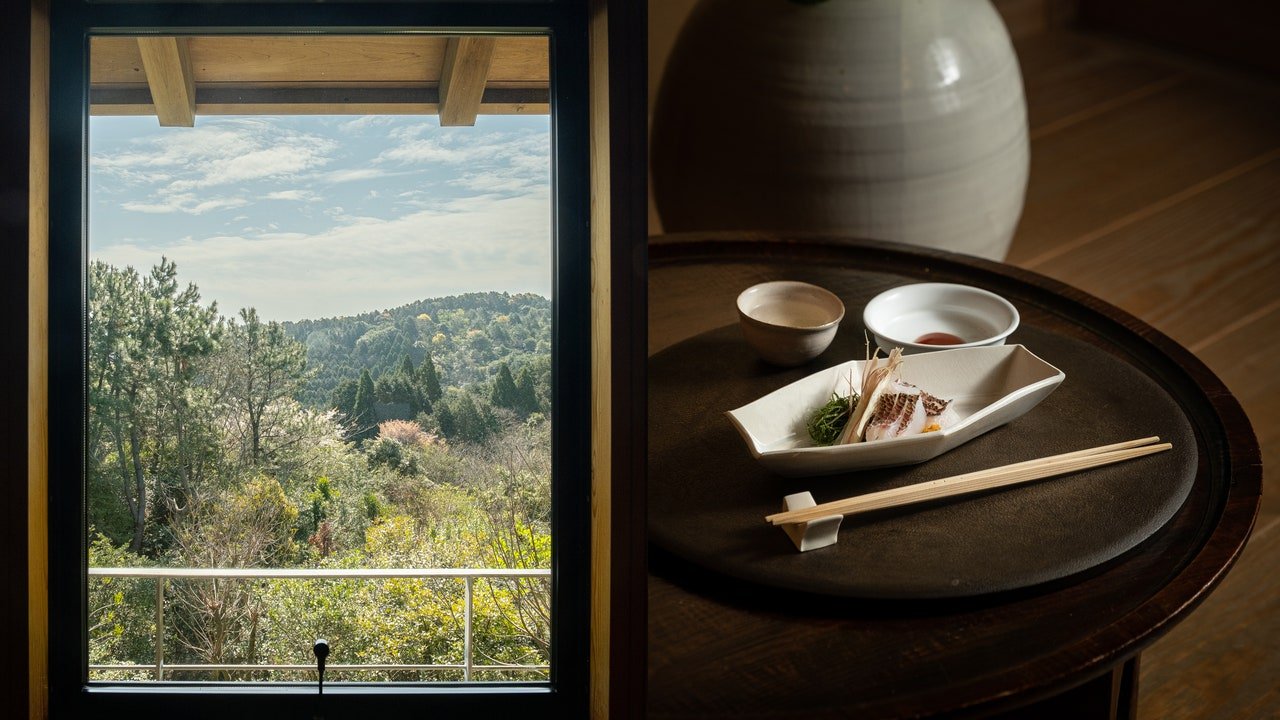
We started with a multicourse dinner at the lauded Arutokoro, a rustic farmhouse renovated by chef Sunao Hirakawa, who offers a flawless but unprecious take on kaiseki. We ate at a local establishment that serves only tofu in many forms and at the female-owned, female-cheffed Tamatori restaurant in Karatsu. We foraged for watercress and fukinoto. Mostly, we spent leisurely hours connecting with the countryside and cooking in Prairie and Hanako’s compact open-plan house. Making dinner was a long, meditative process. Prairie shaved flakes of mineral-hard dried skipjack tuna to make dashi from scratch; I ground sesame seeds with a mortar and pestle; the fukinoto we’d plucked finally became a delicate tempura.
Just across the road, Prairie has acquired a terraced parcel of farmland where she is building a dedicated home for the salon, “a big place to cook and exist together,” as Prairie puts it, to be surrounded by a kitchen garden and a small orchard.
I asked her if she thought the ideas of farm-to-table dining and traditional craftsmanship were as prevalent in Japan as in the United States. “In Japan, it’s not yet mainstream,” Prairie replied, “but I do feel like the future is bright on that level.” Tourism can help. “Foods are great for their flavor,” she added, “but when you see how they’re made and the people behind them, they take on this other depth.”
On the second morning, we drove an hour south through forested hills and past tile-roofed villages, transecting the sleepy prefecture of Saga, historically a trading center known for porcelain and green tea and now a major global supplier of nori. At a riverfront dock, we met up with Tsunehiro Kawahara, a nori distributor, and climbed aboard an open boat. The frigid February wind whipped at my face as we chugged out into the Ariake Sea, but a frosty nose was worth it for the astonishing sight that awaited: a vast network of two million fiberglass poles stretching into the distance, sticking out of the shallow ocean like so many acupuncture needles and supporting around 200,000 of the nets on which nori grows for its short, labor-intensive season during the coldest part of the year. Never would a spicy tuna roll look the same.


Later, Tsunehiro showed us around the small facility where he processes nori into different products, offering tastes as we went, all of it rich with oceanic umami. Tsunehiro belongs to the Saga Collective, a local association of small-scale, high-quality, environmentally friendly producers of food and crafts who are banding together to preserve traditional Saga industries by attracting both international and domestic tourists and buyers. Collective members make—among other things—sake, furniture, washi paper, noodles, porcelain, and the hot-sour condiment yuzu kosho. “In Japan, there’s much less of a divide between art and craft,” Prairie told me. “They’re able to coexist in one place.”